The Tasmanian Tiger's Skull Has No Match Among Living Predators
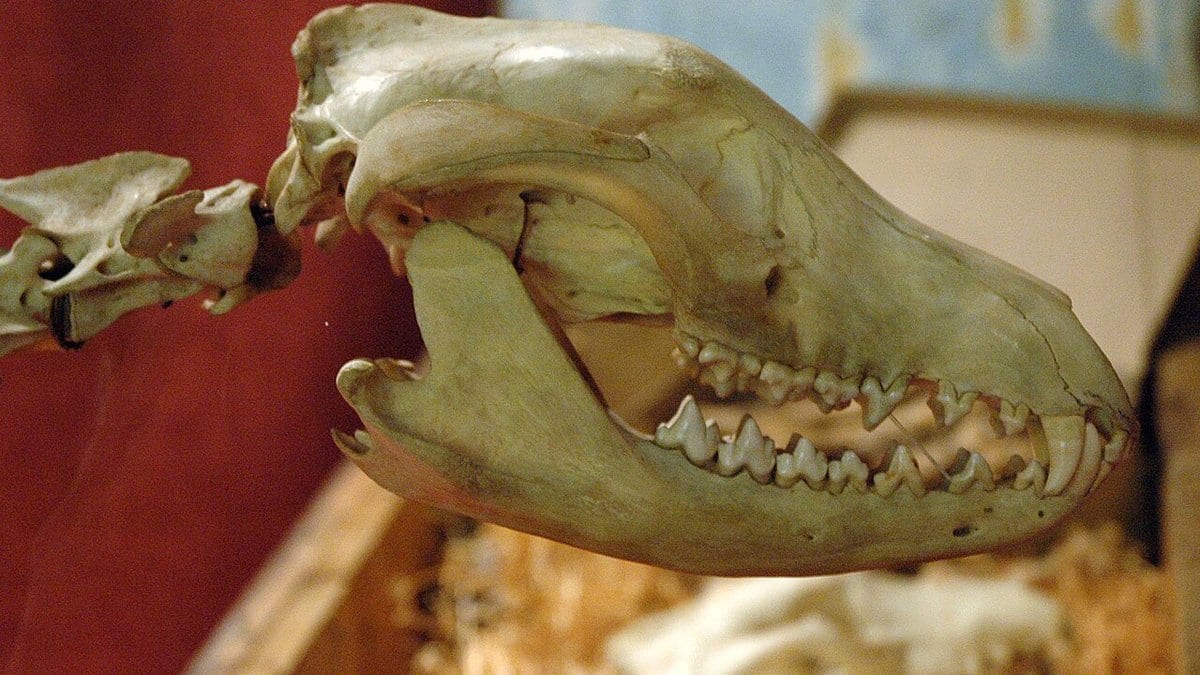
The skull of the thylacine, the marsupial predator hunted to extinction in Tasmania in 1936, combines features found in no living meat-eating mammal, according to a study published Aug. 31 in Nature Communications. Its authors say that complicates the animal's standing as a textbook case of convergent evolution with wolves and foxes.
Vera Weisbecker of Flinders University and three colleagues compared three-dimensional shape measurements across 225 skulls spanning 14 families of meat-eating mammals, the paper reports. The thylacine's snout sits closest to foxes and jackals, they write, while its braincase sits closer to its marsupial relatives, a pairing that the paper says is "not represented among canids or other living mammalian carnivores."
The head is also outsized for the body. The thylacine weighed about 17 kilograms, the authors report, but its skull matches in size the skulls of species weighing 24.5 to 66.7 kilograms. The foxes and jackals nearest to it in overall skull shape weigh 6 to 14 kilograms.
From that mix, a long, narrow, unusually tall snout on a large skull with an expanded flare of bone at the canines that the authors call a terminal rosette, the team infers a fast, high-impact snapping bite used on relatively small, quick prey, which earlier work cited in the paper puts at about 45% of the thylacine's own body mass. The traits "suggest adaptations to fast, high-impact snapping behaviour in prey capture," the authors write, a reading of bone shape rather than an observation of a living animal.
The skulls also carry an unusually large infraorbital foramen, the facial opening a sensory nerve passes through. The paper reports it exceeds in both absolute and relative size any figure recorded for a living marsupial, and says no clear explanation can be offered for the trait.
The study is open access. Co-authors Andrew J. Pask and Axel H. Newton of the University of Melbourne write that the completed thylacine genome offers a route to test which developmental changes produced these skull features.
Sources
- Nature CommunicationsPeer-reviewed