Half an Atom Falls, Half Stays Still, and Einstein's Rule Holds
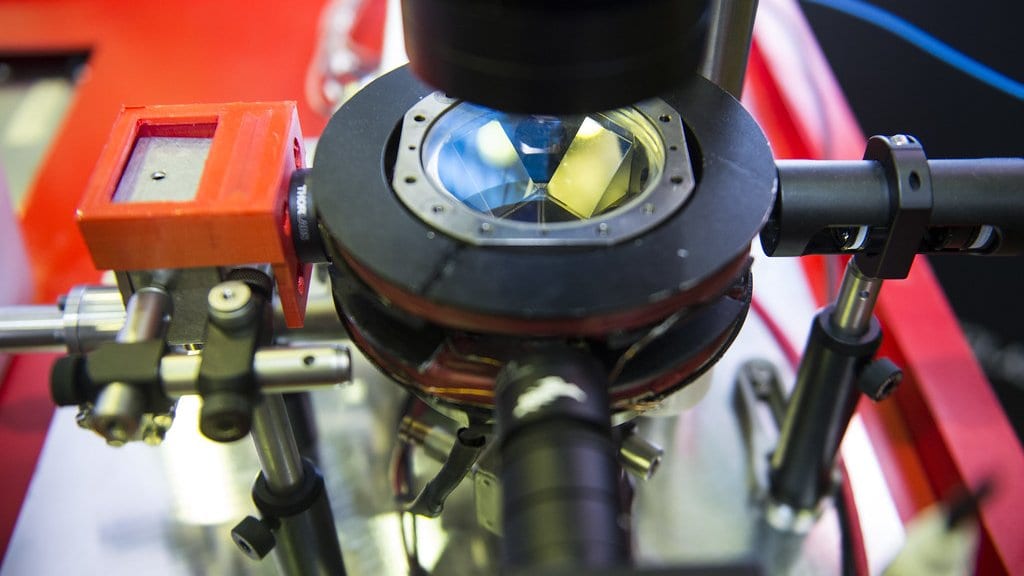
Physicists at Ben-Gurion University of the Negev, working with colleagues in Germany, Britain and the United States, have measured the quantum phase that develops between two halves of a single atom's wave when one half is left to fall and the other is held in place. The measured phase matches the value theory predicts, the team reports in a paper published on September 2, 2026, in Science Advances.
The instrument is a cold-atom interferometer, a device that splits an atom's wave into two parts and later recombines them to read the difference between the two. The authors describe an arrangement in which "one wave packet stays static in the laboratory frame while the other is in free fall."
The equivalence principle, the rule underlying general relativity that the effects of gravity and of acceleration cannot be told apart locally, "has been confirmed to great accuracy for large bodies," the paper states. In the quantum domain, the authors write, it "has been predicted to take a unique form involving a gauge phase," which on Earth is the phase of a free-falling wave packet measured against a counterpart held static. That phase is what the experiment set out to read.
"The observed relative phase of the wave packets confirms the predicted phase and shows that, in our low energy regime, the equivalence principle may be applied to the quantum domain," the authors report. They call the result "a fundamental test of the interface between quantum theory and gravity," and say the interferometer "opens the door for further probing" of that interface and for searches for new physics.
Sources
- Science AdvancesPeer-reviewed