A Blood Test Did as Well as a Spinal Tap at Finding Alzheimer's Plaques
Two Alzheimer's blood tests identified brain amyloid about as accurately as the authorized spinal fluid tests they could replace, with every test read at the cutoff values regulators approved. Noëlle Warmenhoven, Sebastian Palmqvist and colleagues at Lund University in Sweden ran the comparison in 129 memory clinic patients, 220 primary care patients and 165 in the North American ADNI study.
The team reports that clinicians able to order either test may have to choose between them, and that no earlier study had compared the two at the cutoffs approved for clinical use. The results were published Nov. 18, 2026, in Nature Aging.
Both tests measure p-tau217, a form of tau protein, on Fujirebio's Lumipulse platform: one alone, one as a ratio to amyloid-beta-42. The Food and Drug Administration has cleared the ratio, read with two cutoffs, for detecting amyloid plaques in patients with cognitive symptoms in specialist care, and p-tau217 alone carries a CE mark in Europe. Judged against amyloid PET brain scans, each blood test classified 83% to 92% of participants correctly, and adding a second cutoff that leaves borderline samples unclassified put p-tau217 at 90% to 97% in the two Swedish groups. None of those differences in accuracy against the spinal fluid tests was statistically significant.
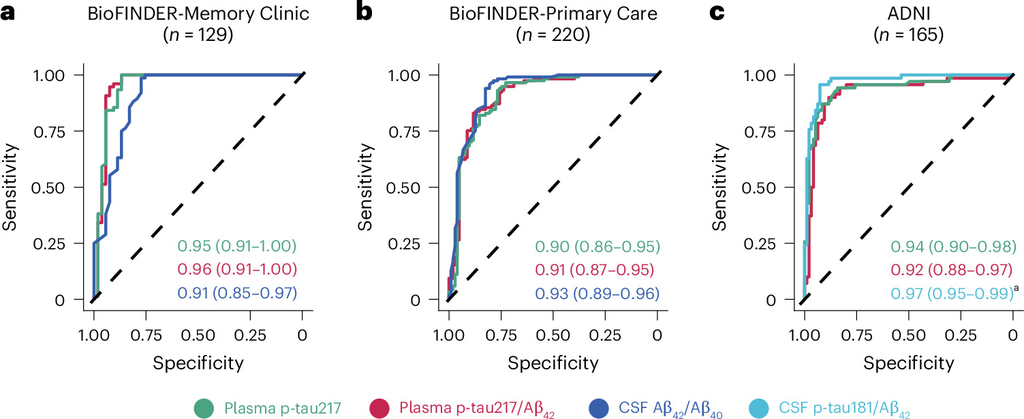
The differences sat elsewhere — in primary care the ratio test cleared only 62% of people who had no amyloid, against the 91% its manufacturer reports. Under published practice guidelines, the authors write that p-tau217 reached the bar for replacing a scan or a spinal tap in the memory clinic and the lower triage bar in primary care, while both spinal fluid tests reached only the triage bar. They conclude that the blood tests could serve as an alternative to spinal fluid testing in patients with cognitive symptoms.
All the participants had cognitive symptoms, the use the tests are authorized for, and almost all were white. Funding came in part from the U.S. National Institute on Aging; several authors declare fees from drug and diagnostics companies, and one is an employee of both Lund University and the drugmaker Lilly.
Sources
- Nature AgingPeer-reviewed

Medical Disclaimer: This content is provided for general informational and educational purposes only. It is not medical advice and should not be used as a substitute for professional medical advice, diagnosis, or treatment. Always consult a qualified healthcare professional regarding any medical condition, concern, symptom, or treatment decision.