A Virus Overwhelms Bacterial Immune Defenses Instead of Picking Them Apart
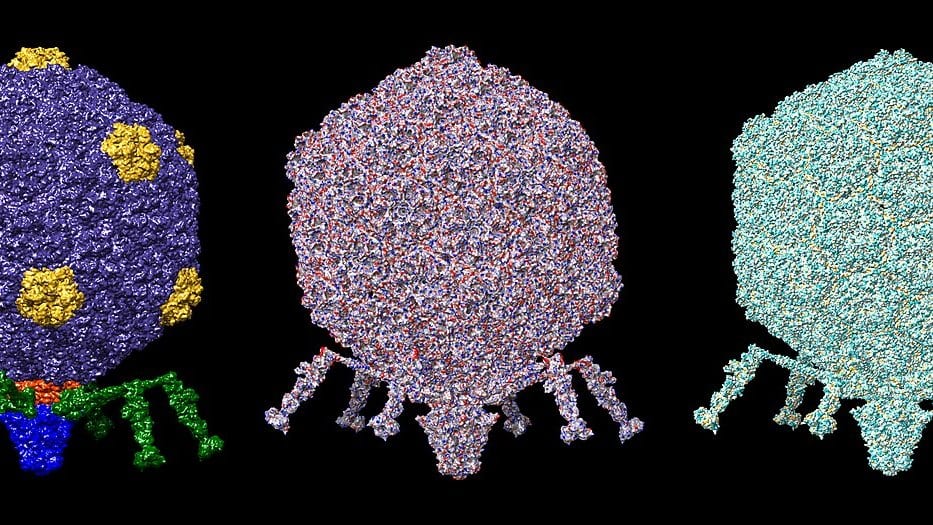
A virus that preys on bacteria shuts down its host's immune defenses by attaching phosphate groups to almost every protein in the cell, a group at EMBL Heidelberg reports in Nature on Aug. 19. The enzyme doing it, the kinase of bacteriophage T7, was identified in the 1970s and had been described as redirecting a handful of host proteins.
Kinases attach phosphate to proteins, a chemical switch that can turn their activity on or off. During infection by normal T7, the team detected 19,532 distinct phosphorylated peptides in Escherichia coli, against a few hundred in uninfected cells and in phage mutants lacking a working kinase. Within five minutes, about 70% of the host and phage proteins being expressed carried the modification, with no sequence preference. The authors call the enzyme "hyperpromiscuous."
Measuring what fraction of each protein's copies were modified, the group found the heaviest modification on 82 host proteins, mostly ones that bind DNA and RNA. It traces that bias to the kinase's C-terminal domain, which binds DNA but not RNA.
Because many bacterial defense systems act on DNA, the team tested 13 of them in laboratory E. coli. Three blocked T7, and two of those, the Retron-Eco9 and DarTG1 systems, lost ground when the kinase was present. On Retron-Eco9 the paper reports 17 phosphorylation sites on the system's toxin five minutes after infection, and mutations imitating phosphorylation at single sites abolished the defense.
Across a library of 513 natural E. coli isolates, 54 could be infected at all and 17 showed measurable defense. The kinase weakened that defense in six strains, by more than 1,000-fold in two, and strengthened it in one. Those six carried no defense system in common.
EMBL's own release frames the work as relevant to phage therapy for drug-resistant infections, and quotes senior author Athanasios Typas saying that "engineering phages with broad anti-defence systems, such as the T7 kinase, might be key in this quest for effective phage therapies."
Similar enzymes are found almost exclusively in phages, the paper reports.
Sources
- www.nature.comPeer-reviewed