Orcas Filmed Hold-And-Ramming a Sharptail Sunfish Apart: A Hunting Move Never Described Before
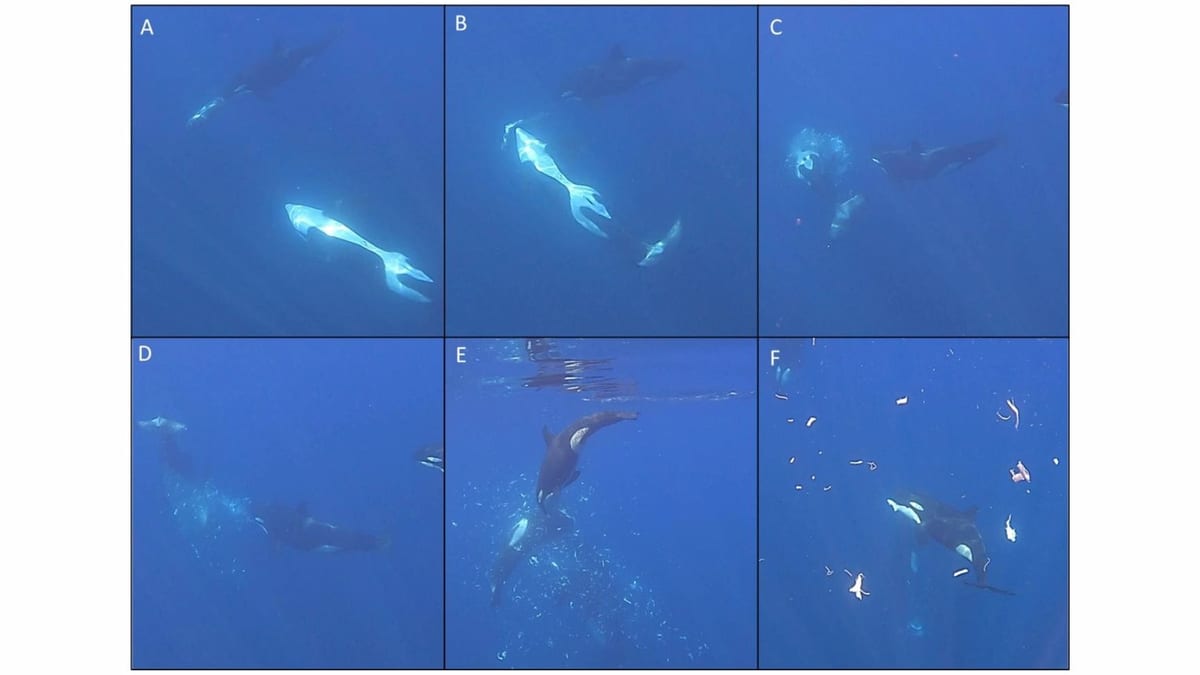
Orcas in the Gulf of California have been filmed using a hunting tactic scientists had never formally recorded: one whale grips a sharptail sunfish by the tail while a second accelerates in and rams it at high speed, hard enough to fragment the fish and scatter pieces through the water. Researchers describe the "ram-to-fragment" strategy in the journal Frontiers in Ethology.
One point is worth getting right: the prey is the sharptail sunfish (Masturus lanceolatus), a specific member of the molid family, not the more famous giant ocean sunfish, Mola mola. The distinction matters to the biology. The sharptail's more pronounced tail-end, or clavus, may be exactly what gives a whale something to grip.
The behavior was pieced together from two chance encounters about a year apart. The first came on July 29, 2024, at an offshore seamount near San José del Cabo, where a group of five orcas (three adult females, a male and a juvenile) was recorded by one of the study's authors. The second, on September 7, 2025, in the Isla Cerralvo channel, was caught by a third party and showed three adult females and a calf. In both, one orca held the fish while another came in ventral-side-up at speed to strike.
What the whales get out of it is still an open question. The researchers float several possibilities without settling on one: the ramming may break a large, awkward fish into pieces small enough for a calf to eat, it may be a way for young orcas to practice and learn, or it may simply be play. The presence of a juvenile or calf in both encounters is suggestive, but two observations cannot resolve it.
Whatever its purpose, the find fits a familiar pattern. Orca populations are increasingly understood as cultural: different groups invent distinct, local hunting traditions and pass them on. A hold-and-ram move seen twice in the same corner of the Gulf of California looks like one more of those regional signatures, now on the record for the first time.