Musango Matusadonaensis: Zimbabwe's Fifth Named Dinosaur, From the Shore of Lake Kariba
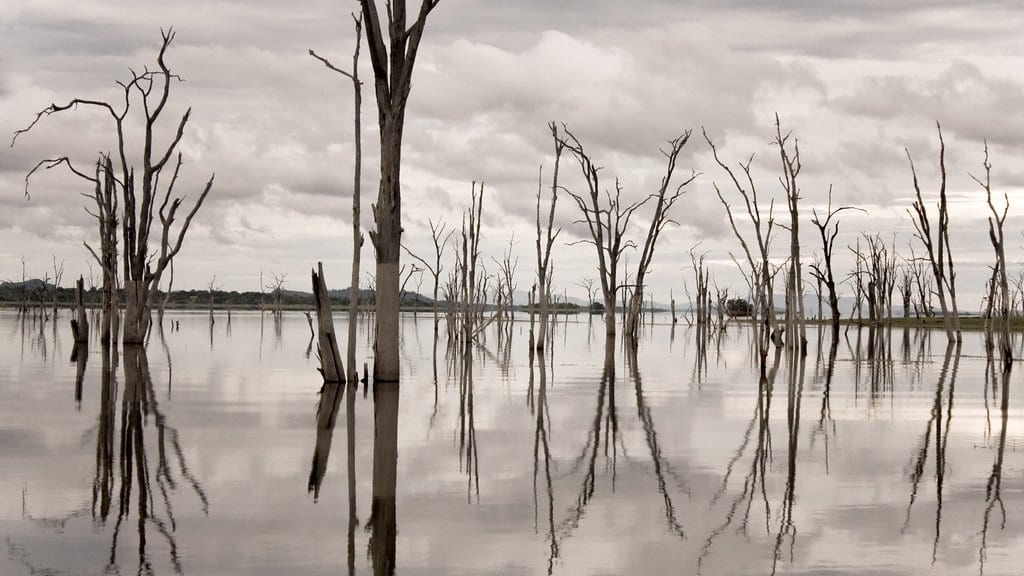
An international team of paleontologists has named a new dinosaur, Musango matusadonaensis, from a partial skeleton excavated in 2018 on the shoreline of Lake Kariba in northern Zimbabwe. The description was published online July 28 in the Journal of Systematic Palaeontology, led by Paul Barrett of the Natural History Museum in London with colleagues in Zimbabwe and South Africa. It is the fifth dinosaur ever named from the country.
Musango was a sauropodomorph, part of the lineage that later produced the long-necked giants, but nothing like one itself. The researchers put it at about 4.5 meters long and roughly 222 kilograms, about the weight of a full-grown pig, lightly built and probably bipedal. They date it to around 210 million years ago, in the Norian stage of the Late Triassic, from the Pebbly Arkose Formation.
The published description covers vertebrae, ribs, shoulder and hip bones, and parts of the arms, legs and feet, which makes the specimen one of the most complete Zimbabwean dinosaurs of its age. The animal was about eight years old and close to full size when it died, and its bones record healing from a serious injury or infection. No skull was recovered, so the diet is inferred rather than read from teeth; the team takes it for a plant-eater or an omnivore feeding near rivers and streams.
The genus name is the ChiShona word musango, "living in the bush," for the remoteness of the site; the species name comes from Matusadona National Park nearby. The fieldwork was run from a houseboat on Lake Kariba; the Natural History Museum's own account of the find calls it a dinosaur discovered from a boat. The bones themselves were spotted protruding from rock a few meters above the waterline, and the team came back to dig out the surrounding shoreline.
Zimbabwe's dinosaur list is short. "Syntarsus" rhodesiensis was named in 1969, Vulcanodon in 1972, Mbiresaurus in 2022 and Musankwa sanyatiensis in 2024. That last one is easy to confuse with the new animal and should not be. Musankwa sanyatiensis is a separate taxon, described in a separate paper in Acta Palaeontologica Polonica two years ago, and it was substantially heavier, an estimated 386 kilograms against Musango's 222. It was named for the houseboat the team worked from. What the two share is the rock: both come from the Pebbly Arkose Formation on Lake Kariba.
That overlap is what the researchers find interesting. Two sauropodomorphs of very different size in the same Late Triassic landscape, they argue, points to southern African ecosystems that were already varied rather than uniform. The setting they reconstruct for Musango is a seasonal, semi-arid floodplain crossed by rivers and streams, shared with lungfish, phytosaurs and other early dinosaurs, and drier than the comparable South African sites. This reading sits in the paper's discussion, which is paywalled. It is the authors' interpretation of two animals, not a settled result.
Barrett has put the point more bluntly. "Until recently, it was assumed that the dinosaurs living across southern Africa were largely the same," he said, and the two Kariba animals argue otherwise. On the region's fossil record generally, his line is that "what we've found so far is only the tip of the iceberg." Africa's Late Triassic has produced far fewer dinosaurs than South America's or Europe's, and the gap has more to do with where people have dug than with what lived there.