Mosquito Neurons That Sense Your Breath Are Wired Back to Each Other
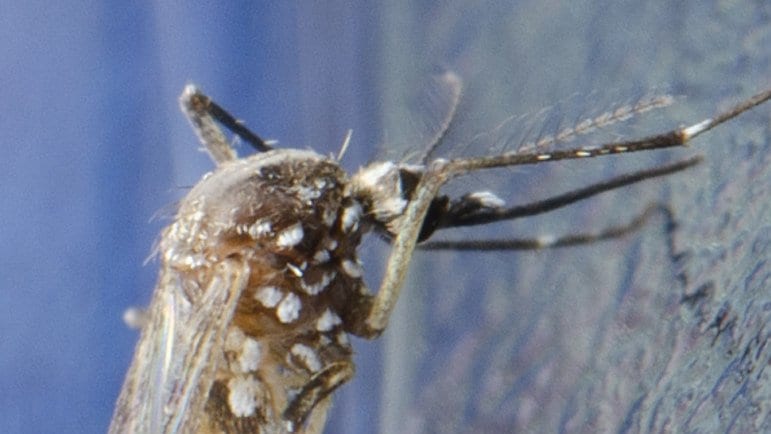
Researchers at Boston University and Harvard Medical School have mapped the mosquito brain circuit that responds to carbon dioxide and found the neurons detecting the gas connect mostly back to one another rather than forward to the next cell in line.
Carbon dioxide in a person's exhaled breath is the cue that starts a mosquito's search for them. The authors write that the gas opens the insect's odor and heat pathways and switches on host-seeking, and propose that the looping connections keep that signal usable when the surrounding air is full of other smells. The work appeared Sept. 10, 2026 in PLOS Biology.
The team sliced the brain of Aedes aegypti, a mosquito that bites people, and imaged the sections with an electron microscope. From those images it reconstructed the three neuron bundles fed by the maxillary palp, a sensory organ beside the mouthparts. In the carbon dioxide bundle, each sensory neuron made about 283 connections back onto its neighbors, against about 59 and 69 in the two other bundles. Those neurons made more connections back to one another than forward to the output cell that carries the signal deeper into the brain, a balance reversed in the other two bundles.
Compared with every smell bundle mapped in the fruit fly Drosophila melanogaster, the mosquito's carbon dioxide neurons carried about 11 times as many back-connections, the paper reports, and the fly's own carbon dioxide bundle was not a close match.
A computer model the group built from those counts, and from firing rates measured in earlier studies, needed the boost supplied by the loops to register carbon dioxide at the low levels mosquitoes respond to once background odors were at ordinary strength. The authors present the amplifying role as a proposal, not a measurement in a living mosquito.
At some of the looping contacts the team also found 60 dense structures resembling the ribbon synapses of the vertebrate retina and inner ear, seen in no other bundle in either insect.
Sources
- PLOS BiologyPeer-reviewed