A Swedish Model Spots Hip-Fracture Risk From Health Records Alone
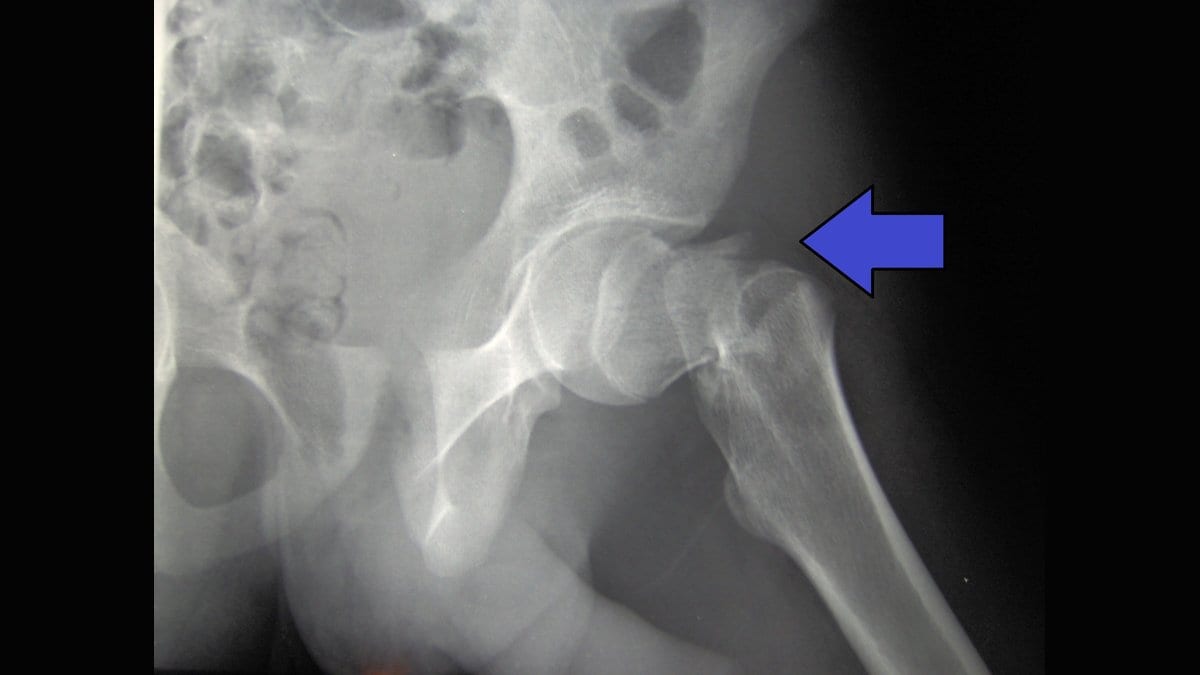
Researchers at the University of Gothenburg report a hip-fracture risk model built entirely from Swedish national registry records, with no questionnaire, bone scan or clinic visit. The model scored an area under the curve of 0.89 at one year, according to a paper published in PLOS Medicine on August 27. The authors write that "the lack of external validation and implementation studies represents a limitation," and that such studies are needed to establish whether the tool is clinically useful.
The cohort covered every Swedish resident aged 50 or older at a baseline date set between 2011 and 2013, excluding anyone prescribed osteoporosis medication in the previous two years: 3,542,647 people, followed through the end of 2021. During that period, 142,327 of them broke a hip, the paper reports. The team defined 139,980 candidate variables from diagnoses, medications, procedures and demographic and socioeconomic records, then split the data into discovery, development and holdout groups. The published model, called FRACTURE-ML, uses a deep-learning survival method named DeepSurv on 2,500 predictors.
The comparison the authors draw is with fracture liaison services, the secondary-prevention approach Sweden currently advocates, which targets people who have recently broken a bone. At two years, that approach scored an AUC of 0.55, against 0.88 for FRACTURE-ML, the paper reports. The model "identified nearly seven times more persons at risk," with sensitivity of 0.84 against 0.12. It does that by flagging many more people who will not break a hip: specificity falls to 0.79 from the current approach's 0.98.
A reduced version using 35 predictors performed similarly, at an AUC of 0.87 at two years and 0.85 at five, per the paper. The authors' own conclusion is that FRACTURE-ML "could be used as a resource-efficient solution for population screening." The code is posted on GitHub and archived on Zenodo; the registry data behind it cannot be released publicly, the authors write, citing Swedish confidentiality law.
Sources
- PLOS MedicinePeer-reviewed
Medical Disclaimer: This content is provided for general informational and educational purposes only. It is not medical advice and should not be used as a substitute for professional medical advice, diagnosis, or treatment. Always consult a qualified healthcare professional regarding any medical condition, concern, symptom, or treatment decision.