Enough Iron for 500 Swords Turned up in an Austrian Gravel Pit
About 500 iron bars weighing an estimated 1,035 kilograms, dug out of a gravel pit beside the Danube in Upper Austria, are the largest mass find of prehistoric iron bars so far known in Europe, Peter Trebsche of the Universität Innsbruck and Marion Berranger of the CNRS report in the journal Antiquity.
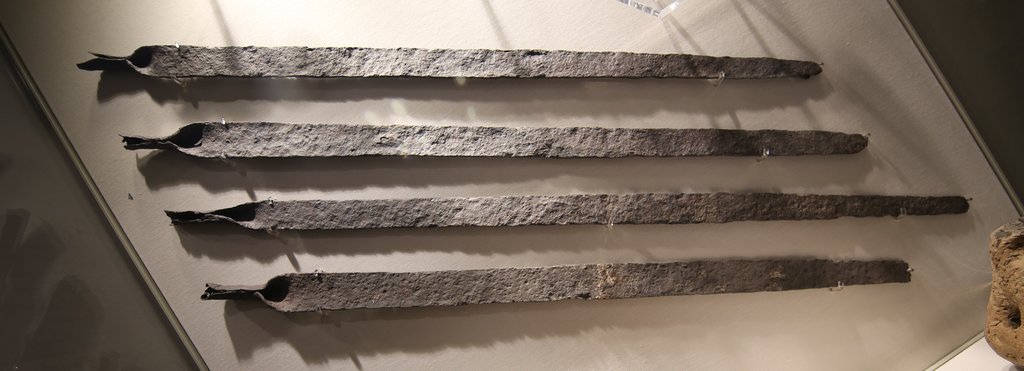
The paper says the haul is direct evidence of how much iron the La Tène culture of Iron Age Celtic Europe could make and move in a single consignment, and that radiocarbon dating places the bars between the fourth and first centuries BC, substantially later than the similar double-pointed bars found west of the Rhine.
Workers at the Deinham gravel plant noticed rusted, double-pointed lumps coming up on the excavator bucket in spring 2019 and reported them to Austria's Federal Monuments Office. The excavator had already destroyed the original context, which lay below the water table in a silted-up side branch of the river, so the bars were dated from the metal itself, using samples drilled from three of them.
Nothing of this size is known elsewhere in Europe, the authors write. The next largest group of these bars, from Durrenentzen in eastern France, weighs 308.5 kilograms. They put the Deinham quantity at enough iron to forge roughly 500 swords, or enough nails to fasten the timber frame of almost half the rampart around Manching, a Celtic town in Bavaria.
No boat was found with the bars, and the study frames the shipwreck reading as a question rather than a conclusion. The authors argue that a lost cargo is still the likeliest explanation, because the bars are all one kind of object, unlike the mixed material in Iron Age river offerings. Where the iron came from is still open. Work on its provenance is underway, and the smelting district and the forge must lie upstream on the Danube or a tributary, because a loaded boat could only have traveled downstream.