A Texas Fossil Long Filed as a Crustacean Is Named an Early Insect
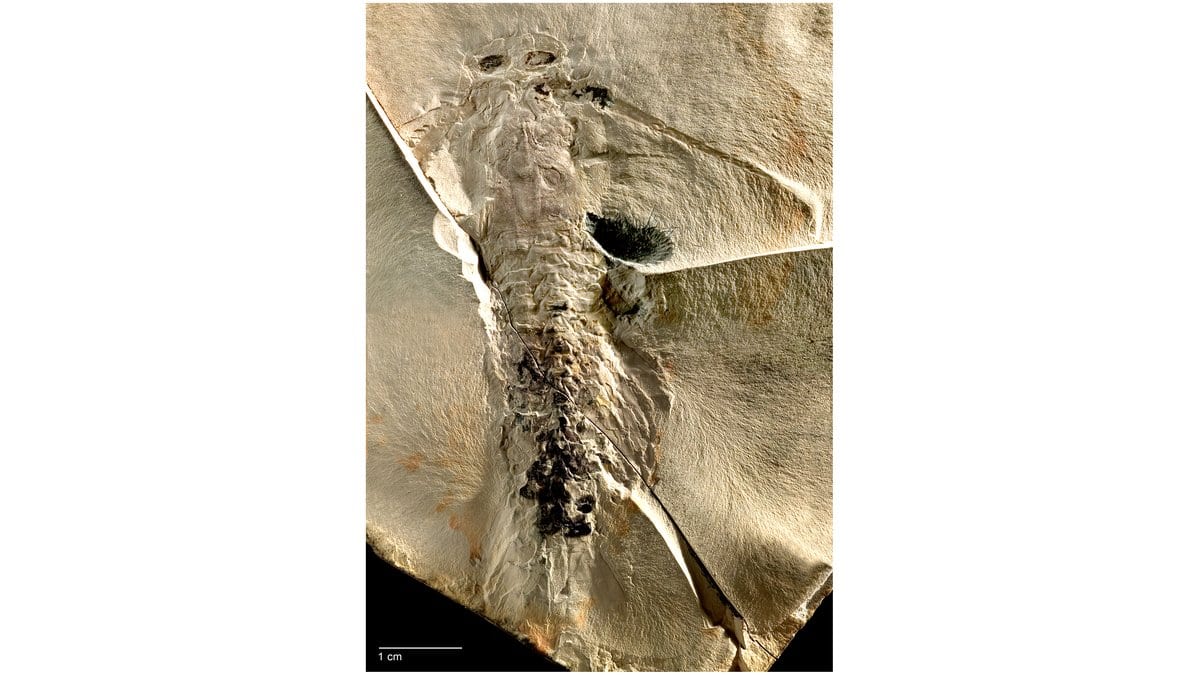
A fossil from West Texas that had been taken for a crustacean is described in Nature as an early insect with paddle-tipped legs running down its abdomen.
The paper, "Amphibious stem-insect sheds light on colonization of land" (DOI 10.1038/s41586-026-10961-2), was published was published on August 26 with Erik Tihelka as first author, and names the animal Chosha praecursor. It comes from the Tesnus Formation of the Late Mississippian, about 324 million years ago, the paper states.
Imaging under cross-polarized light reveals insect features "including an ovipositor and a terminal filament," according to the abstract, an egg-laying tube and a tail-like appendage, while the animal "differs from crown-group insects, most notably with respect to the presence of multisegmented abdominal legs with paddle-like modifications." Crown-group insects are those alive today plus their closest extinct relatives. The authors' phylogenetic analysis "recovers C. praecursor as a hexapod, strongly favouring its placement as an early-diverging insect," the abstract says.
The abstract gives no leg count. Science News, which interviewed Tihelka, a paleoentomologist at the University of Cambridge, reported three pairs of walking legs plus nine additional pairs of short legs on the abdomen, the rear ones ending in flattened paddles, 24 legs in all. Tihelka told Science News the discovery "straddles a big gap in the fossil record," and that he traveled to the San Diego Museum of Natural History to examine the specimen after finding a line drawing of it in a secondhand Russian paleontology textbook.
The paper also revises three other fossils: the Devonian Leverhulmia and two undescribed Carboniferous specimens from the Mazon Creek deposits. Together, the authors write, these "represent the earliest uncontested insects and partly reconcile the incongruence between molecular clock estimates and the fossil record," the long-standing mismatch between DNA-based estimates of when insects arose and the fossils actually found. The paddle-like appendages, they add, "suggest a semiaquatic mode of life in at least some stem-insects."
Sources
- NaturePeer-reviewed