Bacteria Grow Protein Cables to Breathe Beyond the Membrane
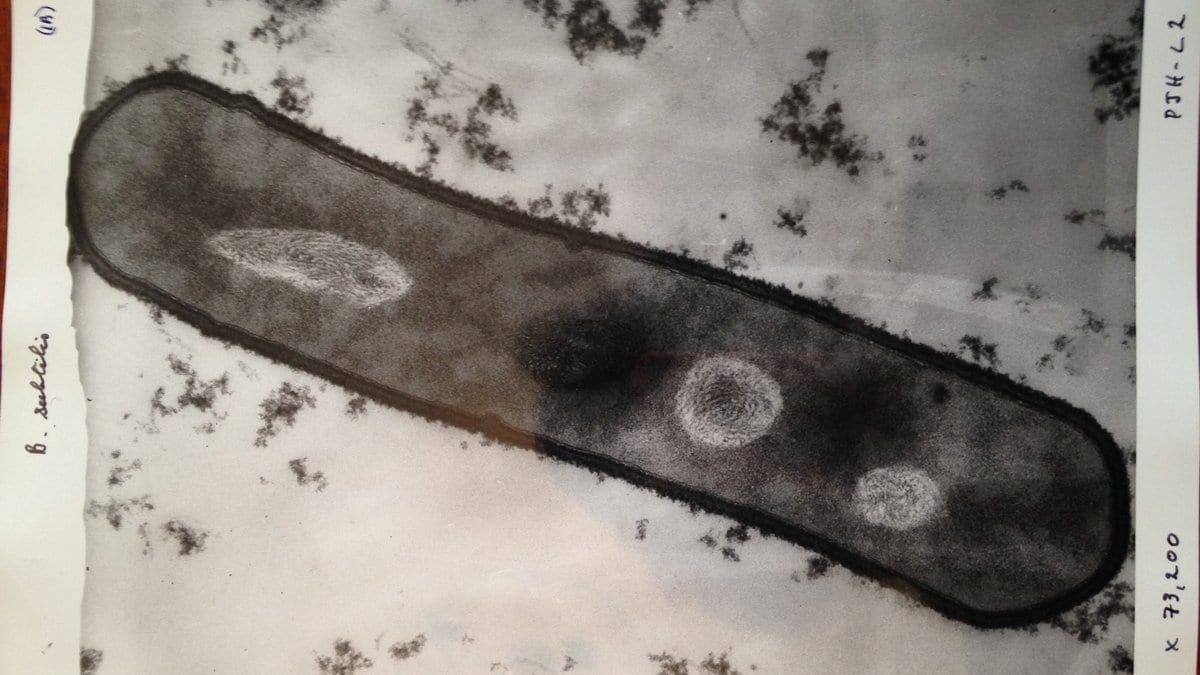
The soil bacterium Bacillus subtilis assembles tubes of protein that carry the fat-soluble molecules of respiration away from its cell membrane, a research team reports in a paper published Aug. 17 in Nature Microbiology. The arrangement gives the cell more respiratory capacity without more membrane.
Respiration passes electrons to quinones, carrier molecules that normally sit inside the membrane, which ties a cell's output to how much membrane it has. The paper's abstract states the gap it addresses: Gram-negative bacteria "expand this capacity through internal membrane invaginations and eukaryotes use membrane-bound organelles," while "whether Gram-positive bacteria have alternative capacity-generating mechanisms is unknown."
Two proteins do the work, according to the paper: the NADH dehydrogenase Ndh, and a partner the authors name Ncp, for Ndh-coupling protein, previously cataloged only as the gene yjlC. The two co-assemble with lipids in what the paper calls a 4:4 stoichiometry. Cryo-electron microscopy resolved one complex at 2.11 angstroms, the authors write; it spans about 90 angstroms in length and about 120 in width, with openings of about 20 angstroms at each end of the Ncp tube. Inside is a sealed chamber lined with phospholipids that holds quinones.
The complexes stack. Purified Ndh–Ncp "forms filaments with as many as 13 repeating units," the paper reports, linking the chambers into a continuous conduit; the filaments were characterized from protein extracted from cells, not imaged inside intact ones. The authors calculate that the arrangement "could allow 52 Ndh subunits to access quinones with a membrane footprint similar to a single NDH-2 dimer embedded in the bilayer."
For how common it is, the team searched "all 113,104 representative archaeal and bacterial species genomes" in the Genome Taxonomy Database. It reports 684 species that encode both proteins, spanning 30 families, and says its phylogenetic analysis "suggests that this capacity is widespread in Bacillota," the phylum that includes Bacillus, Staphylococcus and Clostridium.
The first author is Ashleigh Kropp and the senior author is Rhys Grinter, with the work led from Monash University in Australia.
Sources
- www.nature.comPeer-reviewed