Physicists Shrink the Double-Slit Experiment to the Size of a Chemical Bond
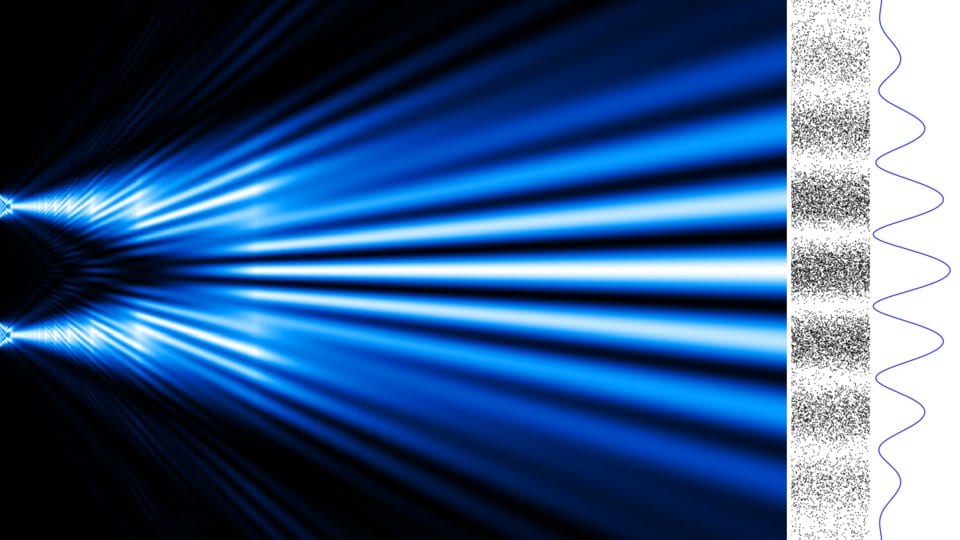
Physicists have run a double-slit interference experiment inside a silicon crystal, using two neighboring rows of silicon atoms as the slits, 1.36 angstroms apart, in a paper published Aug. 19 in Nature. An angstrom is a ten-billionth of a meter.
The work was done by Koudai Tabata, Takehito Seki, Ryo Ishikawa and Naoya Shibata of the University of Tokyo with Toma Susi of the University of Vienna. The team used a scanning transmission electron microscope, which sweeps a tightly focused electron beam across a sample, with a probe 1.1 angstroms wide parked midway between a pair of adjacent silicon atomic columns. The nuclei pull the beam onto the two columns, the paper explains, so the columns act as two sources of electron waves that then interfere.
The detector recorded fringes spaced 0.736 per angstrom, the reciprocal of the 1.36-angstrom separation, the paper reports. Averaging 356 equivalent patterns, some 33 million electrons in total, brought the third bright fringe into view. Placing the beam on a single column instead made the fringes vanish, which the authors take as confirmation that the pair of columns is doing the work.
The fringes also survived heating. The group reports that they persisted from 300 kelvin to 900 kelvin, with the third-order fringe fading and the second still visible at the top temperature. A simulation in which each atom vibrates independently erased everything above the first fringe, the paper states, while a simulation using silicon's correlated vibrations reproduced the measurements.
From the surviving fringe visibility the authors extract how strongly the two columns' vibrations move together: a correlation coefficient of 0.39 along the axis joining them and 0.24 across it, with essentially no cross-correlation. Those numbers map onto the stiffness of that specific atomic bond, the paper says.
The authors write that interferometry at atomic length scales "has remained unexplored," describe their setup as downscaling Thomas Young's original light experiment by seven orders of magnitude, and say it opens routes to examining lattice dynamics at the level of single bonds.
Sources
- www.nature.comPeer-reviewed