A Robot Now Tests New Versions of the Genetic Code
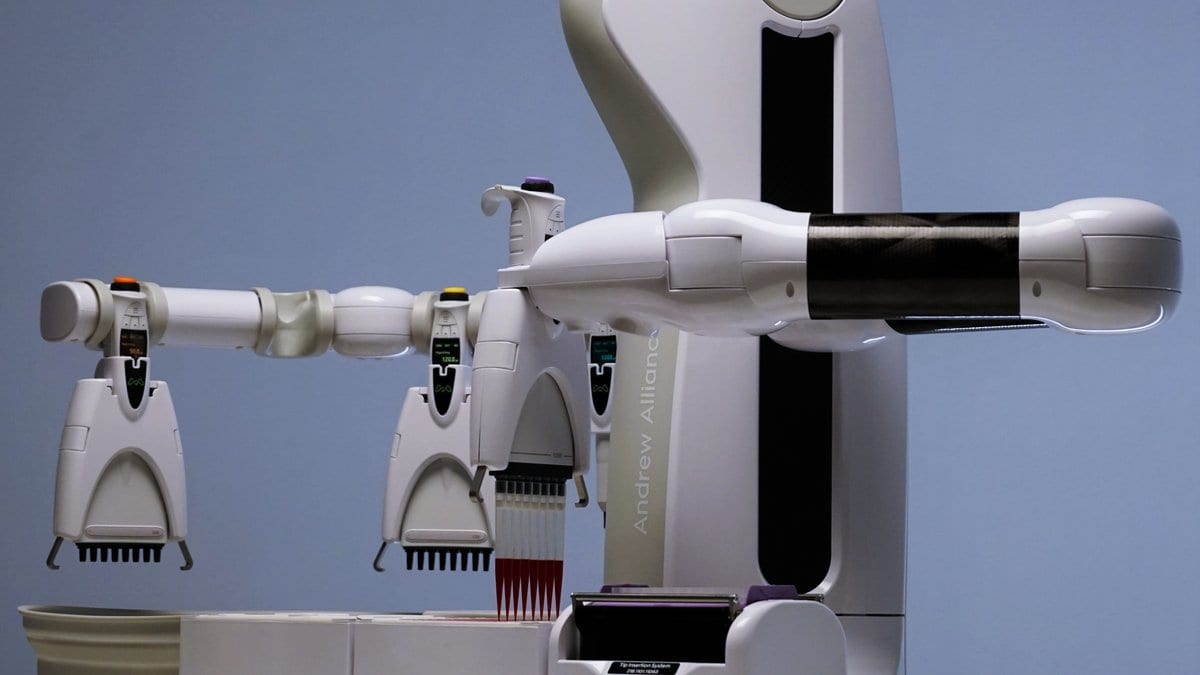
A robotic system that builds and tests redesigned genetic codes in cell extracts, without recoding a living organism, is described in a paper published on August 26 in Nature.
The open-access study, "Automated prototyping of genetic codes" (DOI 10.1038/s41586-026-10949-y), is by Felix Radford, Nayan Sapers, George M. Church and colleagues. They call the platform AGENTEX, short for automated genetic tRNA expansion, and describe it in the abstract as a system "for multiplexed robotic prototyping of genetic codes in cell-free translation systems."
The standard genetic code uses 64 codons, the three-letter instructions in a gene, to specify 20 amino acids, the paper states. Changing those assignments normally means rewriting an organism's whole genome, which the abstract calls "exceptionally challenging."
The central finding concerns transfer RNAs, the adapters that carry amino acids to the ribosome. All of them end in the same three bases, CCA, and that ending was long assumed to be required before an amino acid can be attached. The authors report that "the tRNA 3′ end shows remarkable flexibility to mutation, allowing aminoacylation of most otRNAs by all Escherichia coli aaRSs", most tRNAs with altered ends were still loaded by every one of the bacterium's loading enzymes.
Building on that, the team reports cell-free translation systems running "compressed genetic codes of 34 aaRSs for 34 codons," and says it evaluated two such codes alongside the standard code, "with non-standard amino acid incorporation and reassignment of up to three codons." The authors write that new-to-nature genetic codes "enable new chemistries, therapeutics and ecosystem engineering," their framing of why the work matters rather than something the paper measures.
Every result is in cell extracts, not in a living recoded organism. Mass spectrometry of a test peptide detected products of both the redesigned and the standard code but no mixed products, the paper reports, "indicating no crosstalk." The authors also state that AGENTEX's components "are not functional if transferred to living organisms in the environment."
Sources
- NaturePeer-reviewed