Skip to content
See the World Through ScienceA project of ALLATRA
Source: Peer-reviewedHydrology and Earth System Sciences2 sources

Added Snow Detail Helps Water Models With Timing, Not Volume
Environment

Republish this story

Our work is licensed under Creative Commons BY-NC 4.0. You may republish this piece for free — with credit to ALLATRA Media and a link to the original, unedited beyond length trims, and not for commercial use.

Read the full license

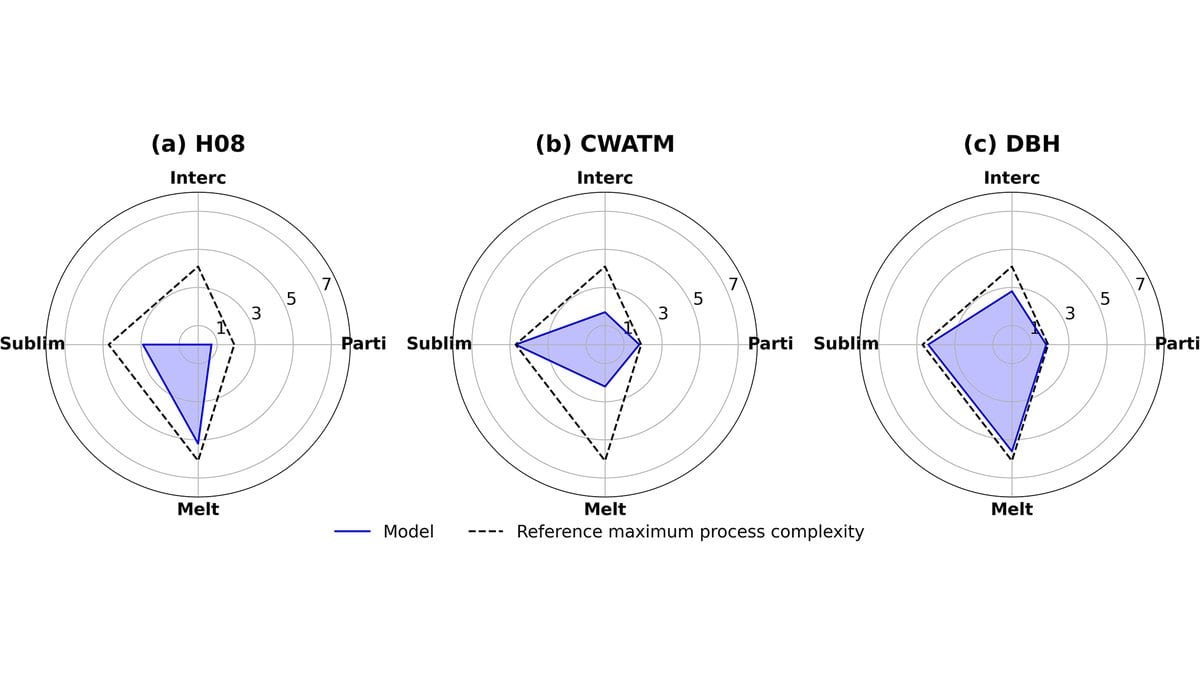
Three radar plots, one each for the H08, CWATM and DBH models, scoring four snow processes: partitioning, interception, sublimation and melt, against a dashed outline marking the most detailed treatment in the ensemble.
Three of the 13 models compared process by process. Each colored polygon is one model; the dashed outline marks the most detailed treatment of that process anywhere in the ensemble, so a small polygon is a simpler snow routine.Figure 12 from Xiangyong Lei, Haomei Lin, Kaihao Zheng, Peirong Lin (2026), "Process diagnostics of snowmelt runoff in global hydrological and land surface models – Part 2: Are more complex models better?", Hydrology and Earth System Sciences — CC BY 4.0, resized and padded

A team at Peking University has scored how much snow physics each of 13 global water models contains, then checked those scores against how well the models reproduce the runoff from melting snow in 1,455 northern river basins. Added detail barely tracked better results for the amount of meltwater or the size of the peak flow.

The paper describes these models as central to water resources management, flood forecasting and climate-impact assessment; in snow-fed basins, that means forecasting how much meltwater will arrive and when. Xiangyong Lei, Peirong Lin and two colleagues at Peking University published it Nov. 18, 2026, in Hydrology and Earth System Sciences.

The method breaks each model's snow routine into the steps it represents and scores them. Some models melt snow with a simple air-temperature formula; others solve the energy balance at the snow surface. They also differ in whether they track snow caught in tree canopies and snow lost straight to the air. Total scores ran from below 10 for the least detailed to above 14 for the most, with the widest spread in how melting is treated.

Set against river-flow records from basins with little human influence, the scores showed only a weak association with how well a model captured the melt season's total runoff or its peak. Timing was the exception: complexity and timing skill rose together (a correlation of 0.32), with timing defined as the day by which half the season's runoff has passed. The association was stronger among models driven by one shared weather dataset.
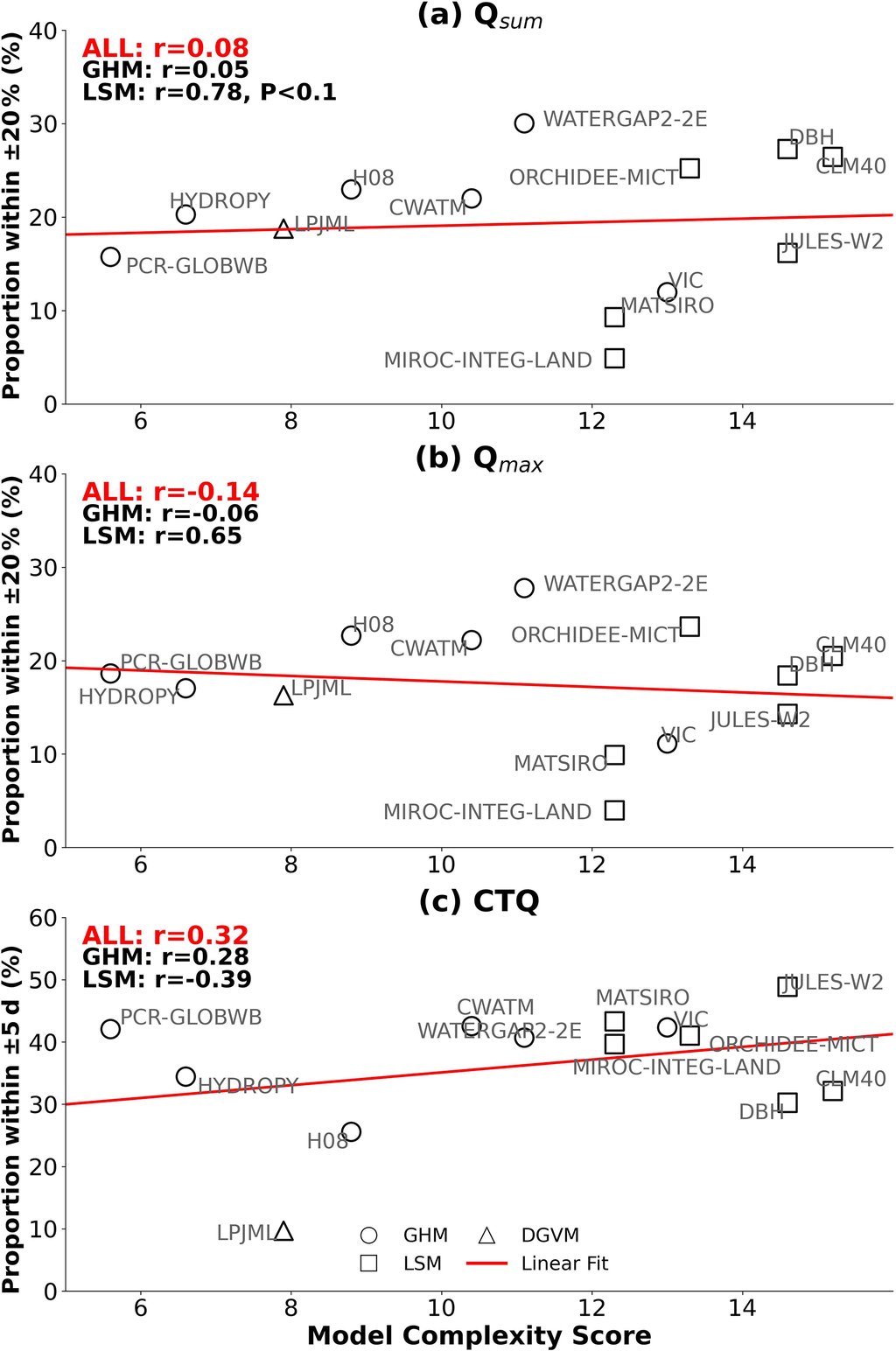
Three scatter plots of model complexity score against the share of basins simulated within acceptable error, for runoff volume, peak flow and melt timing, each with a fitted red regression line and named models.
Each point is one of the 13 models. Over all of them the score tracks melt timing a little (r = 0.32) and runoff volume and peak flow almost not at all. Figure 6 from Xiangyong Lei, Haomei Lin, Kaihao Zheng, Peirong Lin (2026), "Process diagnostics of snowmelt runoff in global hydrological and land surface models – Part 2: Are more complex models better?", Hydrology and Earth System Sciences — CC BY 4.0, resized

The authors conclude that performance depends more on representing the key processes in a balanced way than on complexity alone. Leaving a process out cost more than simplifying one: they trace one model's poor accuracy to missing components, including any treatment of snow caught in the canopy. One of the simpler models performed consistently well.

The paper is the second of a two-part study; Part 1, in the same journal earlier in 2026, set out the basin selection and the runoff measures it uses.

Sources

Spot an error?

Spot an error?

Report an error

Spotted a mistake on this page? Tell us what's wrong and our editors will take a look.

What kind of problem?

Only if you'd like us to be able to follow up. We won't use it for anything else.

We correct mistakes openly. Select any text to flag it. Fixes are logged under our Corrections Policy.

Report an error

Reporting on

Added Snow Detail Helps Water Models With Timing, Not Volume

What kind of problem?

Only if you'd like us to be able to follow up. We won't use it for anything else.

We read every report. Corrections are logged publicly.