Antarctic Penguin Colonies Emit Methane That Climate Budgets Do Not Count
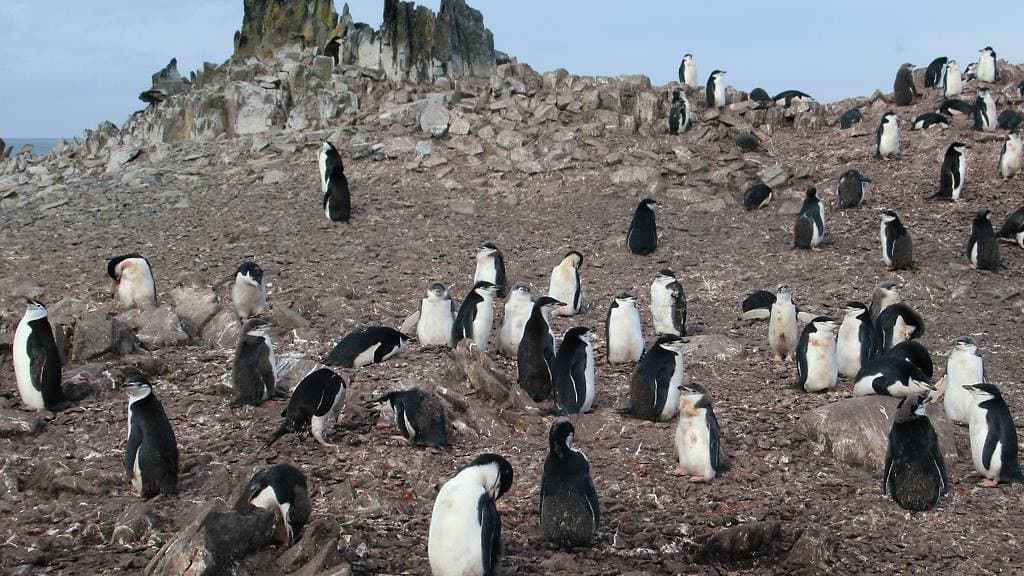
Antarctic penguin colonies give off methane, and Spanish researchers have now put a number on how much. Chinstrap penguin colonies across the continent emit an estimated 0.49 ± 0.16 teragrams of the gas a year. A teragram is a million metric tons.
The estimate comes from Alejandro Román, I. Emma Huertas and colleagues at the Spanish National Research Council's Institute of Marine Sciences of Andalusia. Their paper appeared in the open-access journal npj Climate and Atmospheric Science on Sept. 23, 2026. The authors note that natural methane sources are poorly pinned down in the polar regions. They describe dense wildlife colonies as a previously overlooked component of the Antarctic methane cycle, arguing that future methane budgets should account for biologically driven emissions.
They measured the gas with chambers placed on the ground at the colonies and mapped the guano patches and colony outlines from drones, then combined the two to get emissions per unit of area. Soil loaded with guano, the birds' droppings, released methane intensely. The bare soil around it released a negligible amount.
The researchers call the annual figure modest next to the dominant human sources of methane and describe the colonies themselves as exceptionally intense hotspots. The Antarctic-wide number is scaled up from the sampled plots rather than representing a directly measured total.
The projects behind the work were funded by Spain's Ministry of Science, Innovation and Universities and by the research council, with field support from the research vessel Sarmiento de Gamboa and the Spanish Antarctic base Gabriel de Castilla.
Sources
- npj Climate and Atmospheric SciencePeer-reviewed