Where Metal Nodules Cover the Deep Pacific Seabed, a Different Set of Animals Lives
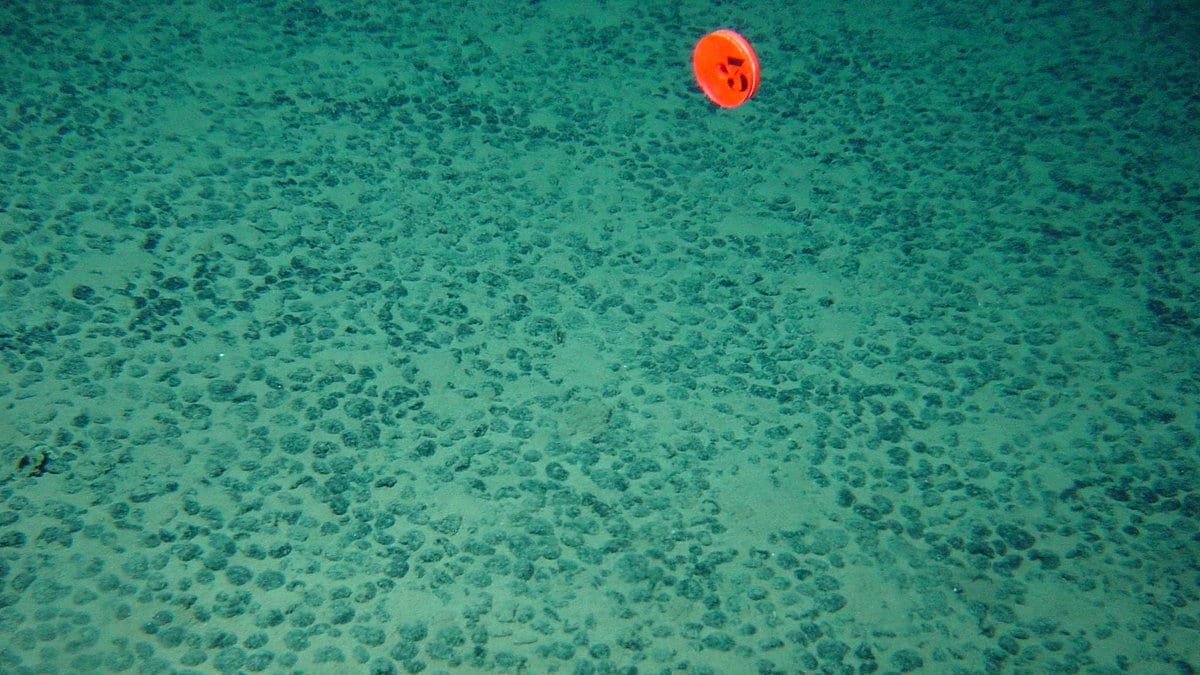
Seafloor animal life in a metal-rich basin of the northwest Pacific does not simply rise as the metal does, according to a photographic survey published Sept. 10 in Communications Earth & Environment. Animal density fell as polymetallic nodules, the potato-size metal lumps strewn across the deep seafloor, went from sparse to middling cover, stayed roughly flat through the middle of the range, then climbed sharply where the nodules were thickest.
Leyi Fang, Chunsheng Wang and colleagues at the Second Institute of Oceanography in Hangzhou, China, write that what is known about nodules and deep-sea animals has come mostly from places where nodule cover is low. Their survey spans a wide range of cover in a basin where nodules are abundant.
From the images the team counted 169 kinds of animals, sorted by appearance, across 14 broad branches of the animal kingdom, with sea cucumbers and sponges the most common. The mix changed as much as the count. Where nodules were sparse, the community was dominated by animals that crawl over the sediment and feed on it. Where cover was heaviest, it was dominated by animals fixed in place that strain food from the water. That shift came from changes in how abundant the dominant groups were, rather than from one set of species replacing another.
Compared with the Clarion-Clipperton Zone, another nodule field in the Pacific, the northwest Pacific basin held fewer animals for a given area of seabed and a different mix of species, but a comparable variety of them. The paper attributes that to larger-scale conditions: the supply of food particles sinking from the surface and the water chemistry that governs how readily shells dissolve.
The authors describe the relationship they found as previously unrecognized in this part of the Pacific, and say it underscores the need for region-specific management of deep-sea mining. The paper is open access.
Sources
- doi.orgPeer-reviewed