Fourteen Deep-Sea Vent Fields Mapped in the Central Indian Ocean
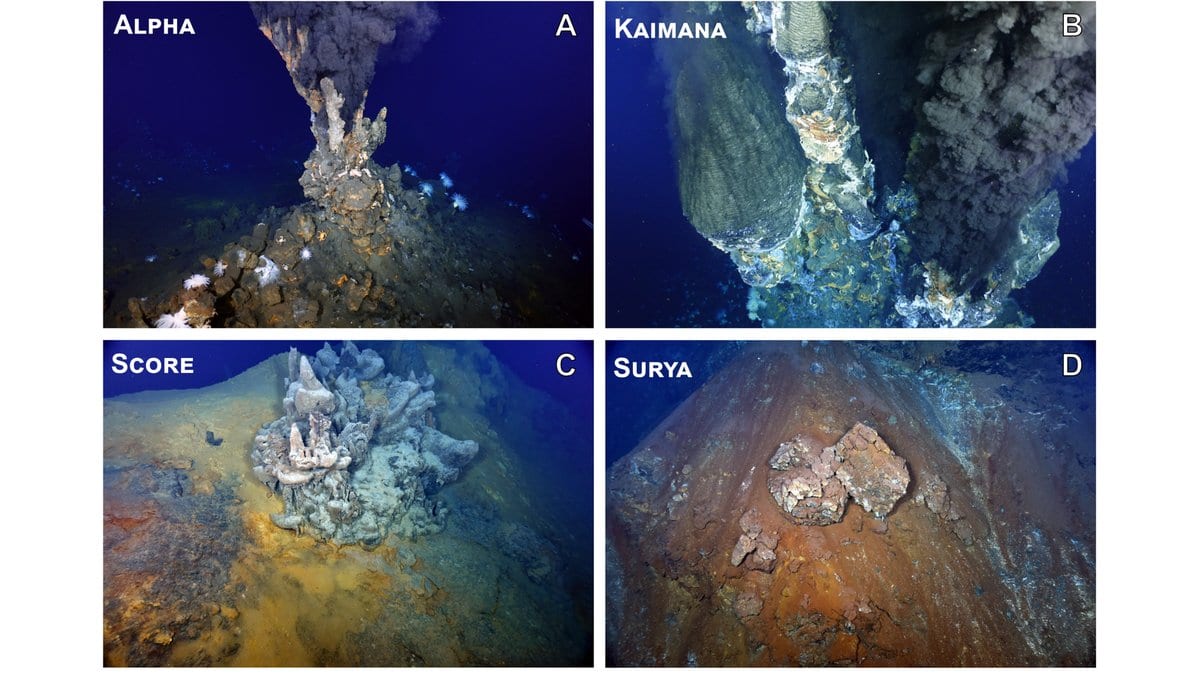
Researchers at Germany's Federal Institute for Geosciences and Natural Resources report fourteen hydrothermal vent fields, places where hot mineral-rich water escapes the seafloor, around the Rodrigues Triple Junction in the central Indian Ocean. The authors describe them as including the first vent fields on the Southeast Indian Ridge to be characterized in detail. The paper was published Nov. 18, 2026, in Scientific Reports.
The fields lie inside an area the International Seabed Authority licensed to the institute in 2015 for the exploration of polymetallic sulfides, the metal-rich mounds that vents build up. The paper offers its measurements as a reference set for later work on the deposits, resource assessment, biology and monitoring of the two ridges. The authors note that their data do not say how much metal could be recovered, because every sample came from the seafloor surface.
Sebastian Fuchs and his co-authors located the fields by mapping the seabed from the ship and from a towed sled and watching the water above for plumes of vent chemicals, and then sampled each one with remotely operated vehicles. The fields sit 2,375 to 3,680 meters down, in the ridge's central valley, on its flanks, on a raised plateau and at breaks between segments. Ten are on the northern Southeast Indian Ridge, a stretch the paper calls poorly documented until now. Most rest on basalt lava; four rest on gabbro and peridotite, rock from the lower crust and the mantle pushed up along large faults, and their sulfides carry more tin and gold than the rest.
Surveys repeated over the same ground turned up sulfide deposits as far as 16 kilometers from the ridge axis, where new crust forms. The authors conclude that watching for plumes is not enough on its own: the inactive fields showed up only in close-range mapping repeated across several expeditions, so counts of vent fields that rest on plume surveys probably run low.
Inactive mounds outnumber active ones in most of the fields, and animals already known from other Indian Ocean vents dominate the life the cameras recorded.
Sources
- Scientific ReportsPeer-reviewed
