Skip to content
See the World Through ScienceA project of ALLATRA
Source: Peer-reviewedNature Geoscience1 source

The Gulf Stream Helps Shape Pacific Ocean Temperatures, a Model Experiment Finds
Environment

Republish this story

Our work is licensed under Creative Commons BY-NC 4.0. You may republish this piece for free — with credit to ALLATRA Media and a link to the original, unedited beyond length trims, and not for commercial use.

Read the full license

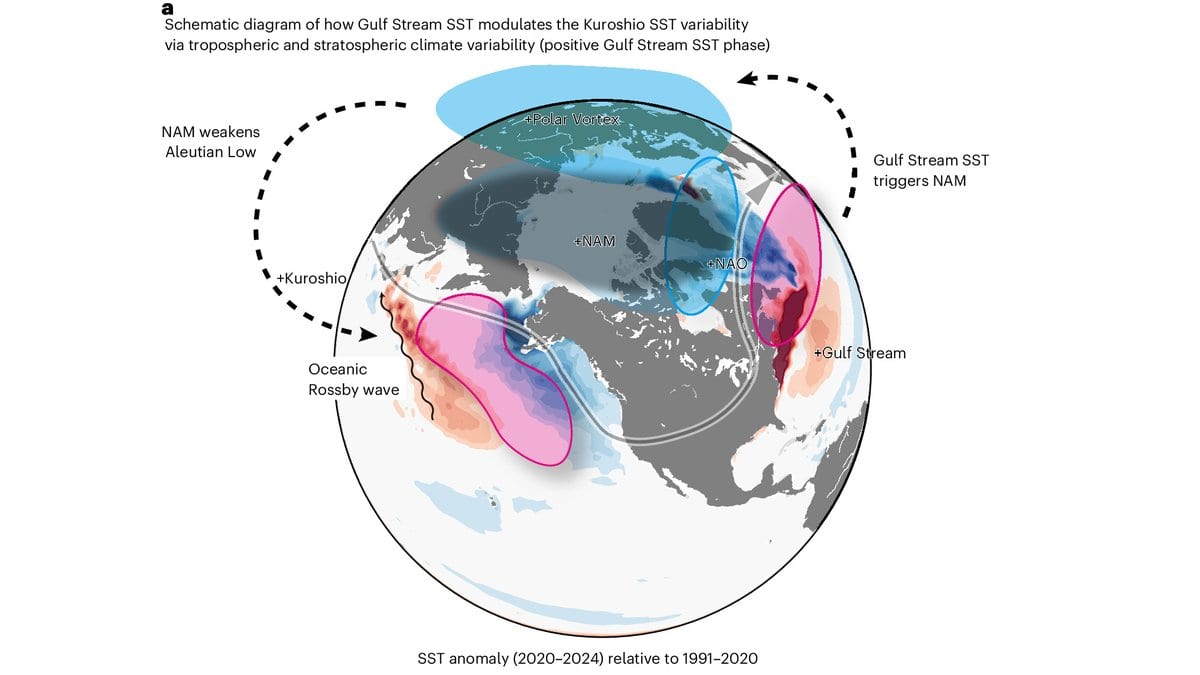
Schematic globe showing warm water over the Gulf Stream setting off a ring of atmospheric circulation changes over the Arctic that weaken the Aleutian Low and shift the Kuroshio Extension north.
The pathway the authors propose, drawn on a globe: a signal that leaves the western Atlantic, crosses the Arctic in the winter winds and arrives over the North Pacific (panel a of the study's Fig. 4).Fig. 4 from Yoko Yamagami, Hiroaki Tatebe, Tsubasa Kohyama, Shoichiro Kido, Satoru Okajima, Yoshiki Komuro (2026), "Kuroshio Extension warming shaped by Gulf Stream variability via the Arctic atmosphere", Nature Geoscience — CC BY 4.0, cropped and padded

A 100-year climate simulation at the Japan Agency for Marine-Earth Science and Technology has tied temperature swings in the Gulf Stream to the warming of a major current on the far side of North America, and the route it found runs through the atmosphere, not through the sea.

The work is a model experiment and not a measurement of the real ocean. Yoko Yamagami of the agency and colleagues held sea surface temperatures in one basin to the values of a reference run, then watched the other basin respond. Gulf Stream variability accounted for 13% of the temperature swings that the model's Kuroshio Extension, the warm current running east from Japan into the open Pacific, produces on its own. The team says the pathway contributed to the unusual North Pacific warmth of 2020 to 2024, and that it may make Northern Hemisphere climate more predictable a decade ahead. The paper was published Nov. 17, 2026, in Nature Geoscience.

The chain the authors describe is atmospheric. Warm water over the Gulf Stream pushes the Atlantic storm track north and strengthens the belt of winds circling the Arctic high above it. By late winter that signal reaches the North Pacific and weakens the Aleutian Low, the region's winter low-pressure system. The slackened winds launch slow westward-traveling ocean waves, and those shift the Kuroshio Extension north and draw warm water with it.
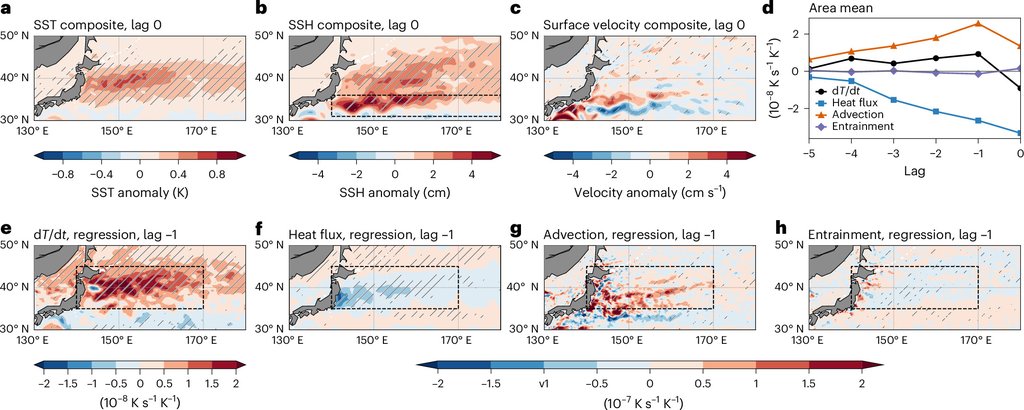
Maps of the ocean east of Japan showing simulated temperature, sea surface height and current anomalies along the Kuroshio Extension, with a plot of the heat budget terms.
In the simulation, a warm Kuroshio Extension comes with a raised sea surface and a current shifted north of its usual track, and the heat budget credits ocean transport rather than the air above (the study's Fig. 2). Fig. 2 from Yoko Yamagami, Hiroaki Tatebe, Tsubasa Kohyama, Shoichiro Kido, Satoru Okajima, Yoshiki Komuro (2026), "Kuroshio Extension warming shaped by Gulf Stream variability via the Arctic atmosphere", Nature Geoscience — CC BY 4.0, resized

The influence ran one way. When the same experiment constrained North Pacific temperatures instead, Gulf Stream temperatures did not follow, and the authors report no evidence that the Kuroshio modulates the Gulf Stream in return. In the reference run, Gulf Stream temperatures led the Kuroshio by up to four years.

The link also depends on how finely the ocean is modeled. Repeated with a coarser grid that smooths out ocean eddies, the Atlantic experiment left North Atlantic variability explaining 0.49% of the Kuroshio's temperature swings, and the Aleutian Low response vanished.

Sources

Spot an error?

Spot an error?

Report an error

Spotted a mistake on this page? Tell us what's wrong and our editors will take a look.

What kind of problem?

Only if you'd like us to be able to follow up. We won't use it for anything else.

We correct mistakes openly. Select any text to flag it. Fixes are logged under our Corrections Policy.

Report an error

Reporting on

The Gulf Stream Helps Shape Pacific Ocean Temperatures, a Model Experiment Finds

What kind of problem?

Only if you'd like us to be able to follow up. We won't use it for anything else.

We read every report. Corrections are logged publicly.