Losing Greenland's Ice Makes North Africa Wetter in Climate Simulations
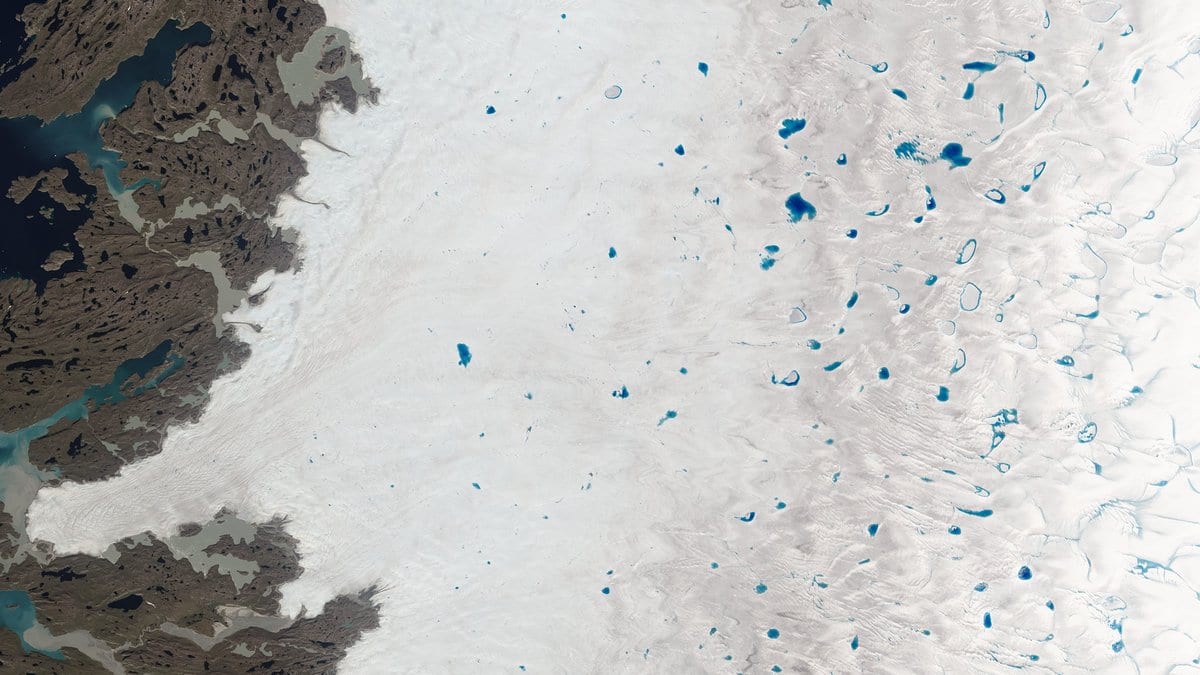
Greenland's retreating ice sheet strengthens the summer monsoon over North Africa, a team of climate researchers reports from a set of model experiments published Nov. 19, 2026.
Zixuan Han of Hohai University in Nanjing and Stockholm University, Qiong Zhang of Stockholm University and eight colleagues report in Nature Communications that they combined paleoclimate proxy evidence with coupled climate-model simulations, sensitivity experiments and idealized atmospheric modeling, and that Greenland's retreat acts as "a dynamically important amplifier" of North African monsoon rainfall. In the authors' account, the work identifies a pathway by which slow changes in high-latitude ice alter monsoon rainfall far to the south under sustained warming.
In the experiments, ice loss over Greenland adds warmth to the Arctic. That extra warmth disturbs the belt of westerly winds high in the atmosphere, which sets up a stationary Rossby wave train, a wave pattern that holds its position, reaching from Greenland to North Africa. The paper reports that the pattern strengthens the monsoon's circulation and draws moisture together over land, leaving the Sahara and the Sahel wetter in the simulations.
The comparison the work rests on is the mid-Pliocene, a warm period in Earth's past, used here as a natural experiment in sustained warmth. Monsoon rainfall in those simulations came out markedly stronger than in simulations of transient future warming at comparable increases in the global mean temperature — a difference the experiments tie to Greenland's retreat.
The paper is open access under a CC BY 4.0 license, and names funders including the National Key Research and Development Program of China, the Swedish Research Council and the Danish National Research Foundation. Nature Communications is carrying the peer-reviewed accepted version, received March 11, 2026, and accepted Oct. 20, 2026; a final edited version is to replace it automatically.
Sources
- Nature CommunicationsPeer-reviewed