Telling Deep-Sea Mining Damage From Climate Change Will Be Hard, Model Study Finds
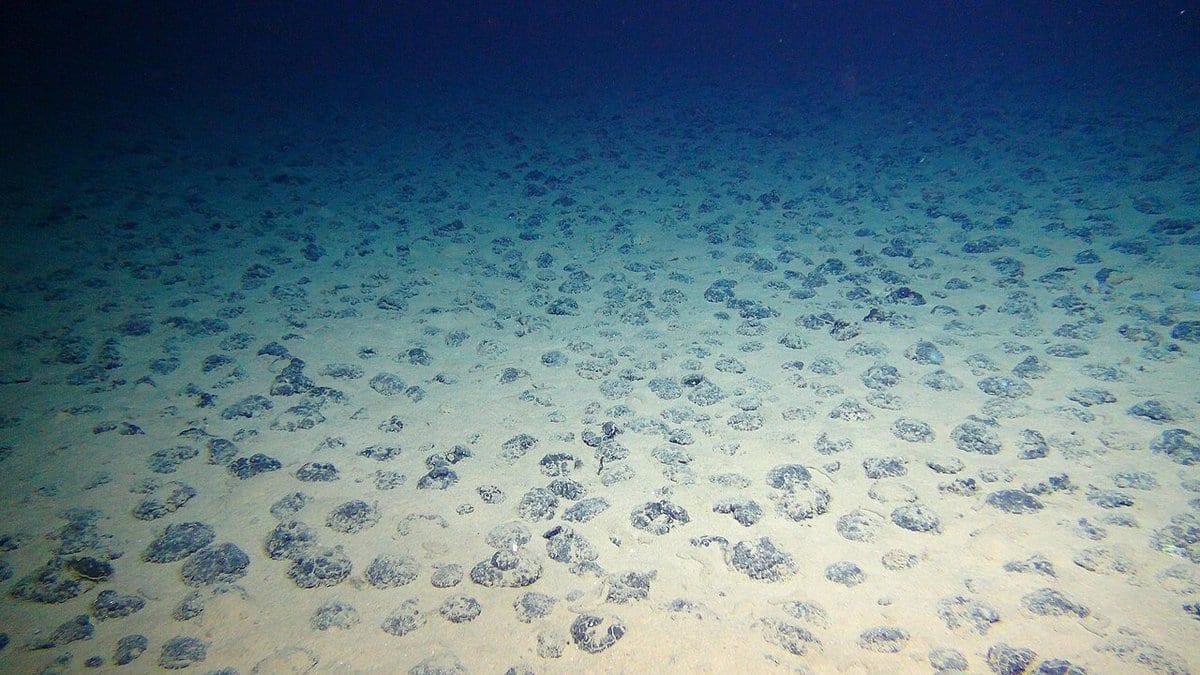
Climate-driven change in the deep seabed of the equatorial Pacific, where companies plan to mine polymetallic nodules, will rarely be distinguishable from natural variability by 2035, and had begun to emerge in 17 of 34 model-variable-scenario combinations by 2050, according to a modeling study published Sept. 3 in Environmental Research Letters.
Rong Wang and colleagues at China's Second Institute of Oceanography frame it as a problem for mining contractors, whose environmental baselines must separate mining's effects from a deep ocean already changing.
The authors used a five-model CMIP6 ensemble, a standard set of climate simulations, tracking temperature, dissolved oxygen and pH at 5,000 meters in the Clarion-Clipperton Zone and the particulate organic carbon sinking past 100 meters as a proxy for food reaching the seafloor. A signal counted as emerged when its ten-year average pulled away from a modeled 2015-2030 reference state by more than twice the size of preindustrial variability, and held there five years. These are projections, not seabed measurements.
Robust emergence was rare by 2035, the paper reports, occurring in one model and for temperature only. By 2050 it had begun in 17 of 34 combinations and been confirmed in 16.
Where signals emerged, the physical changes were small. Oxygen shifted by less than 1% of its background concentration and temperature by a few thousandths of a degree, in the authors' words, "well below plausible physiological thresholds." Food supply was the exception, with a 15% decline in the single case that emerged, in one model under the high-end SSP5-8.5 pathway only, and not before the late 2050s.
The variables that emerge earliest are the least likely to matter biologically, the authors write, while the food supply that would matter most is set in the upper ocean rather than by mining. That, they conclude, is where attribution will be hardest, and why a fixed historical baseline "needs to be supplemented rather than relied upon."
Ten-year records also proved too short to characterize deep-ocean variability, the paper reports, and the protected Areas of Particular Environmental Interest differed from contract areas once depth and location were matched.
Sources
- Environmental Research LettersPeer-reviewed