Less Water Down the Amazon Would Mean a Faster Current off Brazil
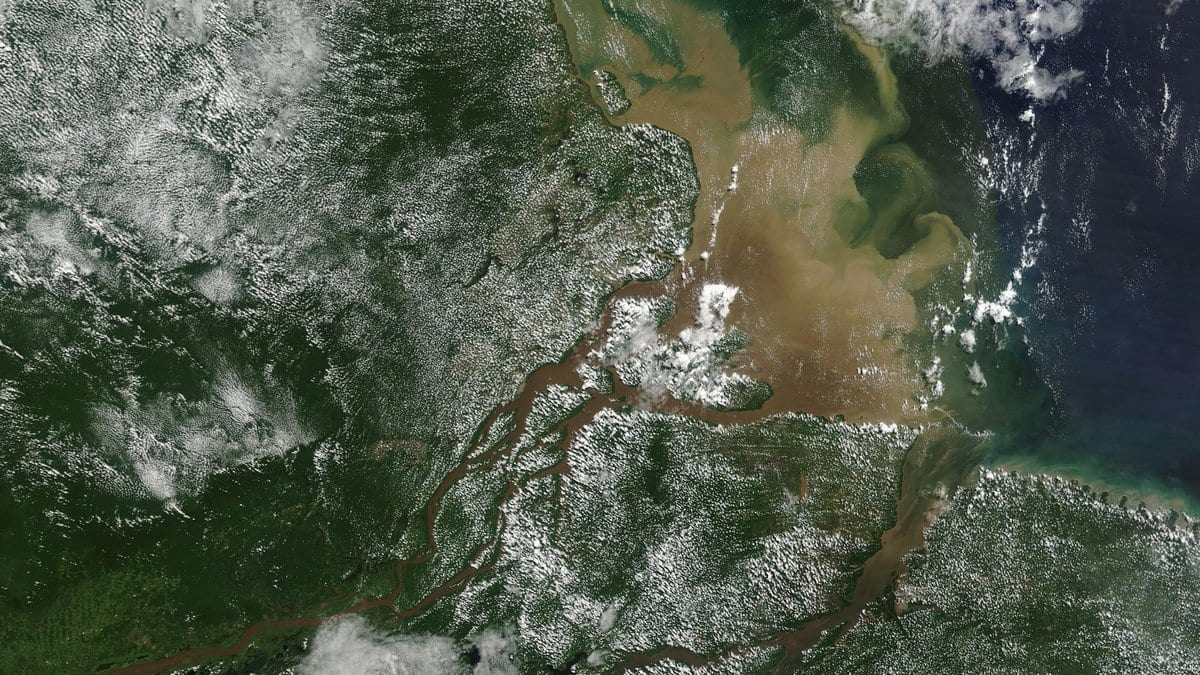
A simulation of heavy Amazon deforestation projects a stronger ocean current off northern South America, because the shrinking forest leaves the river delivering less fresh water to the Atlantic. In a scenario where about 45% of the forest is gone by 2050, the authors report the North Brazil Current and its retroflection, the bend that turns the flow back east into the open ocean, intensifying by about 14%.
The authors write that how changes in the Amazon's water cycle reach tropical ocean circulation remains poorly understood, and that their setup isolates the effect of the river's freshwater export alone.
The study was published Nov. 9, 2026, in Scientific Reports. Nelson de Almeida Gouveia of the University of Victoria and the Federal University of Pará is its first and corresponding author. Douglas F. M. Gherardi of the National Institute for Space Research in Brazil is its senior author, and five other researchers share the byline.
The team ran a large-basin hydrological model on its own to produce river outflow for a business-as-usual deforestation path projected for 2050, then fed that outflow into the Regional Ocean Modeling System for the period 1992 to 2015. The ocean years are historical and the discharge projected, so the figures are what the two models produce under that scenario, not an observed change.
In the dry season, flow drops by more than half in southern tributaries and by about 12% where the main river passes Óbidos. Surface water grows saltier and the Amazon's plume reorganizes. The upper ocean mixes more deeply, the thin fresh cap over it grows even thinner, and surface temperatures rise by up to 0.4 °C along that corridor in the northern summer and fall.
The authors conclude that sustained Amazon forest loss can drive lasting changes in the upper-ocean circulation and heat distribution of the tropical Atlantic.
The paper is open access and was funded in part by Brazil's CAPES agency and the Brazilian Space Agency. The journal says the version now online is an accepted manuscript, to be replaced by the final version of record.
Sources
- Scientific ReportsPeer-reviewed
