A Different Gas Lets Quantum Chip Films Be Made at Half the Temperature
Researchers led by a Cornell University team have grown the superconducting tantalum films used in quantum-computing chips at substrate temperatures as low as 200 degrees Celsius by switching the gas used to deposit them from argon to krypton, in a paper published Aug. 18 in Nature Materials.
The films are laid down by sputtering, a standard method in which a gas is ionized to knock atoms off a source target so they land on a silicon wafer. Getting tantalum into the body-centered-cubic form that qubit makers want has until now required heating the wafer above 400 degrees Celsius, the paper states. Substituting krypton, a heavier gas than argon, produced that phase on silicon at 200 degrees, and the paper describes the resulting process window as compatible with back-end-of-line fabrication standards, meaning the later, temperature-limited stages of an ordinary chip production line.
Heat is not a neutral cost here. The paper reports that higher deposition temperatures went with higher microwave losses, which it attributes to tantalum and silicon mixing at the interface between film and wafer.
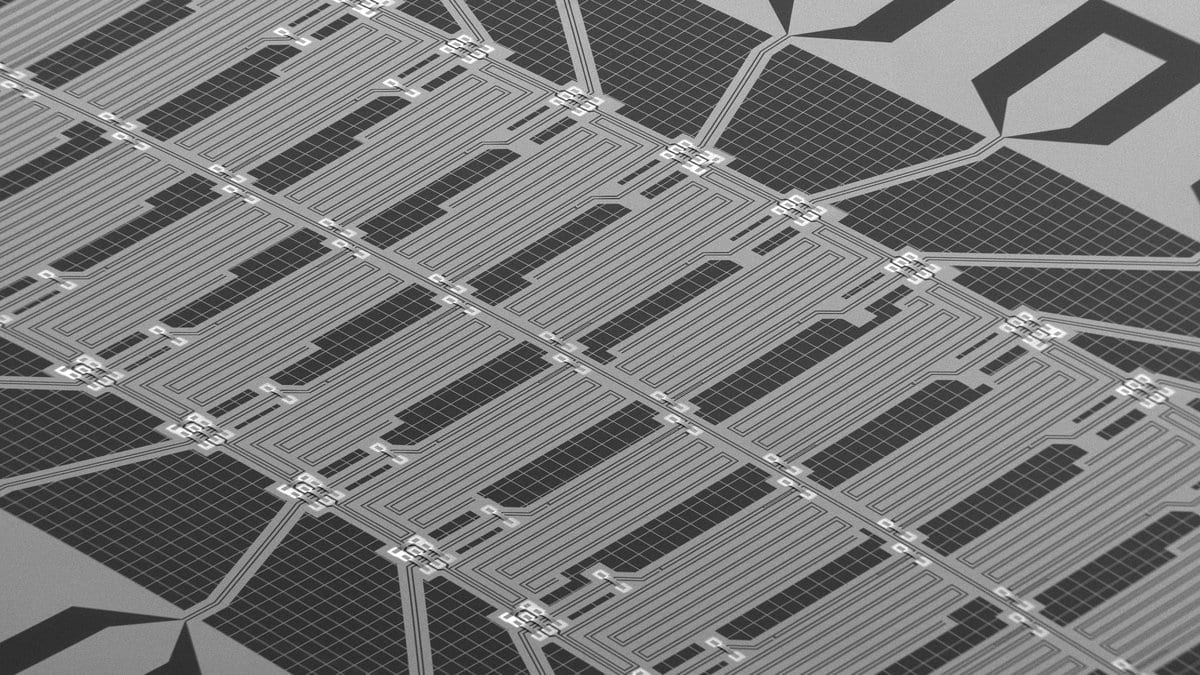
The team then built devices on the films. It reports transmon qubits, the most widely used superconducting qubit design, with quality factors up to 16.9 million and capacitor gaps of 20 micrometers, according to the paper. Quality factor measures how many oscillation cycles a resonator sustains before its energy leaks away, so a higher figure means a longer-lived qubit; the narrow gap matters because shrinking that dimension normally makes losses worse.
The paper also reports that coplanar-waveguide resonators made this way showed tightly grouped performance across devices, which is a claim about consistency between chips rather than about any single best device.
The article, "Krypton-sputtered tantalum films for scalable high-performance quantum devices," lists authors at Cornell University, the Cornell NanoScale Facility, the University of Florida and NY CREATES, with Maciej W. Olszewski as first author and David A. Muller and Valla Fatemi among the senior authors.
Sources
- www.nature.comPeer-reviewed