Ridgecrest's Crossing Faults Rarely Break Together: Paleoseismic Trenches Rewrite a Hazard Assumption

Over roughly 34 hours in July 2019, the desert northeast of the town of Ridgecrest, California, tore open twice. A magnitude 6.4 shock struck on the Fourth of July; the next evening a magnitude 7.1 mainshock followed. What caught seismologists' attention was not just the size of the pair but its geometry. The two quakes broke two nearly perpendicular faults, a "conjugate" arrangement in which the strands cross like an X and rupture almost in the same breath. That left an uncomfortable question hanging over anyone who draws California's earthquake hazard maps: was this a freak coincidence, or do these crossing faults routinely fire together?
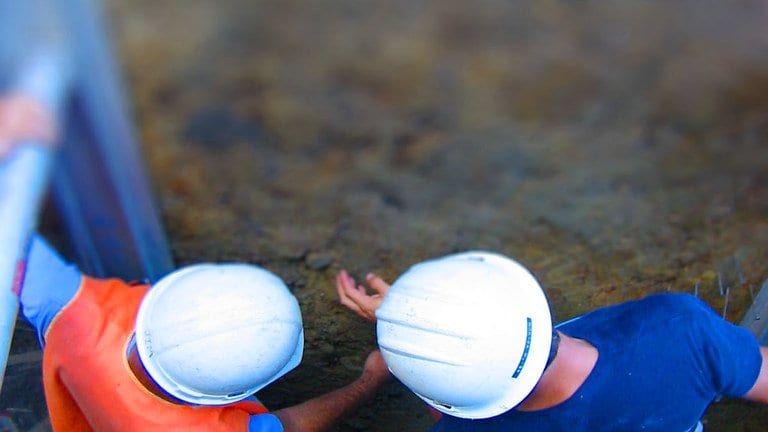
A team led by geologist Ian Pierce went looking for the answer in the dirt. Across the two fault strands they excavated five paleoseismic trenches (deep, walled slots cut perpendicular to the faults, where the layered sediments record every past earthquake as a break, a warp, or a buried scarp). Then they dated those disturbed layers using luminescence, a technique that measures how long buried mineral grains have sat in the dark since sunlight last reset them. Reading the trench walls quake by quake, the researchers reconstructed the deep past of both faults. Their conclusion, published on 10 July in the diamond-open-access journal Seismica, is that the 2019 double rupture was the exception, not the rule: the two faults almost never break in tandem.
A mismatched pair
The pairing turns out to be lopsided in a way the surface rupture alone never hinted at. The right-lateral Paxton Ranch fault, the strand that produced the magnitude 7.1 mainshock, is the busy one. The trenches preserve two clear Holocene ruptures, one between about 4,400 and 8,700 years ago and another between roughly 10,600 and 14,600 years ago, plus evidence for up to three more events reaching back into the late Pleistocene. Its slip rate, the pace at which the two sides grind past each other, works out to somewhere between 0.2 and 1.3 millimetres a year.
Its partner is far sleepier. The left-lateral Salt Wells Valley fault, which slipped in the magnitude 6.4 foreshock, shows only the 2019 rupture and a single earlier surface-breaking earthquake, one that struck somewhere between 17,000 and 27,000 years ago. Its slip rate is a crawl: on the order of 0.01 to 0.09 millimetres a year, more than ten times slower than its neighbour.
Line the two records up and the mismatch is stark. Over the same tens of thousands of years in which the Salt Wells Valley fault stirred just once, the Paxton Ranch fault ruptured again and again. Their few known earthquakes do not line up in time. As the authors put it, rupture along the Paxton Ranch fault commonly occurs independently of the Salt Wells Valley fault. The 2019 sequence, in which both let go within a day and a half, looks like a rare moment when the two happened to coincide, not a recurring joint event.
Why "conjugate" ruptures are hard to plan for
That distinction matters more than a piece of geological bookkeeping might suggest. When a magnitude 6.4 and a magnitude 7.1 strike the same patch of ground within two days, the temptation is to treat them as a single system with a single clock: a fault pair that stores strain together and releases it together on some repeatable cycle. Seismic hazard models lean heavily on exactly that kind of regularity: estimate how fast a fault loads, how big its characteristic earthquake tends to be, and how long since the last one, and you get a probability for the next.
The Ridgecrest trenches undercut that clean picture. If the two faults ran on a shared, repeatable cycle, their paleoseismic records would echo each other. Instead they diverge almost completely. The takeaway the authors draw from the trench data is that synchronous rupture across the pair is not systematic but varies among faults within an evolving network. The hazard reflects time-dependent fault-network interactions rather than tidy, single-fault cycles that repeat on schedule. A fault that has been quiet for 20,000 years is not necessarily "overdue"; it may simply be a minor player that occasionally gets swept into a larger neighbour's rupture.
This is the kind of behaviour that has dogged earthquake forecasting for years. The region sits in the Walker Lane, a broad belt of cracked and rotating crust east of the Sierra Nevada that takes up part of the motion between the Pacific and North American plates. Rather than a few master faults doing all the work, the strain there is spread across a dense mesh of shorter, interacting strands. Which of them moves, and whether it drags a crossing fault along, appears to depend on the state of the whole network at that moment, not on any one fault's private timetable.
What it changes, and what it doesn't
None of this makes Ridgecrest safer or more dangerous in a simple headline sense. The finding is subtler: it argues that the way we estimate the hazard needs to account for faults that cooperate only occasionally and unpredictably. Multi-fault ruptures like 2019 clearly happen (the ground itself proved that), but treating them as a regular, forecastable cycle would overstate how often the crossing faults conspire.
Paleoseismology reads a coarse record; a trench captures the earthquakes large enough to break the surface and leave a trace, and the luminescence ages carry real uncertainty, which is why the event windows span thousands of years rather than pinning a date. Absence of evidence for an event is not quite proof it never occurred. Still, the contrast between a fault with several Holocene ruptures and one with a single event in tens of millennia is wide enough to survive those caveats.
The broader lesson reaches past this one corner of the Mojave. As denser instrument networks and field studies reveal more conjugate and multi-fault ruptures around the world, the assumption that each fault keeps its own steady rhythm looks increasingly fragile. The Ridgecrest trenches offer a concrete case where the network, not the single fault, holds the clock, and where the next big earthquake may come from a combination the maps have not yet learned to expect.
Sources
- SeismicaPeer-reviewed
- central.scec.org