Two Afar Volcanoes May Be Plumbed Together: The Study Behind Hayli Gubbi's First Eruption in Millennia

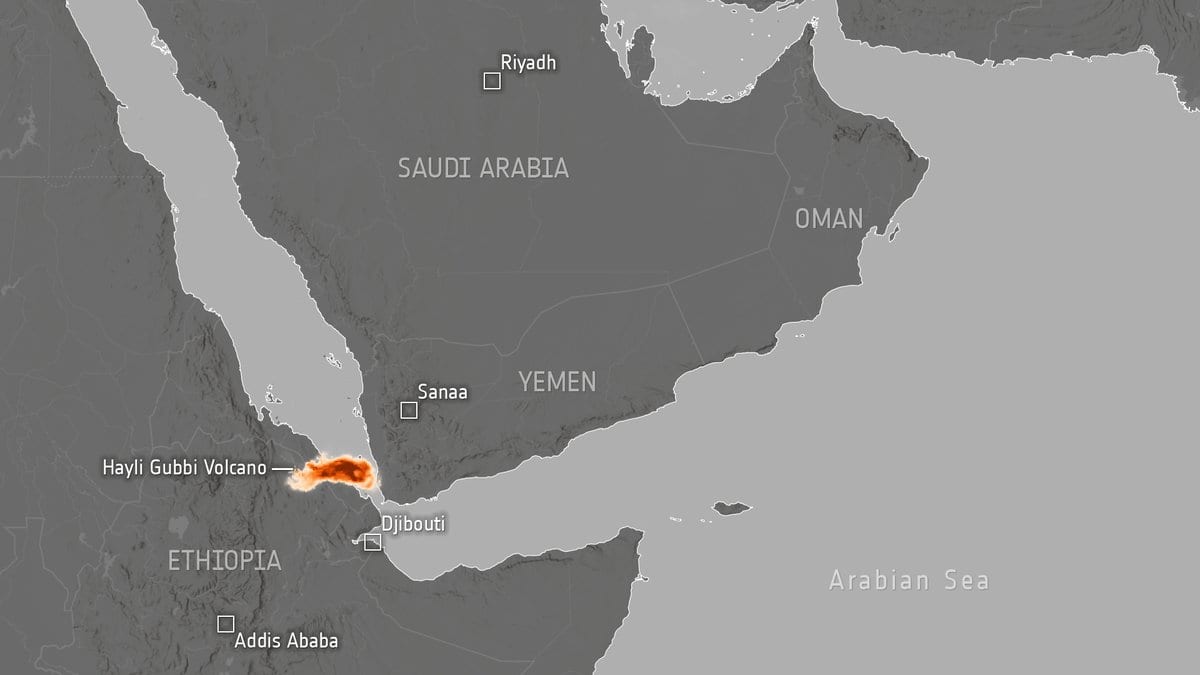
For as long as anyone had bothered to record it, Hayli Gubbi did nothing. It sat at the southern end of the Erta Ale volcanic range in the Afar depression, a low basaltic shield with no eruption in living memory and none in the geological record for what researchers estimate is on the order of ten thousand years. Then, on the morning of 23 November 2025, it came apart. An ash-and-gas column climbed to roughly 15 km above sea level, drifted northeast, and within a day was crossing northern India and China, enough of a hazard that carriers including Air India diverted around it.
A study published in the Bulletin of Volcanology (the journal of the International Association of Volcanology and Chemistry of the Earth's Interior) assembles the first full scientific account of the event, and its central finding is that Hayli Gubbi did not wake on its own.
A leak that travelled
The story the authors tell begins some four months earlier and 30-odd kilometres to the north, at Erta Ale, a famously active volcano known for its long-lived lava lake. In mid-July 2025, Erta Ale erupted, with explosions, crater collapse, and lava flows. According to the study, that eruption coincided with a dyke (a near-vertical sheet of magma forcing its way through the crust) beginning to propagate underground.
Instead of erupting straight up, the magma went sideways and south. Using satellite radar, the team tracked ground deformation over the following weeks and reconstructed a dyke that pushed from beneath Erta Ale, past and beneath Hayli Gubbi, and beyond, a subsurface path of more than 30 km. NASA's Earth Observatory, drawing on the same class of satellite measurements, independently described magma "propagat[ing] south from Erta Ale, passing beneath Hayli Gubbi and beyond," with the ground above swelling upward by several centimetres from late July.
The measurement technique at the centre of all this is interferometric synthetic aperture radar, or InSAR: by comparing radar images of the same ground taken days apart, researchers can detect swelling or sinking of a few centimetres from orbit, invaluable for a place with almost no instruments on the ground. It was InSAR that caught the Afar crust bulging as magma pushed through it, weeks before anything reached the surface.
Why the fuse burned for months
If the magma arrived under Hayli Gubbi by late summer, why did the volcano not erupt until late November? The study's answer is chemistry. The intruding magma from Erta Ale was basaltic: hot, runny, iron- and magnesium-rich. Beneath Hayli Gubbi, the authors propose, it met an older, cooler, stickier body of trachytic magma that had been sitting there. Over roughly four months the two mixed and destabilised, until the system finally breached the surface in an explosive, gas-charged blast, the kind of eruption that lofts ash to aircraft altitude rather than oozing lava.
That mixing model also explains the eruption's character. A pure basaltic system tends to erupt effusively; the involvement of the more viscous, gas-retaining trachyte helps account for why Hayli Gubbi went off with a bang rather than a trickle.
'Structurally coupled'
From the deformation pattern and the dyke geometry, the authors argue that Hayli Gubbi and Erta Ale are structurally coupled, sharing enough of a plumbing connection for activity at one to set off the other.
The blind spot the eruption exposed
Whatever becomes of the coupling argument, the authors are direct about one lesson: hardly anyone was watching. The Afar depression sits astride the East African Rift, where the African continent is slowly tearing apart and fresh crust is being made. Geologically, it is one of the busiest addresses on the planet. Yet volcanoes like Hayli Gubbi carry almost no ground-based monitoring. The advance warning that existed came from satellites overhead, not sensors on the mountain, and even that was read in full only after the fact.
An eruption large enough to disrupt air traffic across two of the world's most populous countries came from a volcano widely assumed to be extinct, in a region where the tools to see it coming were mostly orbital and mostly retrospective. The mechanism the study describes, magma migrating tens of kilometres to ignite a long-quiet neighbour, is precisely the kind of hazard that is invisible without close watching. As the East African Rift keeps pulling apart, the case for watching more of it, and more closely, is hard to argue with.
Sources
- Bulletin of VolcanologyPeer-reviewed