Most Landslide Alarms Are False. A New Model Judges Them One at a Time

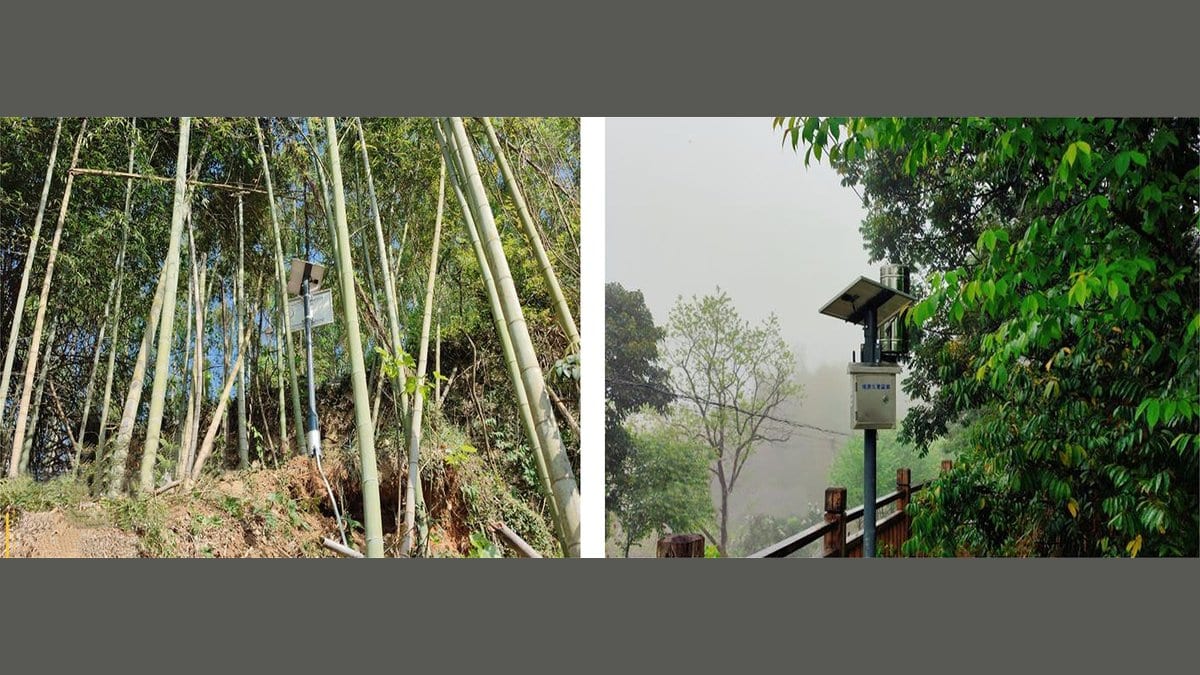
Between 2020 and 2024, the geohazard warning platform of Fujian Province, on China's wet and typhoon-battered southeastern coast, received roughly 2.05 million alarms from the slopes it watches. After expert review and site visits, just over 500 were judged real. The rest was instrument drift, a spike on a cable, or an animal knocking a sensor.
Most of those alarms come from crackmeters: small sensors bolted across the tension crack that opens at the back of a slipping hillside, reading the gap to a tenth of a millimeter, sometimes once a second. Geological experts set four levels of threshold for each sensor, site by site. Crossing one is not a forecast that the hillside will go. It is a request for a human being to look. A paper published Nov. 2, 2026, in Natural Hazards and Earth System Sciences tries to answer that request automatically. Shubing Ouyang, Daichao Li and five colleagues at Fuzhou University and partner institutions in Fujian set themselves a narrower goal than the field's usual one: not to forecast when a slope will fail, but to decide whether an alarm that has already fired is real.
The usual question has proved stubborn in the field, which is what makes the smaller one interesting. The dominant approach smooths the displacement record, predicts the next value and flags the gap between the two. But smoothing hard enough to kill the noise flattens the signal too. The smoothing needs hand-tuning sensor by sensor, and a model fitted to one slope's curve tends to do badly on the next slope's. An alarm, by contrast, is a discrete event with a label on it, and labeled events can be sorted.
The model reads two clocks at once
Their model, which they call PatchDC, takes each alarm on two timescales together. One branch reads the previous 15 days as hourly values: rain in each hour, the median crack width in each hour, and a flag marking every hour whose value had to be filled in. The other reads the last 100 raw measurements from the crackmeter itself, which at the sensors' variable sampling rate is often about the last hour and a half, unsmoothed. Inside both branches the attention is masked, so each stretch of record can only be weighed against what came before it and later movement cannot leak backward into earlier rain. From raw record to verdict takes a few seconds on the platform's hardware, and the code is public.
The training data is where the caveats live. The displacement record came from 429 crackmeters across the province, logged from 2021 to 2024. Far fewer alarms had been confirmed in the field as genuine crack opening: 82 of them, from 52 of those sensors, against 2,142 alarms never confirmed as genuine. The authors say so themselves: "It should be noted that the operational monitoring network comprised 429 crackmeters, whereas field-confirmed true-warning samples were obtained from 52 sensors," they write. Eighty-two positives will not train a deep network, so readings next to the confirmed ones were screened by eye, then by geological experts, and the genuine ones added. Every sample from a given sensor stayed on one side of the split, so no sensor the model was scored on had been seen during training.
On those held-out sensors, 90.32% of the alarms the model called genuine were genuine, and it identified 89.38% of the alarms experts had confirmed, though both figures need reading carefully. A confirmed alarm means experts judged that the rear crack had really opened. "A positive label did not require that complete slope failure subsequently occurred," the authors write: this is a recall of verified alarms, not of landslides. The recall is also measured on the expanded positive set: retrained and scored on the 82 field-confirmed cases alone, the same architecture came in 7.50 percentage points lower.
The gain is real and it is small
PatchDC is built on PatchTST, a published transformer for time series, and the headline comparison is against that same backbone with the two new components stripped out. Against it, precision rose by 0.18 percentage points and recall by 6.57. The authors report the statistics in full. Across five random seeds, only recall and the recall-weighted composite score they optimize for survived a correction for testing five metrics at once. In a stricter check across all 25 individual fold-models, none of the differences did.
It does not beat every baseline on every measure, and the exception is instructive. The crudest comparison in the paper, a rainfall intensity-duration threshold that looks at no displacement at all, caught more confirmed alarms than PatchDC by 6.56 percentage points. It did so at a precision 71.70 points lower, which operationally means burying the duty officer again. That is the shape of the result: a method that misses slightly more than a very conservative rule while being wrong about its positives far less often.
Where it fails, the authors went and looked
The most useful section may be the one where they examine their own misses. Sixteen confirmed warnings were missed in at least two of five runs, and all sixteen came from five sensors. Reading those records yielded three blind spots. Cracks that contract before they open, where the early reverse movement spoils the rising trend the model expects. Stretches of noise louder than anything the real crack has ever done. And deformation caught so early that only a few readings exist, with too little rain to corroborate them. A ranking of what the model leans on put raw displacement first, the fused rainfall-displacement feature second, and hourly rainfall third, close to the order the experts describe using.
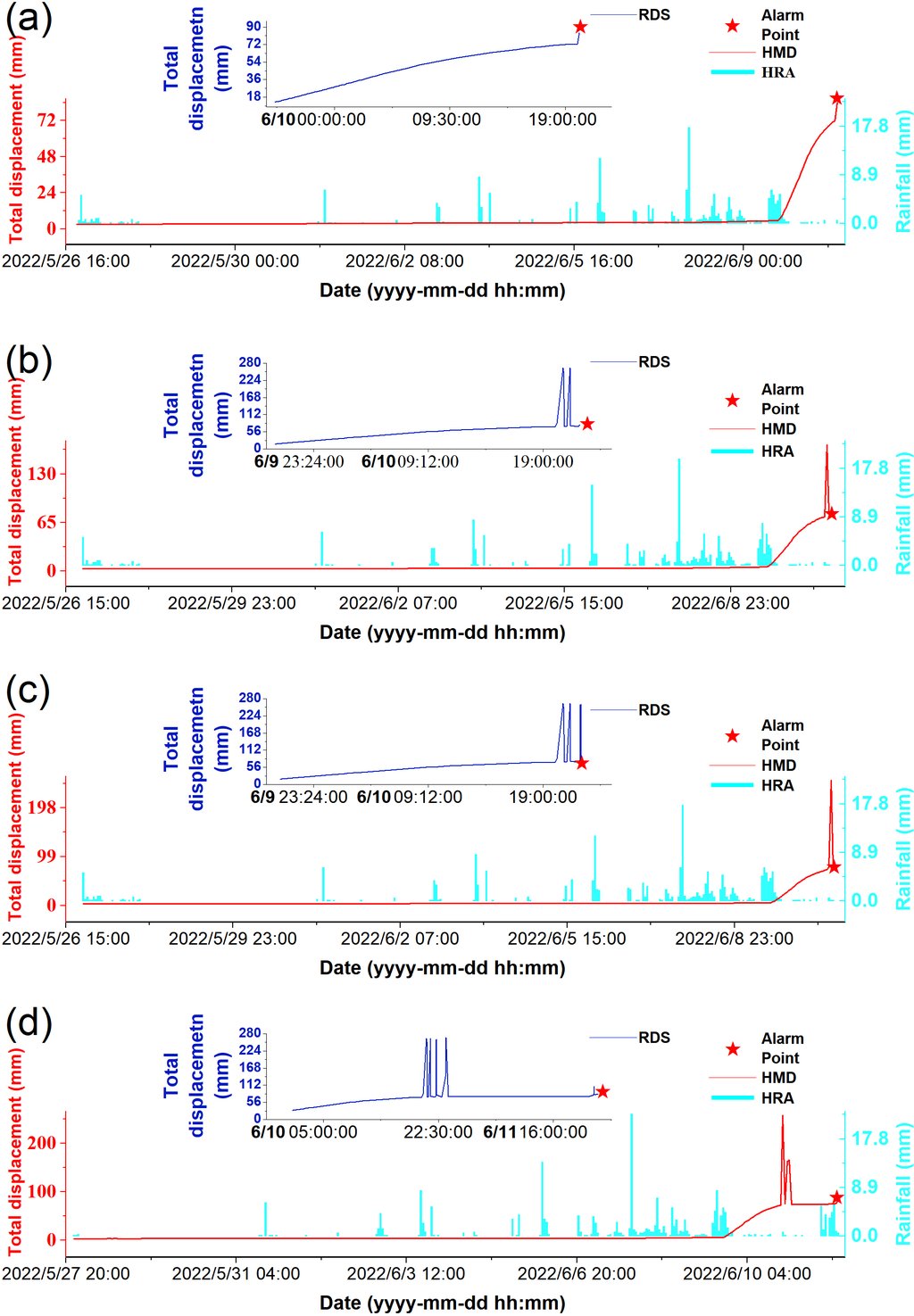
Two limits sit outside the model. One of the author institutions supplied the displacement and rainfall records and also wrote the ground-truth labels. Under that provider's confidentiality terms, the records cannot be released, so no outside group can rerun this test. The code can be downloaded and read. And the validation covers small, rainfall-triggered slopes in one province. A model trained on one province's geology is not a model that works on the next one, and the conclusions say so, listing retraining and independent validation as the price of any transfer. The changes it proposes for cutting missed warnings are addressed to the people running the platform, not to anyone living below a slope: a looser decision threshold, an ensemble that acts on a single positive vote, a forced site visit when one sensor's alarms are dismissed over and over.