Brightening Clouds to Cool the Planet Could Warm Mid-Eastern North America in Winter

The case for cooling the planet deliberately rests on a reassuring piece of arithmetic. Reflect a little more sunlight back into space, and the global average temperature comes down. The arithmetic holds. What it hides is that nobody lives in a global average, and in a new climate simulation one of the most-discussed cooling schemes leaves a large part of North America warmer in winter than it would have been had the scheme never been switched on.
The scheme is marine cloud brightening. Siyu Zhao and Long Cao, atmospheric scientists at Zhejiang University, imposed it on a simulated Earth and traced what happened next. They worked with colleagues at the Hangzhou Meteorological Bureau and China Jiliang University. Their paper was accepted on Aug. 20 and posted by npj Climate and Atmospheric Science six days later, ahead of a final version that the publisher says will replace it automatically.
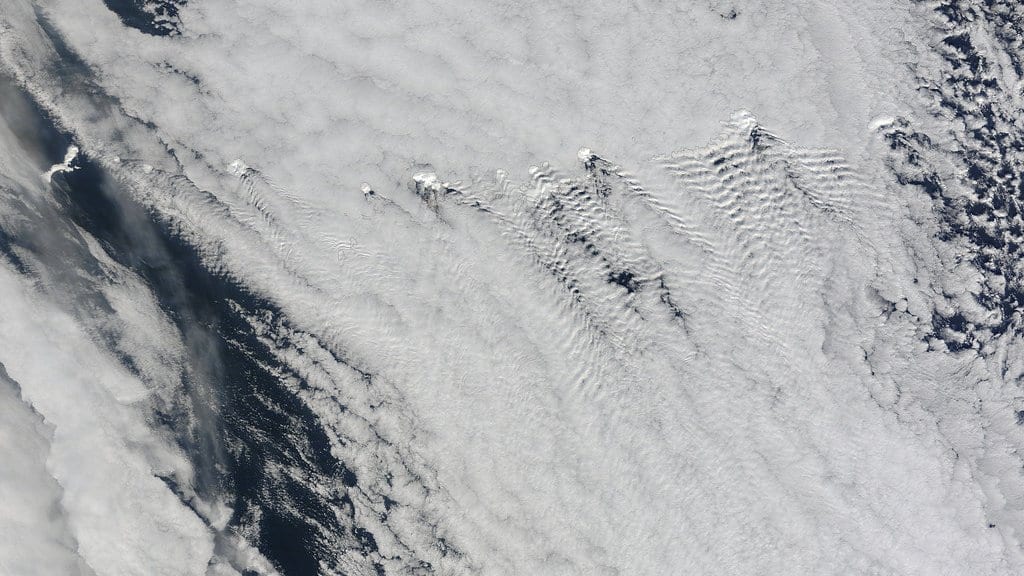
Brightening rests on a piece of cloud physics with nothing exotic in it. Cloud droplets condense onto airborne particles, and sea salt supplies them in quantity. Spray fine seawater droplets into a low cloud over the ocean and the same water spreads across more, smaller droplets, which scatter sunlight better than fewer large ones. The cloud turns whiter. It sends more sunlight back to space and lets less of it into the water below.
The clouds that make the best target sit where the ocean is cool and the air above it is stable, in wide, low decks off subtropical coasts, including the eastern Pacific. That is also, as it turns out, a part of the ocean the rest of the climate system pays close attention to.
In the Community Earth System Model, the team switched that brightening on over a portion of the tropical and subtropical oceans, under SSP2-4.5, a middle-of-the-road emissions scenario. One model, one deployment pattern, one scenario: that is worth holding on to, because what follows is a result about a hypothetical intervention rather than a measurement of anything that has happened.
Globally it worked as intended: the model planet cooled. Over mid-eastern North America, from winter into early spring, it warmed instead. The authors call that warming significant; how large it is the abstract does not say, and the size is what would decide whether this counts as a nuisance or a real cost.
The chain starts far from the continent, in the tropical and subtropical eastern Pacific. Whiter clouds there reflect sunlight that would otherwise have warmed the ocean and the air above it. Cooling that patch of atmosphere does not stay put. It changes the way the tropics push on the circulation of the middle latitudes, through the planetary-scale waves that carry a tropical disturbance poleward and eastward, the same broad-scale waves that steer where winter storms travel.
Two things then warm the continent, and neither of them happens there. The first is a quieting: the procession of passing weather systems that gives a North American winter its cloud cover is suppressed; thinner cloud lets more sunlight reach the ground; and the ground takes it up. The second is more direct: the rearranged circulation carries warmer air into the region. The spraying, meanwhile, is thousands of kilometers away, over open water.
The pattern the model settles into resembles the one that comes with a strong La Niña, the authors write. It is a resemblance, not a claim that brightening the Pacific would set off a La Niña itself. The comparison is the useful part. La Niña winters have been watched and measured many times, and their consequences for mountain snowpack, and for the water supplies that depend on that snow melting on schedule, are what the authors single out as the practical implication.
The paper carries a publisher's banner saying this accepted version will be replaced automatically by a final one, which may differ from what is posted today. What one configuration cannot settle is bigger than that: whether a differently placed or differently sized deployment would do the same thing, and whether other climate models, with other ways of representing clouds and storm tracks, would put the warming in the same place. The authors' own conclusion is the narrow one: that a cooling scheme aimed at one ocean can reach a continent it was never aimed at, and that these long-distance connections need to be understood, process by process, before anyone starts spraying.
Sources
- npj Climate and Atmospheric SciencePeer-reviewed