Why the Ice at the Bottom of a Glacier Glows Blue, Then Whitens Within Hours

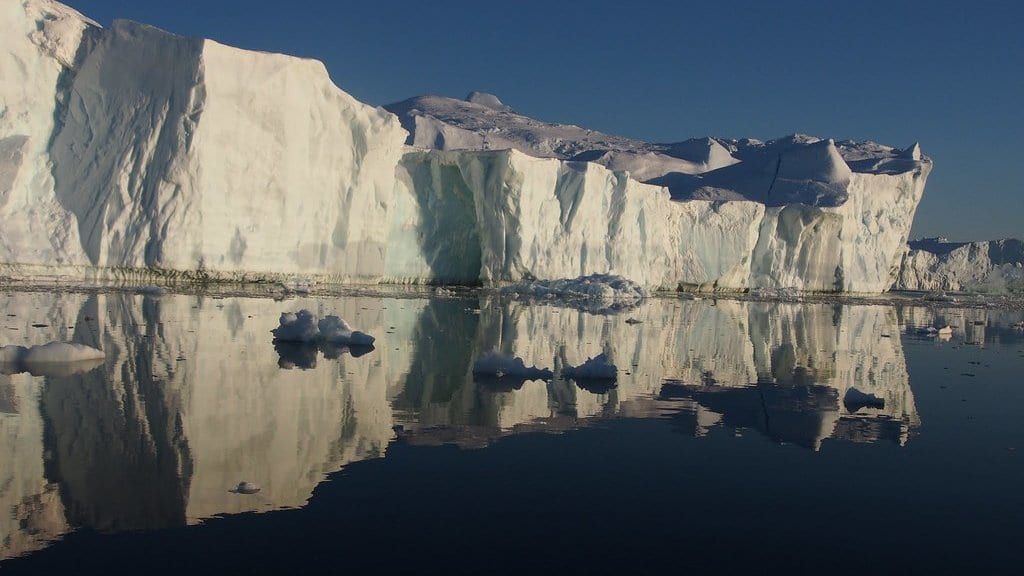
Watch a fresh iceberg roll over in Greenland's Ilulissat Icefjord and, for a while, it wears two colors. The part that rode above the waterline is the flat white of ordinary glacier ice. But the newly exposed base (the section that until moments ago was buried at the very bottom of the glacier) can glow a deep, gemlike blue. It is beautiful, and it is temporary. Over the following days the blue drains away, and the berg turns the same dull white as everything around it.
Antoine Zaninetti and his colleagues at the University of Zurich wanted to know why. In a study published on July 22, 2026, in The Cryosphere, the team turned Sermeq Kujalleq (the glacier long known in English as Jakobshavn Isbrae, and one of the fastest-moving ice streams on Earth) into a natural laboratory. Every iceberg it calves is a cross-section through the glacier, flipped up where instruments can finally reach it. The blue ice, they found, is not a thin surface skin. It forms a layer 200 to 250 meters thick, the bottom quarter of the whole ice column: ice from the glacier's deepest, most deformed base, crushed and stretched under enormous pressure before it broke free.
To pin down what makes it blue, and why the blue does not last, the researchers stacked several kinds of observation. Ground-based time-lapse cameras and theodolite triangulation tracked individual bergs and their coloring over time. A FLIR thermal-imaging camera read the temperature of the ice surface. Sentinel-2 satellite spectra added a view from above. Together these tools let the team follow single icebergs from the moment of calving through their slow fade.
That fade turned out to be swift and predictable. Roughly 60% of the whitening happened within about two days of exposure, and a berg was essentially all white within a couple of weeks. The pace tracked the sun: under strong radiation from May to August the color decayed on a timescale of less than half a day, while in September's weaker light the same change stretched out to about a day. Whatever the blue is, sunlight erases it.
Two explanations were on the table, and both are physically reasonable. The first is clathrate hydrates, cages of ice that trap gas molecules under the immense pressure deep in a glacier. Release that pressure at the surface and the cages could break down into tiny air bubbles, scattering light and turning clear blue ice cloudy white. The second is water: if the deep ice held a high fraction of liquid between its crystals, it would be temperate ice, sitting right at its melting point, and that interstitial water could account for both the color and its loss. The temperate reading is the more consequential one, because it would say something about how warm the deepest parts of a fast Greenland glacier actually are.
Here the study runs into its own most interesting result. The thermal camera should have found the blue ice warm if it were temperate. Instead it found the opposite: the blue ice read a few degrees colder than the surrounding white ice, a difference of about 3 to 4 °C on the smaller bergs. That undercuts the temperate-water idea, at least as a clean explanation, and it does not obviously confirm the clathrate story either. The authors are careful about it. Thermal readings on ice can be thrown off by how the surface emits infrared, so the cold signal might be partly a measurement artifact. They do not claim to have solved it.
The team cannot confirm that the blue ice is temperate, and neither hypothesis fully fits the observations. The case is left open on purpose, which is the honest place to leave it.
That open ending is much of the point. The deepest quarter of a polar ice stream is one of the least observable places on the planet: you cannot easily drill to it, and it rarely comes to you. Calving turns that hidden layer inside out for a few days, and this study is a first careful reading of it. The blue is gone within days. Whether the deepest ice is temperate or cold is still unsettled.
Sources
- The CryospherePeer-reviewed