One Glacier, Two Fates: A Natural Experiment in South Greenland

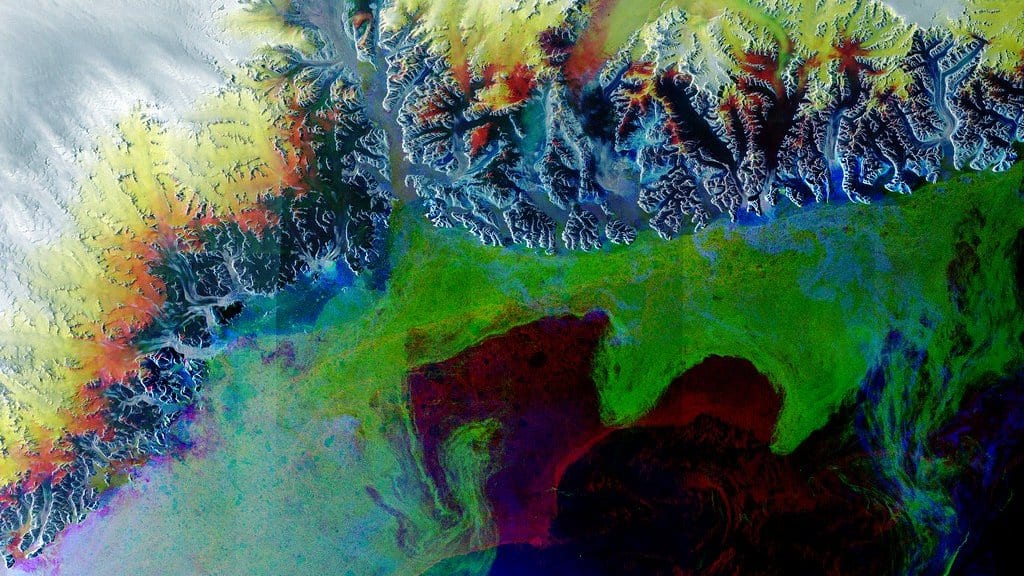
Rarely does nature set up its own controlled experiment. At Qooqqup Sermia, in the fjord country south of Narsarsuaq, it has done exactly that. A single stream of ice flows down from the interior and then forks. One arm slides into a saltwater fjord; the other pushes into Lake Motzfeldt, a freshwater basin some 15 kilometres long and, in places, 368 metres deep. Same ice, same snowfall, same warming air overhead. Only the water at the front is different.
That fork is what drew Florian Vacek and colleagues at Utrecht University, working with a co-author at the University of St Andrews. Because the two branches share everything upstream, any difference at the two mouths has to come from what the ice meets when it reaches the water. It is about as clean a comparison as glaciology gets in the real world, a way to isolate the terminus itself from the tangle of climate and topography that usually muddies such studies. Their analysis appears in The Cryosphere, published on 13 July 2026 and peer-reviewed.
The two mouths turned out to keep completely different habits. The marine terminus flows fast, stays grounded on the seabed and calves often, shedding modest chunks of ice in a rhythm that swings with the seasons. The lake terminus does the opposite. It floats out over the water in a thin extension, ignores the calendar almost entirely, and then, rarely, lets go of something enormous, launching flat, tabular icebergs of the kind more often associated with Antarctica.
Why the split personalities? The answer is largely in the water's chemistry. Salt lowers the freezing point of seawater, so a fjord can hold heat that a freshwater lake cannot. The researchers measured what they call thermal driving (how far the water sits above its own freezing point), and found it three to four times higher in the ocean than in the lake: 2.4 °C against 0.7 °C. That gap translates directly into melt. Underwater, or subaqueous, melting at the lake front was, in their words, extremely low. The cold, near-freezing water of Lake Motzfeldt simply cannot eat away at the submerged ice the way a fjord does.
Here is where the story turns, though, and where any comfortable conclusion falls apart. Low melt did not mean a safe, stable glacier. Between 2012 and 2013 the lake terminus underwent what the authors describe as a massive disintegration of more than 3 kilometres of ice, the front retreating roughly 3.2 kilometres in a single year. Gentle underwater melt over the preceding years had quietly thinned the floating tongue and loosened the points where it stayed anchored, until the whole structure gave way at once. A lake terminus, in other words, can lose ice slowly for years and then very suddenly not at all.
Reconstructing that history took a deep stack of evidence. The team traced hundreds of past front positions from satellite and aerial imagery reaching back to the 1950s (389 at the marine mouth, 308 at the lake), and stacked digital elevation models from 1987, 2012 and 2023 to watch the ice thin. Satellite-derived velocities showed how fast the two branches moved; runoff came from the regional RACMO climate model. Then, in two field campaigns, they went to the water itself, running an echo-sounder to map the lake bed and lowering sensors to profile temperature at depth. The lake averaged well under a degree above freezing from top to bottom.
The takeaway is aimed squarely at the models used to project Greenland's future. Lakes now fringe about a tenth of the ice sheet's margin, and that share is expected to grow as the ice retreats onto land. If a model applies fjord-style melt physics to a lake terminus, it will over-count the steady underwater loss while missing the rare, violent collapses that actually dominate the lake's behaviour. Vacek and colleagues conclude that lake- and marine-terminating glaciers need separate treatment for frontal ablation. The water at the front makes the difference, and today's ice-sheet models often do not account for it.
Sources
- The CryospherePeer-reviewed