Wood Could Store More Carbon in the World's New Buildings Than Biochar Concrete

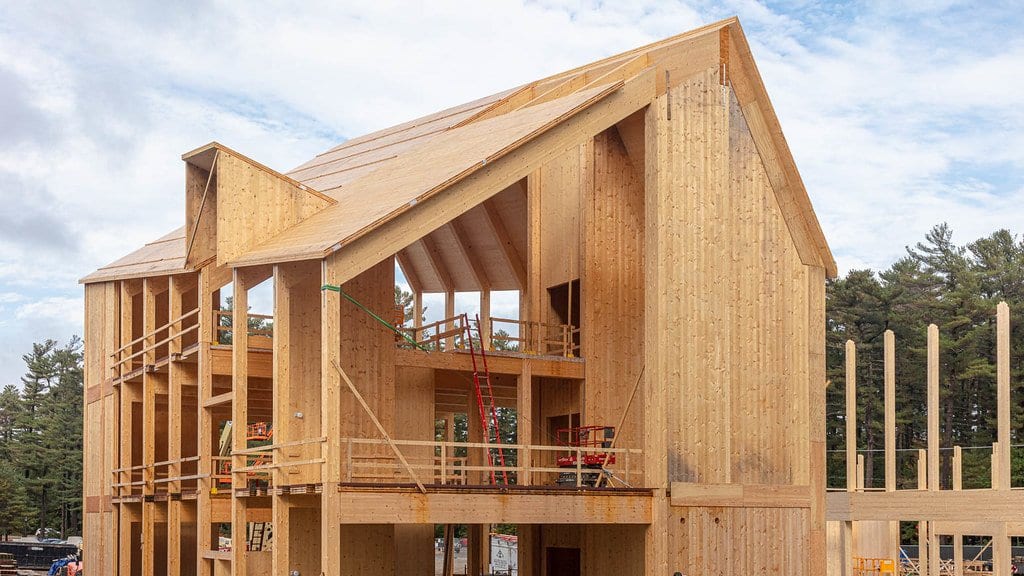
A concrete frame is a debt in climate accounting. The cement in it released carbon dioxide on the way to becoming cement, and nothing the finished wall does afterward pays that back. A timber frame is stranger. The carbon in it came out of the air through a tree, and it stays in the beam for as long as the beam stays in the building. Whether that quirk of bookkeeping amounts to much at the scale of a century of city-building has been argued over for years.
A team led by Alessio Mastrucci and Bas van Ruijven at the International Institute for Applied Systems Analysis, with colleagues at Graz University of Technology, Tsinghua's Shenzhen Graduate School and the Potsdam Institute for Climate Impact Research, has now put a set of numbers to it. Writing in Environmental Research Letters, published on Aug. 27, 2026, they model the world's urban building stock from 2020 to 2100 and change what it is made of. In one family of scenarios, structural wood takes the place of conventional construction systems. In another, concrete made with biochar does. Each family runs at substitution levels of 10%, 30% and 50% across the stock. Biogenic carbon flows into and out of that stock as buildings go up and come down, and the emissions embodied in the materials are counted alongside. These are scenarios rather than forecasts, and are framed accordingly.
In the wood scenarios, the model puts cumulative net carbon storage at 11.0 to 24.8 billion metric tons of CO2 equivalent by 2100, carbon that sits inside standing buildings instead of in the atmosphere. Those same scenarios would cut the emissions embodied in construction by 8% to 40%, measured against current construction practices, which is the study's baseline throughout. The two results are not additive. The reduction comes from lower embodied emissions and from the stored carbon together, so the storage sits inside the emissions cut rather than on top of it.
Biochar-based concrete does less of both. In the same scenario grid, the model gives it cumulative net storage of 7.9 to 14.5 billion metric tons and an embodied-emissions reduction of about 4%. The researchers characterize this performance as "more limited," a consequence of the material's physical properties rather than a lack of ambition. Biochar goes into concrete as a partial replacement for cement, and only so much cement can be swapped out before the concrete stops carrying what it is asked to carry. This is a direct result of the feasible cement substitution rates required to maintain structural performance.
The word substitution is doing two jobs in this study, and they are worth keeping apart. The substitution levels above describe how much of the building stock switches to a different construction system. They are not the share of cement replaced by biochar. That is a separate limit, set by what the concrete can still carry afterward, and a far tighter one.
The largest reductions in the study do not come from materials alone. Combining the substitution scenarios with sufficiency and circular-economy strategies, which reduce floor-space demand and material flows, delivers the greatest mitigation potential: cumulative net embodied emissions lower by up to 64% for wood and 41% for biochar.
Two feasibility conditions sit beside that result, and they fall differently on the two materials. Reaching the full carbon-storage potential without those complementary strategies would require a substantial expansion of biochar supply, well past what exists now. For wood, feasibility depends strongly on the level of material substitution achieved, which is a statement about how much of the world's construction sector actually changes, not about how much carbon a beam can hold.
What sort of result this is matters as much as its size. Every figure here is the output of a model of the world at the end of this century, with no observation available to check it against, and it comes from one study rather than from several groups converging on the same place. The work is peer-reviewed and open access, and it went online as an accepted manuscript, so the numbers can still move a little before the final version of record appears.
None of that makes the comparison less useful. Buildings permitted and poured this decade will still be standing at the end of the century, and the study's value lies less in that endpoint than in the ordering it gives to the choices available before it. The material matters. The cement chemistry caps one of the two options. And the deepest cuts in the study arrive only when the amount of building comes down alongside.
Sources
- doi.orgPeer-reviewed