Fire and Fertilizer Push Alaskan Tundra the Same Way, at Different Speeds

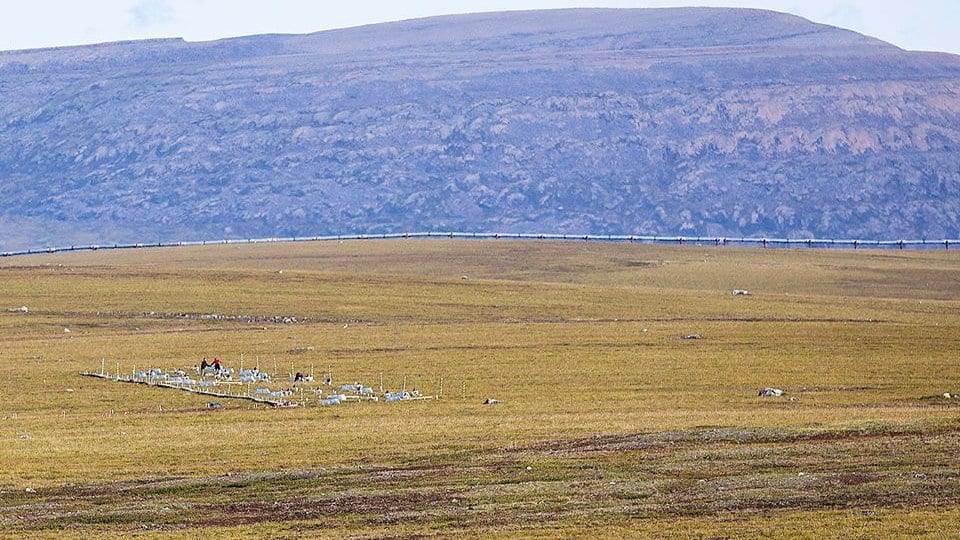
Tussock tundra looks, from the air, like a lumpy green carpet. Up close it is something more particular: a dense mat of mosses and lichens with sedge tussocks rising out of it, a community that changes slowly and by small increments. Two forces are now rearranging it faster than that. Fire is reaching the Arctic more often as the climate warms, and warming soils release more nitrogen and phosphorus as the old organic matter in them thaws and decomposes. Ecologists have watched each pressure green the tundra on its own. What nobody could say with confidence is whether the two push the vegetation toward the same kind of community, or toward different ones, and at what speed.
A paper published on July 31 in the peer-reviewed journal Arctic Science was built to answer exactly that. Adrian V. Rocha of the University of Notre Dame and nine colleagues, among them Gaius Shaver and Edward Rastetter of the Marine Biological Laboratory in Woods Hole, ran a 10-year, two-factor nitrogen and phosphorus fertilization experiment in treeless moist acidic tussock tundra in Alaska: nitrogen alone, phosphorus alone, and the two together, on ground that had burned and on ground that had not. The National Science Foundation's Division of Environmental Biology paid for it.
One decision in the design does most of the analytical work. At the burned site, fertilization did not start until the canopy had closed again after the fire. That timing lets the authors treat the fire as a legacy, its mark left roughly a decade before the fertilizer began going down, and ask what the added nutrients did on top of it rather than alongside it.
The direction of change was the same for both. "Fire and NP+ drove similar directional shifts in vegetation composition, characterized by declines in mosses and lichens and increases in forbs and deciduous shrubs," the authors write. Fire and heavy nutrient loading, in other words, took the same things out of the community and put the same things in. The mat of moss and lichen thinned; leafy herbs and woody deciduous shrubs, the growth behind the Arctic's shrubification story, filled in.
Where they differed was in pace and persistence, and the paper's title says so up front: "Shared and divergent rates and trajectories." Fire accelerated the reorganization; sustained nitrogen and phosphorus produced what the authors call persistent movement toward novel community states, on burned and unburned ground alike. Same heading, different speeds and different distances covered. That is a more careful claim than it looks. Nothing in the paper says the two treatments end up in the same place.
A "novel community state" is the authors' own phrase, and it carries less than it might seem to. It means the mix of species in the fertilized plots moved away from anything those plots had held before, and kept moving rather than settling back. The study does not describe that state as permanent, and it makes no claim about whether the vegetation could return if the nutrients stopped.
Then comes the finding that gives the paper its practical value. "Limited fire × fertilization interactions suggest largely additive effects," the authors write, and the hedge is theirs. Additive means the two pressures do not multiply one another. Burned ground that also got nutrients moved further than either burned ground or fertilized ground on its own, roughly as far as the two effects would go if you laid them end to end. The paper reports limited interaction between the two, which is to say little evidence that fire primed the vegetation to respond more strongly to nutrients, or the reverse.
The nutrient side of the experiment turned on a familiar Arctic constraint. Nitrogen and phosphorus co-limitation, the authors report, strongly regulated how the vegetation responded, and the plots that got both nutrients showed the largest increases in canopy leaf area, surface greenness and compositional change. While this combined treatment produced the most significant shifts, it was not the only one to show an effect. Co-limitation is the ordinary condition of moist tussock tundra, where adding one scarce element tends to run the plants up against the next one.
Alongside the compositional shifts, the paper reports reduced community resistance, greater divergence from the unfertilized control plots and higher leaf area index and surface greenness. The control plots are the yardstick throughout: divergence here means distance from untreated tundra, not distance between the treatments. Decades of nutrient-addition work in Alaskan tundra point the same way. Long-term nitrogen and phosphorus amendments have repeatedly cost mosses and lichens ground while shrubs and herbs gain.
What is new here is not that fire makes tundra shrubbier. Two 2024 papers in Nature Plants had already established that direction, one of them titled "Wildfires accelerate shrubification in the Alaskan Arctic tundra." The contribution of the Arctic Science paper is the head-to-head: running fire and nutrient enrichment against each other in the same experiment, over 10 years, and finding that they push the same way and mostly just add up.
This is one experiment, at one site, in one vegetation type. Moist acidic tussock tundra is widespread in northern Alaska, but it is not the Arctic; nothing here licenses a claim about the tundra as a whole, and the authors do not make one. The fire in question is a single burn whose legacy the plots still carried a decade later.
Why the additivity matters is a modeling question with a physical answer behind it. Mosses and lichens insulate the soil and keep permafrost cold; deciduous shrubs shade the ground in summer, trap snow in winter and darken the surface, and the balance of those effects helps set how much of the carbon stored in tundra soils stays there. Models that project the Arctic's carbon have to combine disturbances that arrive together, and they need to know whether to sum the effects or compound them. For 10 years on one patch of Alaskan tussock tundra, the answer was closer to summing. Rocha and colleagues put a hedge on it, and it will take other sites to say whether it travels.
Sources
- Arctic SciencePeer-reviewed
- doi.org
- doi.org