Same Soil, Same Plastic, Higher Risk: What Fragmentation Does to a Safety Threshold

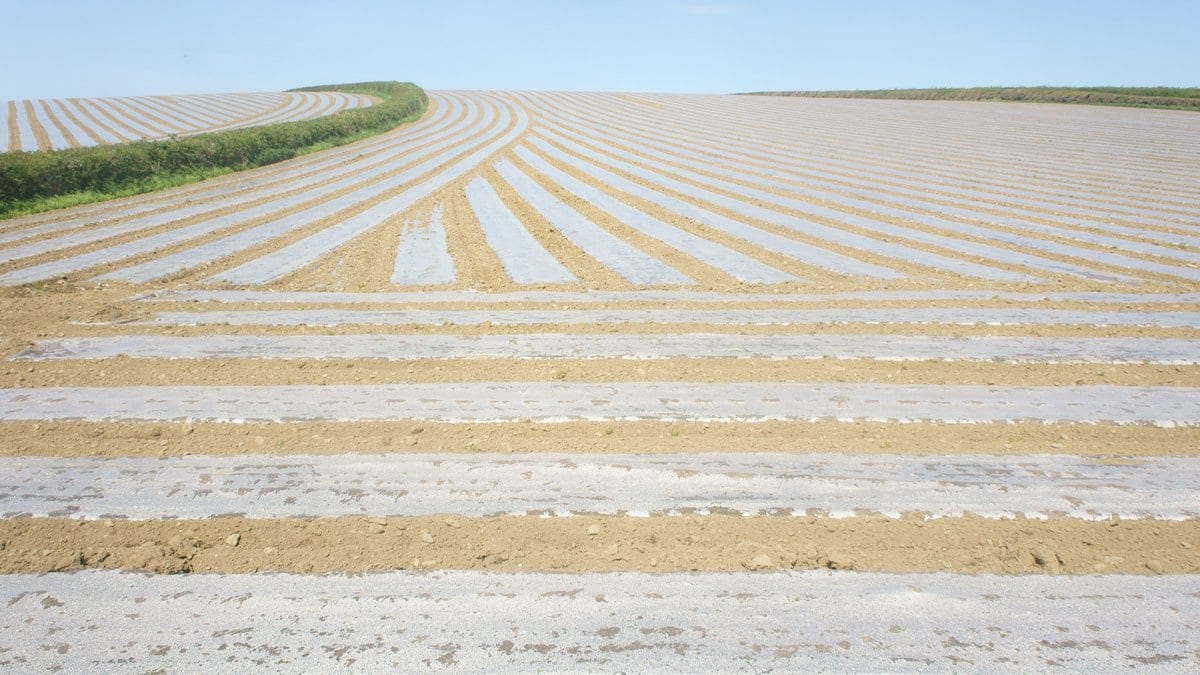
Imagine a field that has been tested. Someone takes soil cores, measures the microplastic in them, compares the result against the concentration at which harm is expected, and finds the field is comfortably under. Now leave that field alone for 20 years. Add no plastic, spread no more film, apply no more fertilizer. Test it again with the same method against the same rulebook, and it can fail. Nothing arrived. What changed is the shape of what was already there.
That scenario is the argument of a paper published on July 4, 2026, in the open-access journal Microplastics and Nanoplastics by Nguyen Thuy-Dung, Jan E. Groenenberg and Albert A. Koelmans of Wageningen University and Research. Existing ecological risk assessments for microplastics, they write, work from steady-state concentrations and are therefore inherently retrospective: they describe a soil as it is, on the assumption that what is in it will stay as it is. The authors present their framework as the first prospective, temporally explicit one for fragmenting microplastics, meaning it models the breaking-up as it happens and asks what the risk looks like at each point along the way. The paper is peer-reviewed, and it is, in the end, a model: no future soil was measured.
The mechanism is easier to see than the machinery. Take a single cube-shaped fragment and break it into eight equal pieces. The mass has not changed, the particle count is eight times higher, and the total surface area has doubled. Each piece is now small enough to be swallowed by something that could not have swallowed the original. For soil animals, the paper models harm as food dilution: an earthworm or a springtail that fills its gut with plastic is not filling it with food. For plants, the modeled mechanism is physical blocking, particles obstructing the root surface. Both thresholds depend on particle volume. So as the volume of the average particle falls, the concentration at which harm begins falls with it.
That threshold has a name and a procedure behind it. Species sensitivity distributions are how ecotoxicologists turn a scatter of results from different organisms into a single regulatory number: you plot the concentrations at which each tested species starts to suffer, fit a curve through them, and read off the concentration that would affect the most sensitive 5 percent. The result is the HC5, the hazardous concentration for 5 percent of species, and it is what a measured soil concentration gets compared against. Divide the one by the other and you have a risk characterization ratio: below one, acceptable; above one, not. The framework in this paper builds species sensitivity distributions for soil fauna and for plants separately, with effect thresholds that depend on particle volume, and then lets the volume change.
For a test case they chose polymer-coated fertilizer, and the choice is a good one. These are fertilizer granules wrapped in a thin plastic shell that meters the release of nutrients over a season, a product farmers buy precisely because it is engineered to break down slowly. The nutrients leave. The shell stays in the field, and it is deliberately applied, on a schedule, in known amounts, which makes it the rare microplastic source whose input history is not guesswork. The team's fragmentation model reproduced measured coated-fertilizer concentrations well over the seven-year measurement period of a 10-year field experiment. That is the paper's one anchor in measured ground, and it is a specific kind of anchor: agreement between a model and an existing set of field measurements, over part of that trial's length.
Run forward, the framework produces not a forecast but a family of them. Under scenarios for single and repeated applications, the modeled food-dilution risk to animals and physical-blocking risk to plants both increase over 30 years, and the size of that increase depends on two things: how often the fertilizer is reapplied, and how fast the coating fragments. Change either and the curve changes. The general statement the authors make is deliberately weaker than the case result: as particle volume decreases with fragmentation, HC5 values and risk characterization ratios vary over time. Vary, not rise. Rising is what happened in this scenario, for this product, under these assumptions. A subtler consequence follows: two soils with identical HC5 values can carry different risk ratios, depending on how their exposure arrived. The number on the page stops being sufficient on its own. You need its history.
How much weight the result can carry depends almost entirely on the toxicity data underneath it, and that data is thin. Species sensitivity distributions for soil organisms and microplastics are assembled from a small, heterogeneous body of experiments using different polymers, shapes, sizes and species, and an HC5 drawn from a sparse distribution is a point estimate sitting on top of a great deal of uncertainty. The abstract reports no confidence intervals for the HC5 values. The volume-dependence of the effect thresholds, the assumption that hazard scales with how much room a particle takes up, is standard and defensible. It is still an assumption, and the whole time-dependence result flows from it. The authors run the assessment probabilistically so that uncertainty in the fragmentation modeling and in the data alignment is carried through to the answer, which is the right instinct and not a substitute for data that does not exist. The group that wrote this paper also built much of the risk-assessment method it extends, so the framework has not yet been put through its paces by anyone else.
What the authors say comes next is mulch film and sewage biosolids. They have not done it here; the framework is described as modular and transferable, which is a statement of design intent rather than a demonstrated result. The paper's own closing claim is regulatory: the framework, the authors write, has high potential to support regulatory evaluations of fragmenting microplastic scenarios in soil systems. That is the ambition. Reaching it needs the toxicity experiments the species sensitivity distributions are currently short of, which is slower and less glamorous work than modeling, and is the part that would decide whether any of these curves are the right shape.
Sources
- Microplastics and NanoplasticsPeer-reviewed