Arctic Sea Ice Holds Nanoplastics and Releases Back While It Is Still Freezing

Pull a litre of seawater from beneath the ice north of Svalbard and hold it up to the light. It looks like the cleanest water anywhere on the planet, and by most measures it is. What it also carries, at concentrations a laboratory has to work to see at all, is plastic ground so fine that a few hundred billions of a gram will vanish into the sample without leaving a trace of cloudiness.
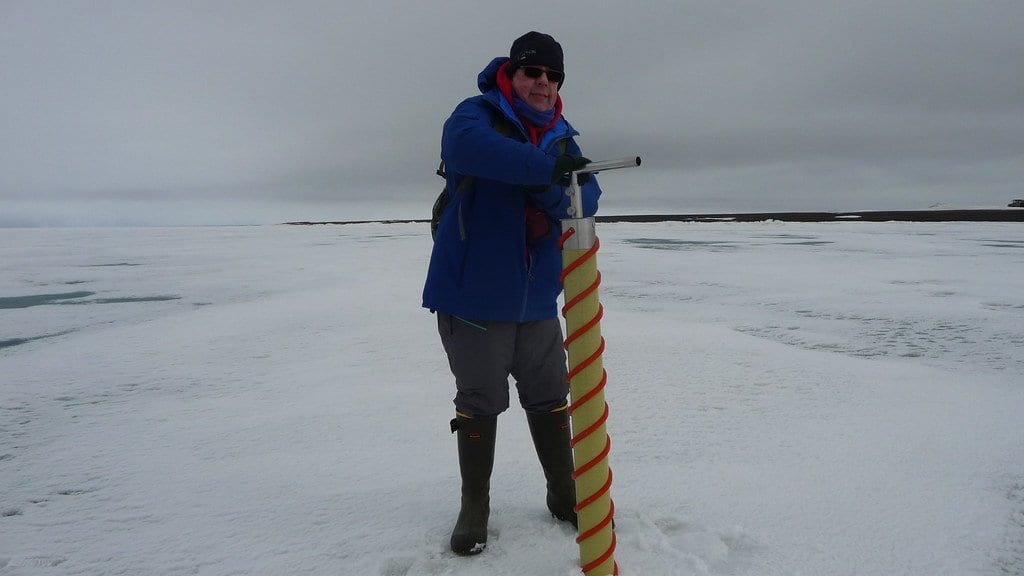
Six researchers at the Takuvik laboratory in Quebec City, a joint unit of France's CNRS and Université Laval, went looking for it. Across two Arctic expeditions, in 2022 and 2023, Huiwen Cai and colleagues sampled 24 locations from the Svalbard region to the central Arctic Ocean, and they did not sample only the water. They scraped snow from the ice surface, cored the ice itself and drew seawater from beneath it, then ran every sample through pyrolysis gas chromatography-mass spectrometry, a method that heats a sample to 600 degrees Celsius and identifies polymers by the chemical fingerprint of what boils off. The work appeared in January in Emerging Contaminants.
Polystyrene and polypropylene, summed, ran from 10 to 900 nanograms per liter across the sampled matrices. Polyethylene was there too, but the paper is careful about it in a way its headline sentence is not: quantification was performed for polystyrene and polypropylene only, because the method for measuring polyethylene at the nanometer scale is still being developed. Polyethylene was identified, not counted.
The distribution is where the study earns its interest. Seawater collected in 2022 ran from 14.2 to 301.6 nanograms per liter, averaging 150.0; the 2023 samples ran higher, from 125.3 to 758.1, averaging 255.1. Snow reached 432.3 nanograms per liter. The top sections of ice cores reached 986.3. In other words, the plastic was densest at the top of the column, in the snow and in the ice nearest the sky, and thinner in the water below.
A vertical gradient like that points upward for its explanation. The authors write that atmospheric transport likely plays a more prominent role than ocean circulation in shaping nanoplastics distributions in the open Arctic Ocean. They are careful not to make it the only route. Coastal sites, they note, may be more influenced by local human activity, while remote regions are likely affected both by atmospheric transport and by inputs carried in on the Transpolar Drift, the current that ferries ice and water from the Siberian shelves across the pole toward Fram Strait. How much each source contributes, the abstract says plainly, remains uncertain and may vary from place to place. Nobody measured a deposition flux here.
The ice is not a lid
Sea ice has an unusual relationship with anything suspended in the water it forms from. As seawater freezes, the growing crystal lattice rejects salt, and the rejected salt collects in a dense, briny liquid that drains back out of the ice. Particles go with it. Most of the nanoplastics, the paper says, are expelled with brine during ice formation, and the rest end up trapped in brine pockets inside the ice.
That makes the ice a strange kind of container, one that is filling and emptying at once. The authors describe enhanced ice formation as something that may increase the release of nanoplastics into seawater, because newly forming ice can concentrate particles that were deposited from the atmosphere and then release them again through brine rejection. Their summary sentence is that sea ice acts as a temporary reservoir and a secondary source of nanoplastics through redistribution across the snow, ice and seawater interface. Elsewhere they put it as a transient reservoir that both stores and releases, a secondary source and a temporary sink at the same time.
A tidier story is available here, and it is not the one the paper tells. In that version, ice locks plastic away through the winter and hands it back when it melts, so a warming Arctic flushes a stored load into the sea. The paper does not report that sequence. The one pathway it describes in detail runs the other way, releasing particles into the water as the ice forms and its brine drains. No flux of any kind was measured, so there is no tonnage, no annual rate and nothing to put a number on. The verbs are the authors' own hedges: likely functions, may increase. The title says potential transport.
What the study cannot close
The most important limitation is one the authors state themselves. Field blanks were not collected during sampling, because of logistical limitations and restricted personnel availability, and they acknowledge that minor contamination during field collection cannot be entirely excluded. That matters more here than it would almost anywhere else. Procedural blanks, which the team did run, are containers of ultrapure water carried through the same laboratory steps as the samples; theirs came back with no polystyrene, polypropylene or polyethylene at all, which is a genuinely good result. But a procedural blank tests the laboratory. A field blank tests the ship, the deck, the corer, the ropes, the clothing and the air, all of which are made of, or shed, exactly the polymers being measured. At concentrations of tens to hundreds of nanograms per liter, that is the control a skeptical reader wants, and it is missing.
Three smaller things belong with it. The study's claim to be first is about design, not discovery: it is the first multi-matrix, multi-site, multi-year assessment of nanoplastics in the Arctic Ocean, and nanoplastics were reported in Arctic snow and ice as early as 2022 by a separate group. Multi-year means two expeditions, one year apart, whose seawater averages differ by a factor of about 1.7 with no way offered to separate real year-to-year variation from method variation. Emerging Contaminants is a new journal, still inside its first volume, properly published by Springer Nature but without a track record to weigh. The article also carries an author correction, issued in February, which fixes a single typo in the introduction: global plastic waste entering aquatic ecosystems is 19 million to 23 million tons a year, not the 19 million to 230 million printed originally.
What survives all of that is still worth carrying around. The Arctic Ocean has nanoplastics in its water, its snow and its ice, from Svalbard to the pole; most of them appear to arrive from the sky rather than on the current; and the ice they land on is not a lid over the ocean but a layer that takes particles in and gives them up on its own schedule, while it is still freezing. Cai and colleagues have given the field its first multi-matrix baseline to argue with. The next team that goes north with a set of field blanks will be able to say how much of it holds.
Sources
- npj Emerging ContaminantsPeer-reviewed