Guided Sampling, Not Brute Force: How HelixFold-S1 Rethinks Structure Prediction

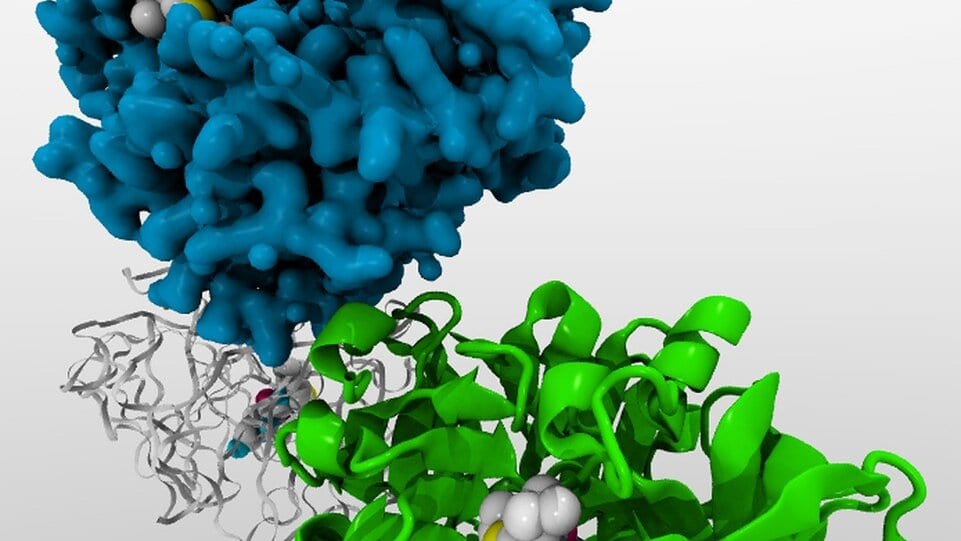
Ask a structure-prediction model to work out how two molecules fit together, and much of what happens next is closer to guesswork than most people assume. The model generates a crowd of candidate arrangements (conformations) and sifts them for the one that best matches physical reality. The trouble is that the crowd is wasteful. Many of the candidates are near-copies of one another, clustered in regions the model already understands, while the genuinely informative arrangements go under-sampled. You end up spending compute to rediscover the obvious.
HelixFold-S1, described in a paper published on July 2 in Nature Machine Intelligence, tries to replace that scattershot search with a plan. The idea, as the authors frame it, is to predict where two chains are likely to touch before committing to a full three-dimensional guess, then treat those predicted contact points as a blueprint of the conformational space. Sampling is concentrated on the arrangements consistent with that blueprint. In the team's description, the model builds a contact prediction and then conditions its generation on it, a "guided planning" step that constrains the search rather then leaving it open-ended.
The claimed payoff is twofold. The authors report "markedly higher structural accuracy than traditional unguided methods," and they say they reach it "while reducing sampling requirements by an order of magnitude" (an order of magnitude being, in plain terms, roughly ten times less). If that holds up, it matters less as a leaderboard result than as an economics result: structure prediction at scale is bottlenecked by compute, and a tenfold cut in sampling is the kind of change that decides whether a screening pipeline is affordable.
Where HelixFold-S1 aims to distinguish itself from earlier AlphaFold-class systems is breadth. The team reports gains not just on protein-protein interfaces but across protein-ligand, protein-RNA and protein-DNA interactions: the small-molecule and nucleic-acid partners that matter most for drug discovery, where a candidate compound has to dock cleanly against its target. The scope is confirmed by the underlying method, which builds on the same multi-biomolecule foundations as recent AlphaFold3-class models.
That points to the honest limit on how far the results should be read. HelixFold-S1 comes from Baidu's PaddleHelix team, and the benchmarks that show it winning were run by the same group that built it. Peer review at a respected venue is a real check (a tier of scrutiny a raw preprint doesn't get), but it is not the same as an outside lab reproducing the numbers on its own data. Every superlative here belongs to the authors until someone independent repeats the test. The preprint version has been public since mid-2025 (arXiv, 2507.09251); the peer-reviewed milestone is the Nature Machine Intelligence paper.
Read with that caveat, the contribution is clear enough. The interesting move is conceptual rather than merely bigger-model: it reframes conformational sampling as a problem you can plan for instead of a lottery you buy more tickets in. Whether the tenfold efficiency claim survives contact with independent benchmarks is the question worth watching. If it does, the payoff lands squarely where structure prediction is most expensive: the high-throughput screening pipelines that decide which molecules ever make it to a lab bench.
Sources
- Nature Machine IntelligencePeer-reviewed
- arXivPreprint