Proteins in Four Guangxi Teeth Point to Two Kinds of Archaic Human

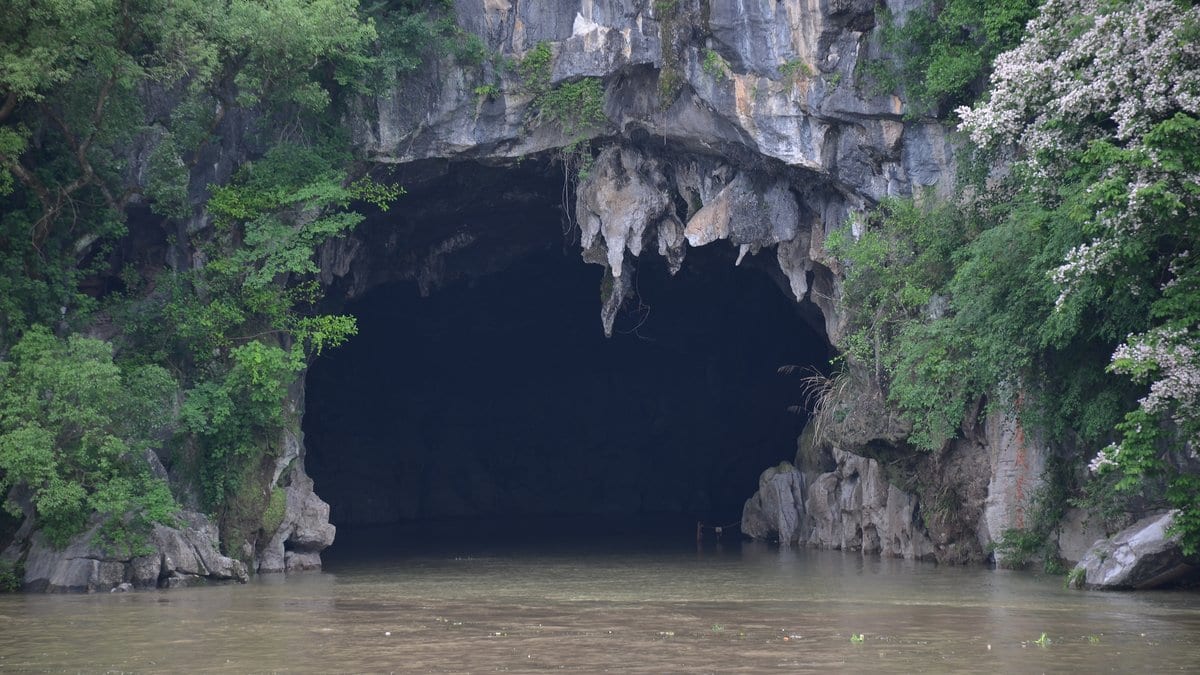
In the western chamber of a cave in Long'an County, Guangxi, a crust of old sediment still clings to the wall; the floor it once rested on has washed away. Two lower premolars lay a few centimeters apart in the third layer down. They belonged to no living kind of human. An interdisciplinary team has been working the late Middle Pleistocene cave deposits of this karst country since 2016, and this is what it was looking for.
Those teeth, with two more from Longchuandong, a cave in Luzhai County to the northeast, were described on Nov. 25, 2026, in Nature, by Song Xing of the Institute of Vertebrate Paleontology and Paleoanthropology in Beijing, Qiaomei Fu of the same institute, and colleagues. Four isolated teeth, two caves, and the authors' reading of them: two different kinds of archaic human living in the subtropics of southern China, a region that had almost no fossils of early humans of their age.
Ancient DNA is the usual way to settle what a fossil is, and in the warm, humid south it rarely survives — which is why the team went after proteins instead. Enamel is the hardest tissue the body makes, and the proteins locked inside it survive conditions that destroy DNA. A microinvasive acid etch on three of the four teeth released a few thousand peptides, the fragments proteins break into, from each sample. A blank and a much younger Neolithic tooth went through the same procedure as controls. All three were male.
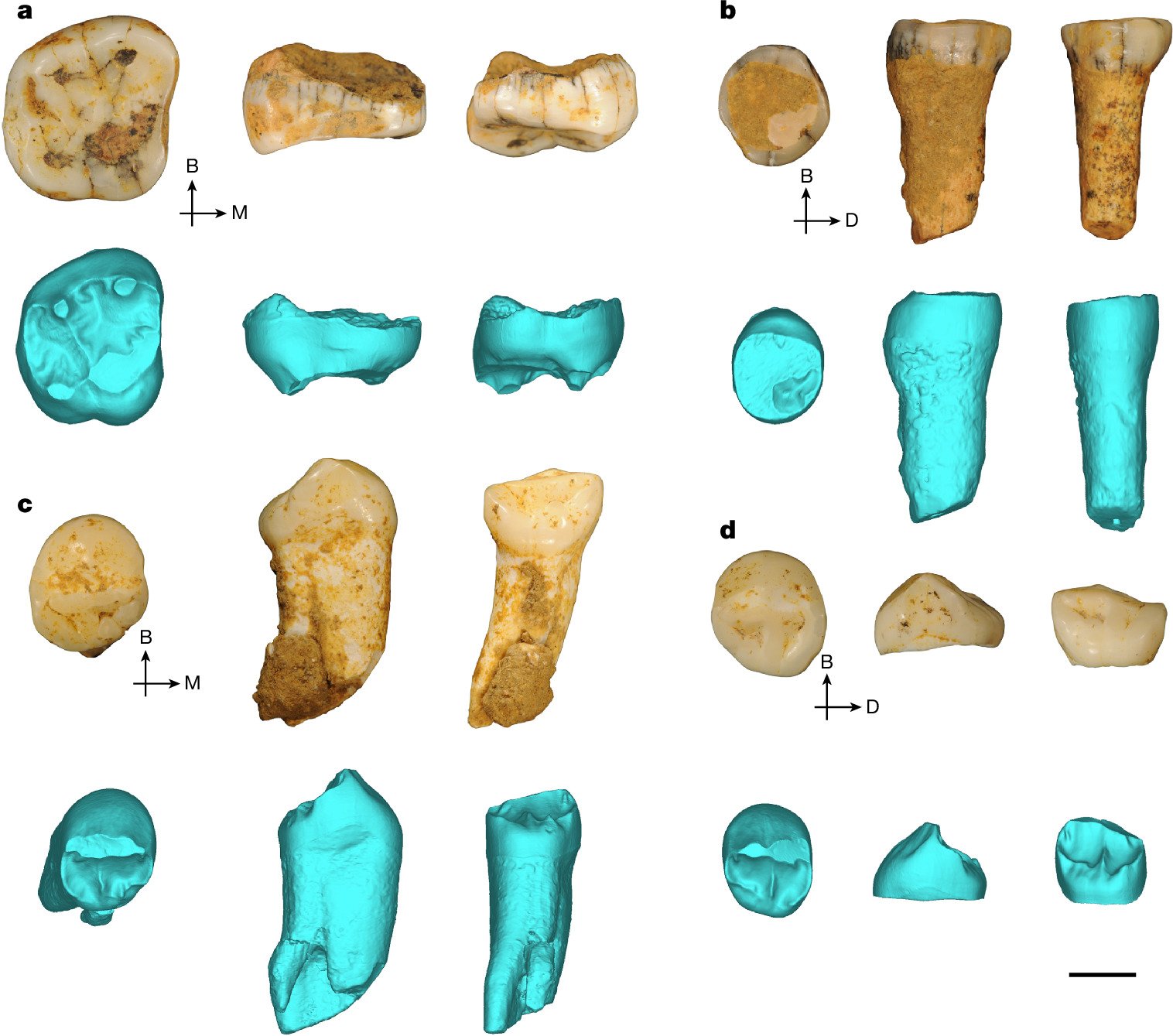
At Longchuandong the two teeth tell a comparatively clean story. Both carry the same form of ameloblastin, an enamel protein, as the Harbin skull, the Penghu jaw, the remains from Bianfu Cave and the Altai Denisovans; Neanderthals and most living people carry a different one. The molar is closest in crown and inner shape to Denisova 4, a tooth from the Siberian cave the group is named after. Dated directly, the pair comes out at 104,500 and 42,600 years old. The authors' wording is careful: the Longchuandong teeth are "likely to represent a Denisovan-affinity lineage in south China." Not a confirmed Denisovan, and no DNA evidence.
The Chuanshandong pair does not fit that pattern. Those teeth lack the Denisovan-associated form of ameloblastin altogether. They carry instead a version reported so far only in late Homo erectus from Zhoukoudian, Hexian and Sunjiadong, together with an ancestral form of a second enamel protein that is shared with Homo antecessor, the species from Atapuerca in Spain, and with living great apes, but not with modern humans, Neanderthals or Denisovans. On the tree built from these sequences, Chuanshandong falls outside all three, branching off before their common ancestor, at the top of the method's confidence scale with a posterior probability of 100%. That number should be interpreted in light of the authors' own caveat: "However, such phylogenetic inference based on the limited proteomic data is preliminary."
Tooth enamel yields about ten proteins, degraded and recovered unevenly along their length, and the placement here rests on three informative positions in two of them. Studies on this same class of data have repeatedly been unable to separate modern humans, Neanderthals and Denisovans from one another. What would firm it up, the authors write, is more molecular data from more places and periods, and ancient DNA from these archaic people if it can ever be recovered. The marker that links Chuanshandong to Homo erectus comes from this laboratory's own earlier paper on enamel proteins from six H. erectus specimens across China, published May 13, 2026, in Nature, which shares seven authors with this one, Fu included. That makes it a consistent framework, not an outside check on it.
The dates need the same care. The 100,800-year figure for Chuanshandong is a minimum age, measured on the left premolar; the two premolars match closely enough in shape and wear that they may come from a single person. The sediment of the layer that held them is younger than the teeth, between 49,500 and 34,200 years old, which the authors read as slow transport or delayed burial down the cave's slope. Those ages belong to the dirt, not to the people in it. And nothing else came with the teeth: no stone tools and no other cultural remains at either cave.
On Nov. 18, 2026, a different group reported in Nature that late Homo erectus was living in rainforest in the same province, on the evidence of nine teeth from the Baxian and Naxian caves near Chongzuo, eight of them identified as H. erectus. Different caves, different specimens, a different question. What the two papers share is the reason southern China stayed a blank for so long: the climate that grows the forest also destroys the DNA.
With Longchuandong added, the paper's own list of places Denisovans have turned up runs from Siberia, northern China and the Tibetan Plateau to the Taiwan Strait, subtropical Guangxi and tropical Laos, environments from cold, dry high plateau to hot, humid lowland, which the authors read as possible evidence of how adaptable the group was. The four Guangxi teeth add something narrower than another dot on that map. In one stretch of subtropical karst, at roughly the same period, the enamel says there was more than one kind of archaic human.
Sources
- NaturePeer-reviewed
- www.nature.com
- www.nature.com