NASA's Roman Telescope Launches and Is Now Flying on Its Own
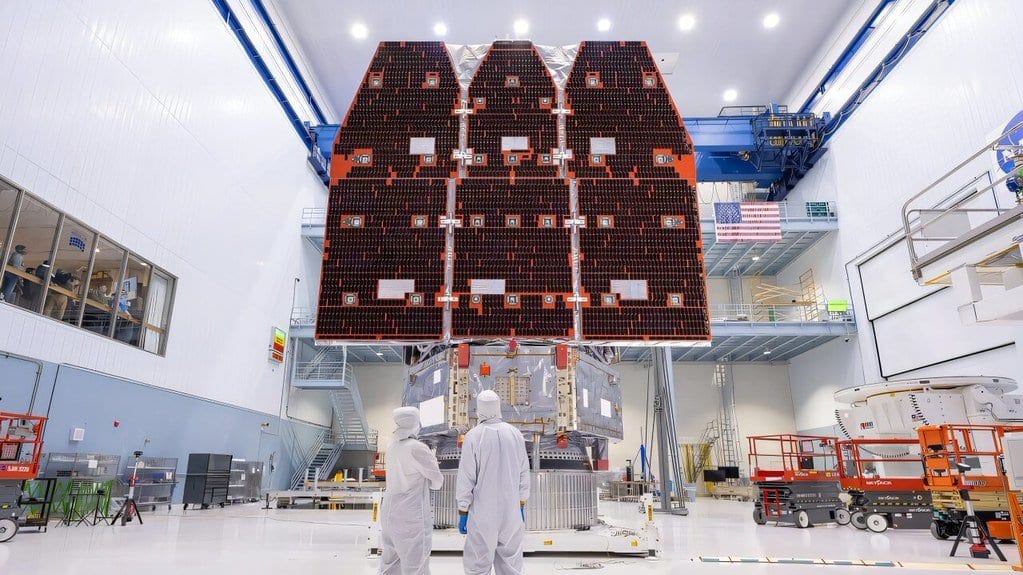
NASA's Nancy Grace Roman Space Telescope lifted off at 7:26 a.m. EDT Sunday aboard a SpaceX Falcon Heavy from Launch Complex 39A at NASA's Kennedy Space Center in Florida, the agency reported on its Roman launch blog.
The Falcon Heavy's 27 Merlin engines were generating more than 5 million pounds of thrust as the rocket climbed. The vehicle's first stage is a center core with two side boosters; the second stage, mounted on the center core, carried the observatory.
The telescope established communications through a NASA Tracking and Data Relay Satellite at 7:56 a.m., the agency said, and separated from the Falcon Heavy's second stage at 7:57 a.m. EDT, 31 minutes after liftoff. NASA posted the separation at 7:58 a.m. Mission controllers will keep monitoring the spacecraft as it heads for an orbit around the second Sun-Earth Lagrange point, or L2, about 1 million miles from Earth.
One step was still outstanding when NASA closed its live coverage at 8:09 a.m. EDT. Roman would deploy its Solar Array Sun Shield within about 30 minutes of separation, with four outer panels swinging into place to complete a six-panel array that powers the observatory and shades it, but the coverage ended without confirming that deployment.
Once science operations begin, NASA's Near Space Network will carry Roman's high-rate science data, and the agency's Deep Space Network will supply tracking, including the range and angle measurements that fix the spacecraft's position. NASA said the European Space Agency and Japan's space agency, JAXA, will provide additional downlink support through their New Norcia and Misasa ground stations.
NASA describes Roman as a five-year survey mission whose wide field of view is meant to map galaxies, find planets beyond the solar system and study black holes, dark matter and dark energy. The agency scheduled a postlaunch news conference for 9:30 a.m. EDT, with participants including NASA Administrator Jared Isaacman and Roman project manager Jackie Townsend.