JWST Measures the Oxygen in Nine Early Galaxies Without the Usual Shortcuts
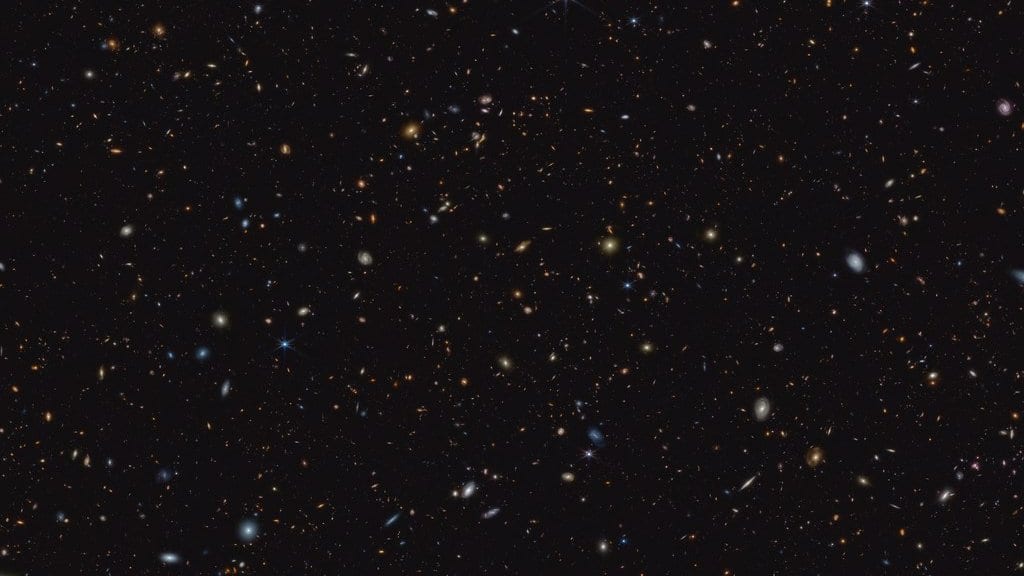
Astronomers have measured the oxygen in nine of the earliest known galaxies directly, instead of inferring it from the indirect calibrations the field normally falls back on at these distances. Raunaq Singh Rai and Guido Roberts-Borsani of University College London, with colleagues, report ultra-deep spectra of nine star-forming galaxies taken with the James Webb Space Telescope's NIRSpec instrument. The galaxies lie at redshifts of 6.0 to 8.3, placing them in the universe's first billion years.
Chemical abundances that far away are normally estimated with strong-line calibrations, which read them off bright, easily seen emission lines using relationships fitted to nearby galaxies. In a preprint posted on Sept. 28, 2026, the team says those calibrations dominate the uncertainty at these distances. The paper has been submitted to Monthly Notices of the Royal Astronomical Society and has not been peer reviewed.
A direct measurement needs a far fainter signal, an oxygen emission line astronomers call the auroral line. Its strength, set against the bright oxygen lines beside it, gives the temperature of the glowing gas, and that temperature is what turns the light into an amount of oxygen. The line is weak and at these distances usually undetectable. Rai and colleagues report catching it in every one of the nine galaxies.
Their oxygen abundances run from 7.14 to 8.18 on the logarithmic scale astronomers use for oxygen atoms per hydrogen atom, written 12+log(O/H). A step of one on that scale means ten times as much oxygen.
Measured against those abundances, the authors report that the nine sit on the same trend as galaxies nearby: for the oxygen a galaxy has, it holds about as much carbon relative to oxygen as a local galaxy does. Nitrogen is less settled. The nitrogen-to-oxygen ratio they infer depends on which nitrogen emission line is used to measure it, ultraviolet or optical.
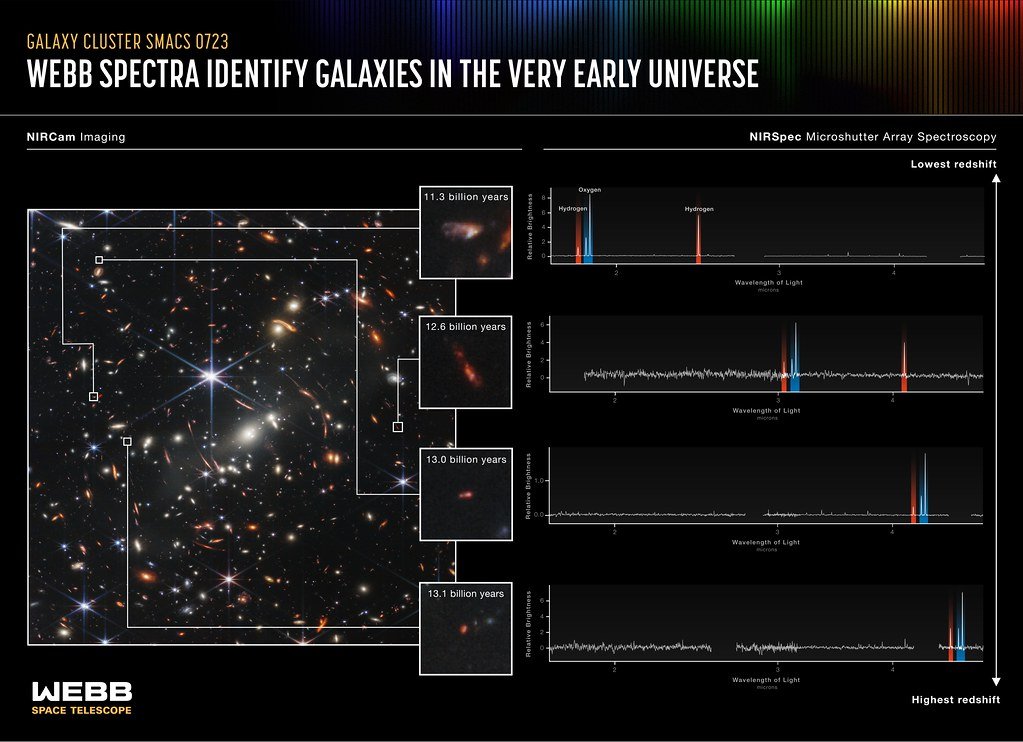
The authors call the work a pilot study and say statistical samples are now needed to describe the full population of star-forming galaxies at redshift 6 and above. The nine come from the OMEGA survey, short for Origins of Metal Enrichment in Galaxies at cosmic dAwn, which observed them in GOODS-N, a well-studied field. The survey paired its spectra with earlier observations of the same galaxies, covering ultraviolet and optical light together.
Sources
- arXivPreprint