A Possible Stellar Grave Turns up Next Door to the Milky Way’s Central Black Hole
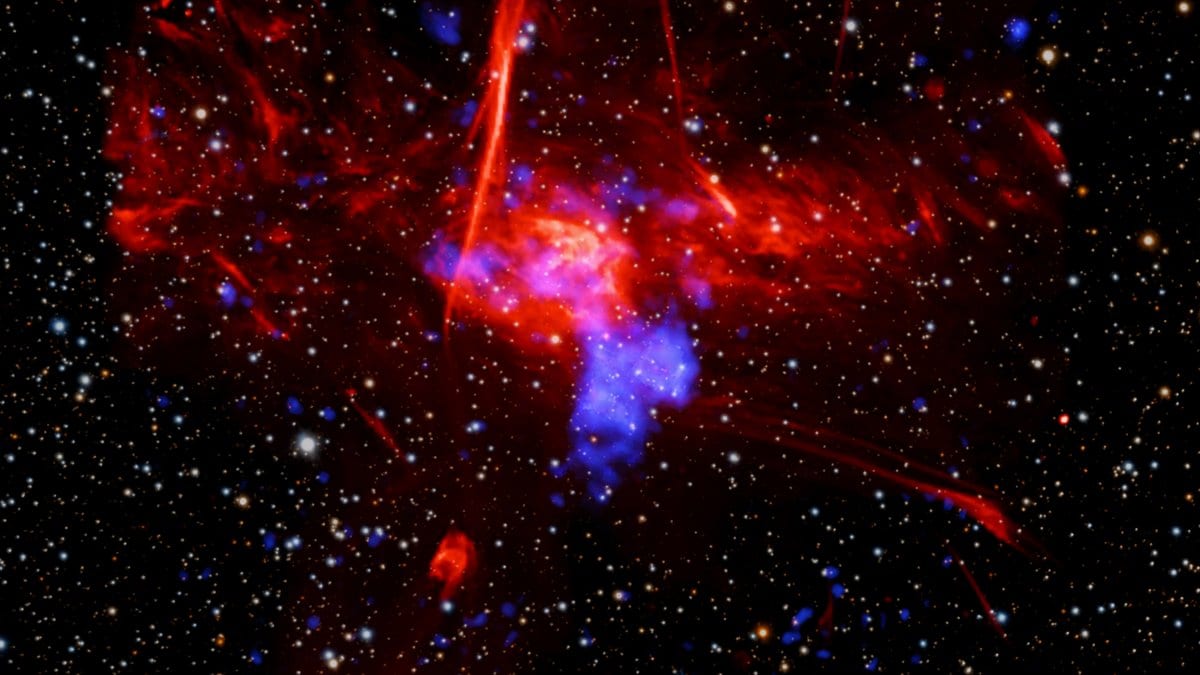
Tucked inside a glowing bubble of gas roughly 26,000 light-years away, in a crowded patch of the Milky Way called Sagittarius C, a faint blue smudge of X-rays has caught astronomers' attention. They suspect it is a grave, the scattered debris of a massive star that detonated as a supernova, with the possible remnant lying closer to the galaxy's central black hole than almost any such wreckage found before.
The word doing the heavy lifting there is suspect. In a NASA release published June 22, a team led by Zhenlin Zhu and Mark Morris of UCLA, with Gabriele Ponti of Italy's National Institute for Astrophysics and Ping Zhou of Nanjing University, is careful to call this a possible supernova remnant. No peer-reviewed paper has appeared yet, and the case is built on a single, ambiguous clue.
That clue is the X-ray "blob" picked out by Chandra and ESA's XMM-Newton, buried inside a larger cloud of expanding gas. The cloud is an H II region (hydrogen stripped of its electrons by a hot young star nearby) that shines brightly at radio wavelengths captured by South Africa's MeerKAT array. Layered with optical data from Pan-STARRS and infrared from the James Webb Space Telescope, the composite shows two overlapping clouds: the broad radio bubble, and the compact X-ray glow that may be the remnant itself.
Why hold back on calling it a supernova remnant outright? The most direct test failed. When the team searched the X-ray data for the surplus of heavy elements that an exploded star usually leaves behind, they did not find one. An alternative is that the hot gas simply comes from a cluster of massive stars, though the researchers think that unlikely, since the blob outshines known stellar clusters by more than tenfold.
Confirmed remnants matter because they are the galaxy's foundries, forging and scattering the iron, oxygen and silicon that go into planets and, eventually, life. Finding one this near the Galactic Center would show that even in that violent, magnetically threaded corner of the Milky Way, dying stars are still doing that work. For now, it remains a candidate, a promising smudge awaiting the harder evidence that would turn a maybe into a discovery.