Mercury Gives Researchers a Stand-In for Earth's Worst Solar Storms
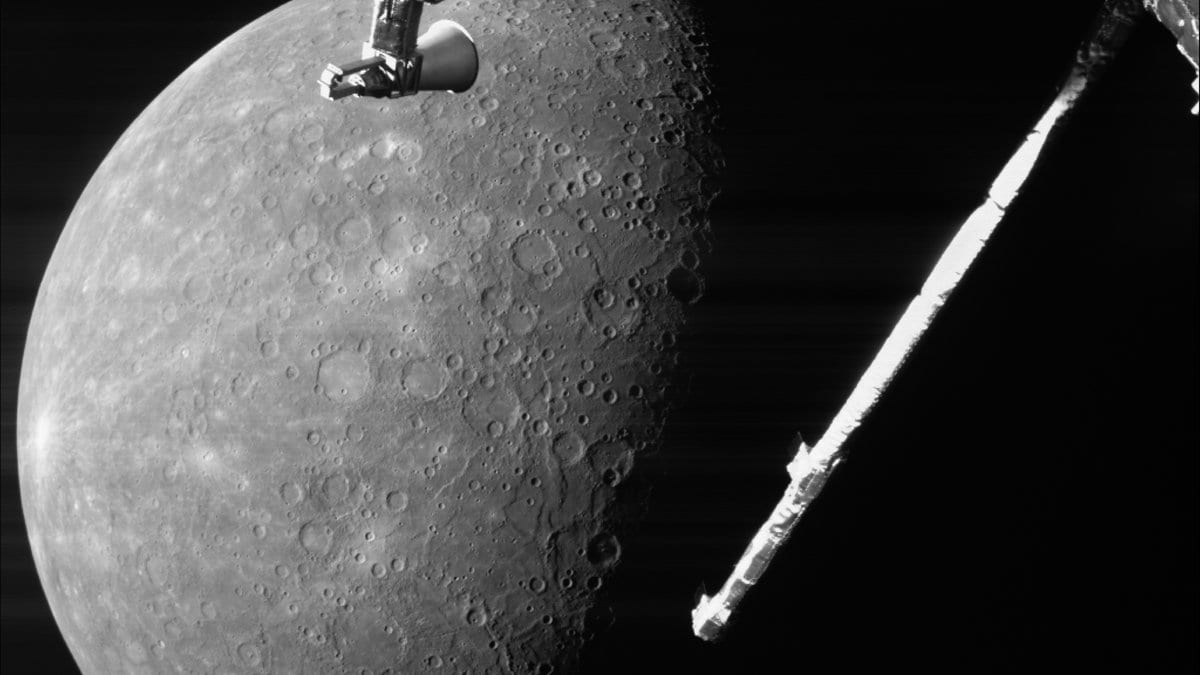
Solar particles thrown out by an eruption on the Sun reached the bare surface of Mercury while the BepiColombo spacecraft flew close overhead, researchers led by the University of Helsinki report in Nature Astronomy. The readings come from SIXS, a Finnish-built particle and X-ray detector carried by the European and Japanese probe, and were published online Sept. 8.
The paper says particle fall of that kind probably alters the chemistry of Mercury's loose surface rock and changes the thin envelope of gas around the planet, and that the same can happen on other weakly magnetized rocky planets orbiting close to their stars.
The University of Helsinki's announcement of the work says conditions at Mercury resemble what Earth would face when a severe solar storm compresses its magnetic shield. "SIXS's observations help us assess how destructive particle radiation would penetrate Earth's near-space environment and atmosphere during the most powerful space storms," said Rami Vainio, co-principal investigator for the instrument and a professor of space physics at the University of Turku.
The flyby was BepiColombo's fourth of Mercury, on Sept. 4, 2024, and it brought the spacecraft within 165 kilometers of the surface while a burst of high-energy particles from the Sun was under way. SIXS found protons and electrons behaving differently. Protons dropped out where the planet's own bulk shadowed them magnetically, while electrons drained down across a wide span of directions and struck the ground.
Mercury has almost no atmosphere to absorb them, and the particles knock atoms and molecules loose from the surface and generate X-rays. "The fourth flyby was truly unique," said Emilia Kilpua, principal investigator for SIXS and a professor of space physics at the University of Helsinki, which calls these the instrument's first results at Mercury. The spacecraft passed far closer than it will in its working orbit, she said, and the solar eruption arrived at exactly that moment.
BepiColombo is settling into orbit at Mercury after an eight-year cruise, and the Helsinki announcement says the orbiters are due to arrive in November.
Sources
- Nature AstronomyPeer-reviewed