A Dark Matter Detector Just Measured Neutrinos From the Sun
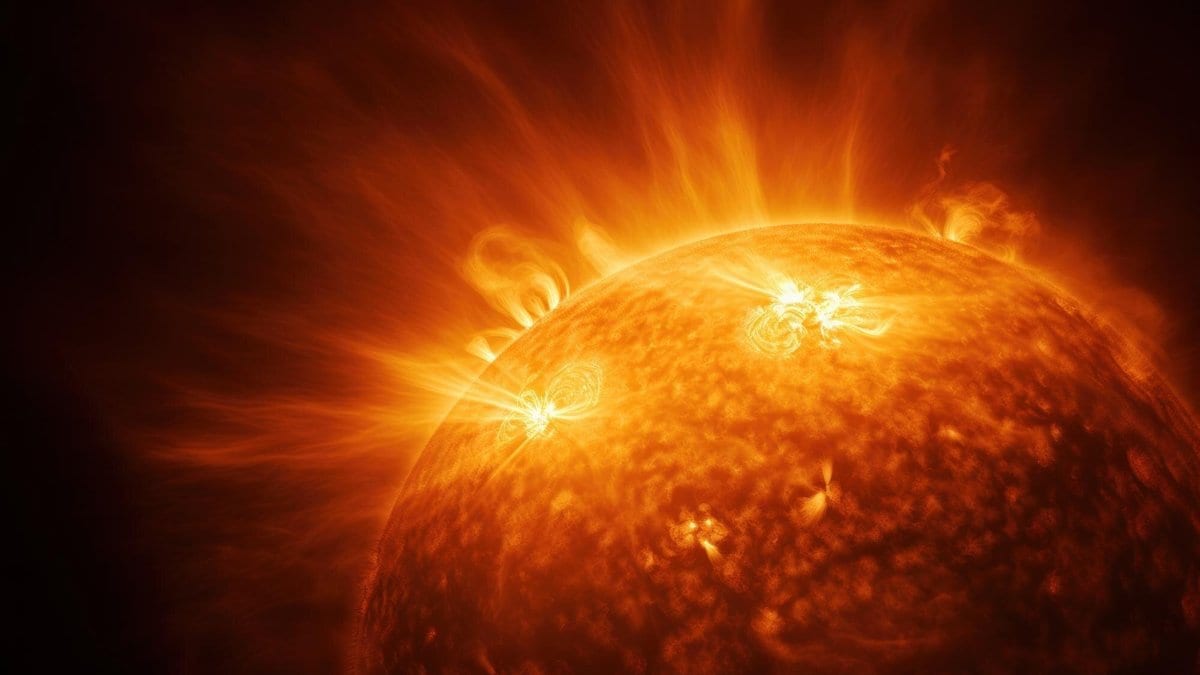
The XENON Collaboration reports that it has measured low-energy neutrinos from the Sun, using a detector built to search for dark matter. The result rejects the background-only hypothesis at a statistical significance of 5.0 sigma. The paper was posted to the arXiv preprint server on Aug. 29 and has not been peer-reviewed.
The neutrinos were detected by elastic scattering off electrons: a neutrino strikes an electron in the detector's liquid xenon and leaves a faint recoil signal. XENONnT itself was built to look for dark matter particles striking xenon nuclei.
The measurement covers electron recoil energies between 1 keV and 140 keV and is sensitive to solar neutrinos with energies down to 17 keV. It draws on an exposure of 2.46 tonne-years from the first two XENONnT science runs.
From that data the collaboration measures a solar pp neutrino flux (the neutrinos released by the proton-proton fusion reaction that powers the Sun) of (10.2 ± 2.0) × 10^10 per square centimeter per second. This is larger than, but statistically consistent with, the previous measurement by the Borexino experiment, agreeing at 1.9 sigma.
The authors describe the result as the first measurement of low-energy solar neutrinos through elastic neutrino-electron scattering "in a dark matter experiment," and say it establishes "the lowest energy threshold for any neutrino detection to date."
The paper sets the measurement alongside recent observations of coherent elastic neutrino-nucleus scattering of boron-8 solar neutrinos in XENONnT and other liquid-xenon detectors, which the authors call "an important milestone towards a next-generation multipurpose observatory."
Sources
- arXivPreprint