Relativity Leaves Its Mark on the Chemistry of a Superheavy Element
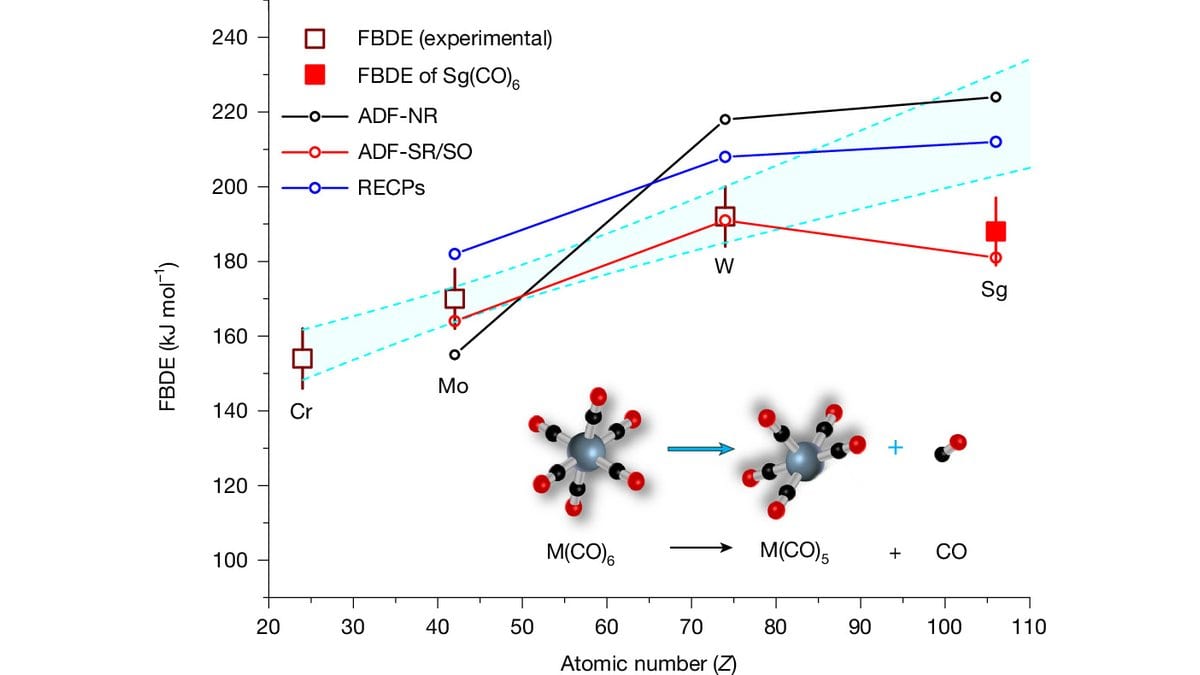
Chemists at the GSI Helmholtz Center for Heavy Ion Research in Darmstadt, Germany, have measured a chemical bond in a compound of seaborgium, element 106, and found it weaker than the same bond one row up the periodic table. The energy needed to pull one carbon monoxide molecule off seaborgium hexacarbonyl came out at 188(9) kilojoules per mole, where the bracketed digit is the uncertainty: 9 units either way. That is 4 kilojoules per mole below the tungsten compound, with an uncertainty of 2 on the difference, so the rise in this energy going down group 6 reverses at the bottom.
Seaborgium is made an atom at a time, and the atoms used here lasted a few tenths of a second. Alexander Yakushev and colleagues published the measurement Oct. 7, 2026, in Nature. They say bonding in the heaviest elements is of particular interest because the inner electrons of such large atoms move fast enough for relativity to shift the energies of their bonding electrons.
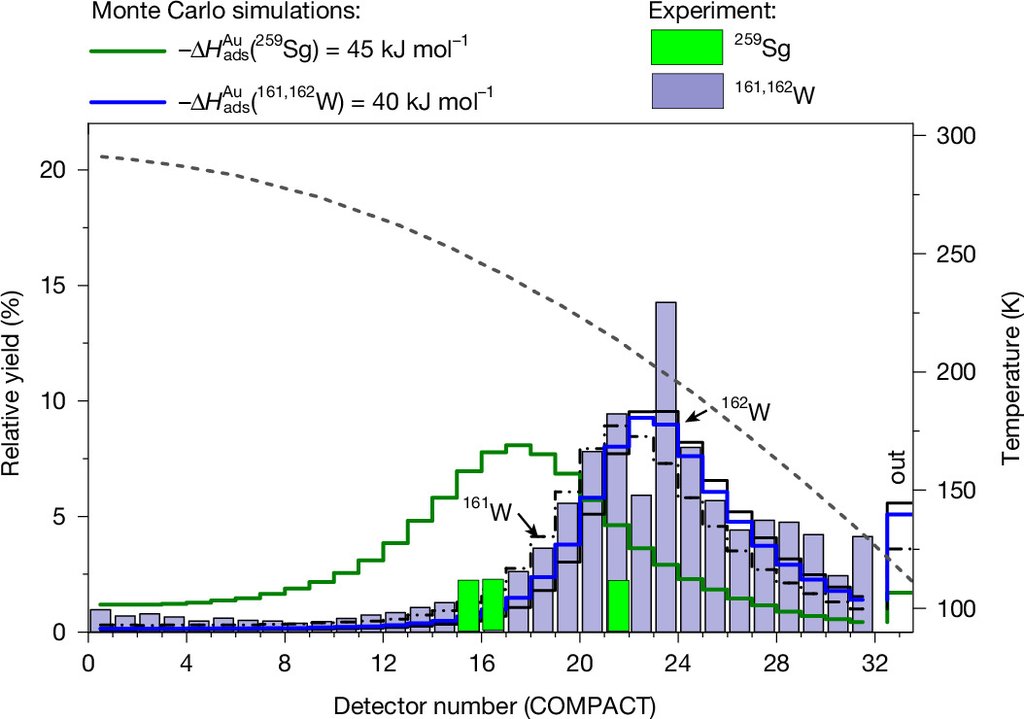
At the laboratory's TASCA separator, seaborgium atoms made by firing chromium ions at a lead target were swept into helium mixed with carbon monoxide, and some picked up a full set of six CO molecules. Only the complete molecule is stable enough to reach the gold-coated detector at the far end; stripped fragments stick to surfaces first. Three of 75 recorded seaborgium decay chains reached that detector, and comparing that yield with tungsten's gave the difference. Subtracting it from tungsten's measured 192(8) kilojoules per mole yielded the seaborgium value. The authors trace most of the 9 to tungsten's own uncertainty.
Calculations had pointed both ways: non-relativistic treatments and an earlier relativistic calculation both put seaborgium's bond energy above tungsten's. The most recent relativistic calculations, by Iliaš and Pershina, predicted a fall of about 10 kilojoules per mole, from relativistic destabilization of seaborgium's 6d orbitals. The GSI group reports agreement with the direction of that prediction, though the measured drop is smaller than any calculation gave.
The compound was first made in 2014, and an earlier attempt at this measurement produced no value.
Sources
- NaturePeer-reviewed