Drought Cuts Upper Colorado River Flows 15% and Leaves Them Warmer and Saltier
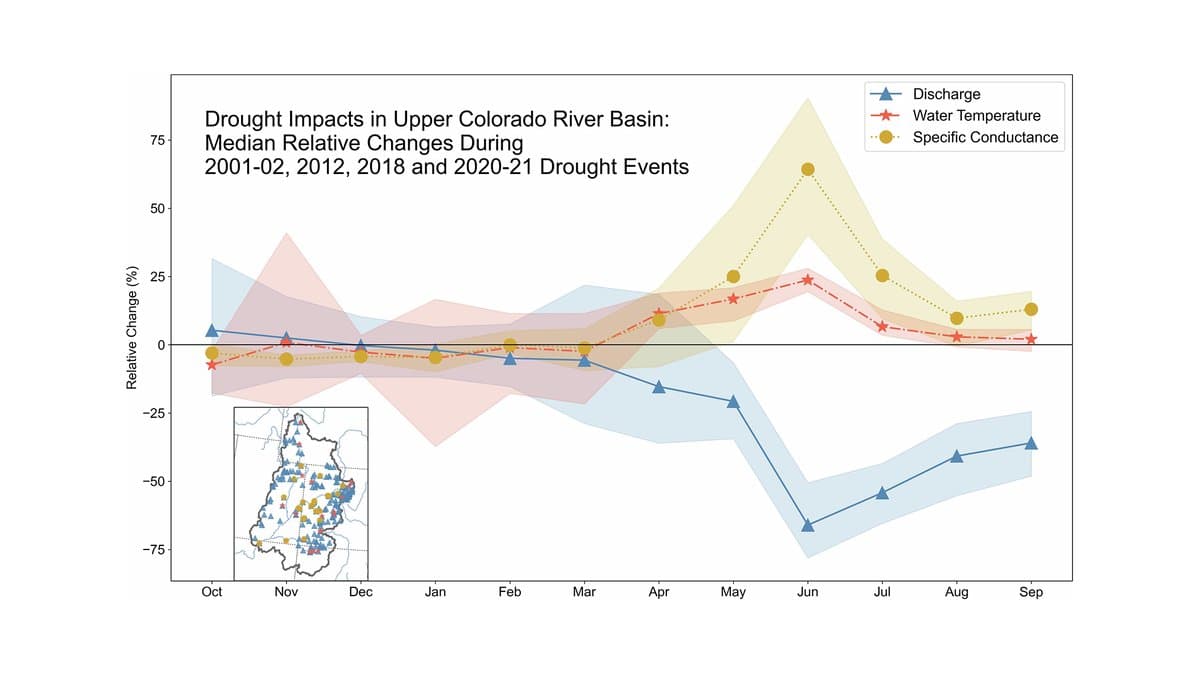
Four severe droughts between 1998 and 2022 cut annual river flow across the Upper Colorado River Basin by about 15% and left the water warmer and saltier at the same time, a team at Lawrence Berkeley National Laboratory reported Sept. 14 in Communications Earth & Environment.
Those headwaters feed a river that supplies more than 40 million people across seven states, tribal nations and northern Mexico, the paper notes. The authors say their aim was to show which watershed traits decide how hard a drought hits a given stream, so that water managers can weigh flow and water quality together.
Emily Nagamoto and colleagues compared the drought years against the normal years on either side of them, using U.S. Geological Survey monitoring records. Flow fell at most gauged sites in the basin, with the sharpest losses in spring and summer. Water temperature rose about 9%, and specific conductance, a measure of dissolved salt, rose about 5%. Both were tracked at far fewer places than flow: temperature at 36 sites and salt at 23.
Flow and salt levels recovered after the earlier droughts, the paper reports, but most sites had not returned to pre-drought levels after 2018, which the authors attribute to a second drought arriving before the streams had time to catch up. Water temperature bounced back fastest, at most sites within a year or two.
Watersheds did not respond alike, even though the droughts fell fairly evenly across the basin. The team found the steepest flow losses where freshwater withdrawals were high, deciduous forest cover was heavy, soils were fine and air temperatures were warm. Watersheds fed by underground flow, and those whose soils soak up water easily, came through best. Reservoirs and open water held the salt increases down.
The work was funded by the U.S. Department of Energy. Charuleka Varadharajan of Berkeley Lab is the senior author. The team used a machine-learning model to fill gaps in stream temperature where no gauge exists. The paper is open access and its data are public.
Sources
- Peer-reviewednature.com
