Antarctica's Ancient Rainforests Caught Fire Again and Again, Buried Charcoal Shows
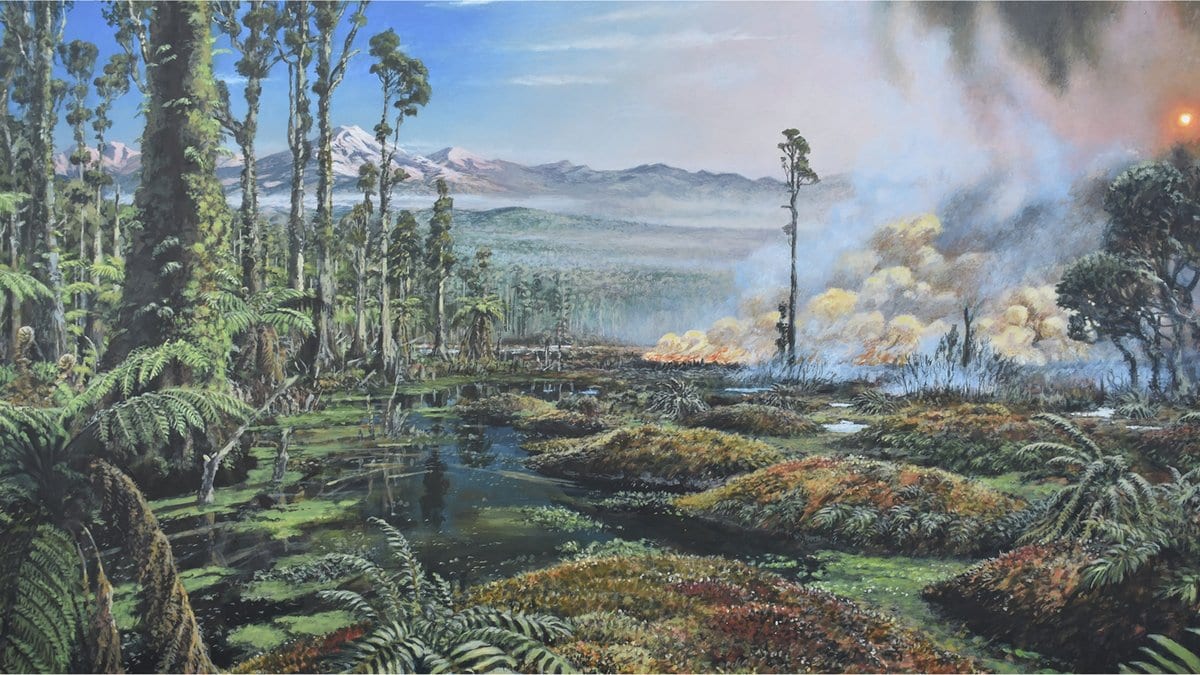
Charcoal buried in rock drilled from the seafloor off West Antarctica records forests and bogs that burned again and again about 900 kilometers from where the South Pole then sat, at a time when the continent carried temperate rainforest rather than ice. Ulrich Salzmann of Northumbria University, Heiko Pälike of MARUM at the University of Bremen and colleagues describe the record in the journal Communications Earth & Environment, published Sept. 7.
The authors present the core as a measured case of how peatlands behave in a hot, carbon-dioxide-rich climate, a question usually put to computer models. Peatlands hold a large share of the carbon stored on land, and the authors conclude that fire was part of how this one worked: repeated low-intensity burning held the trees back and kept the vegetation open, as it does in peatlands today.
The sediments come from a single hole drilled in the Pine Island trough by the research vessel Polarstern: a thin layer of brown coal over root-bearing mudstone, dated to between about 92 million and 83 million years ago. Charcoal runs through the whole sequence and becomes much more abundant toward the top. The way the burnt fragments reflect light points to surface fires at low temperature, around 370 to 400 degrees Celsius. Volcanic eruptions have been proposed as the ignition source for other Antarctic fire records; the team reads the low temperatures as evidence for lightning instead, in a strongly seasonal climate.
Before this, the southernmost Late Cretaceous fire record came from the Chatham Islands off New Zealand, about 1,500 kilometers farther from the pole. The rising charcoal tracks a second change in the same core: swamp forest gave way to a bog dominated by Sphagnum, the peat moss that builds northern peatlands today. The paper calls it the earliest known coal-forming Sphagnum peat of the southern high latitudes, roughly 35 million years older than the previous earliest example, a German brown-coal deposit.
Chemical traces point to conifer wood as the main fuel, matching pollen from podocarps, a family whose living members include the Huon pine.
Sources
- www.nature.comPeer-reviewed