Two Decades of Artificial Drought Left Amazon Trees Better Able to Survive a Real One
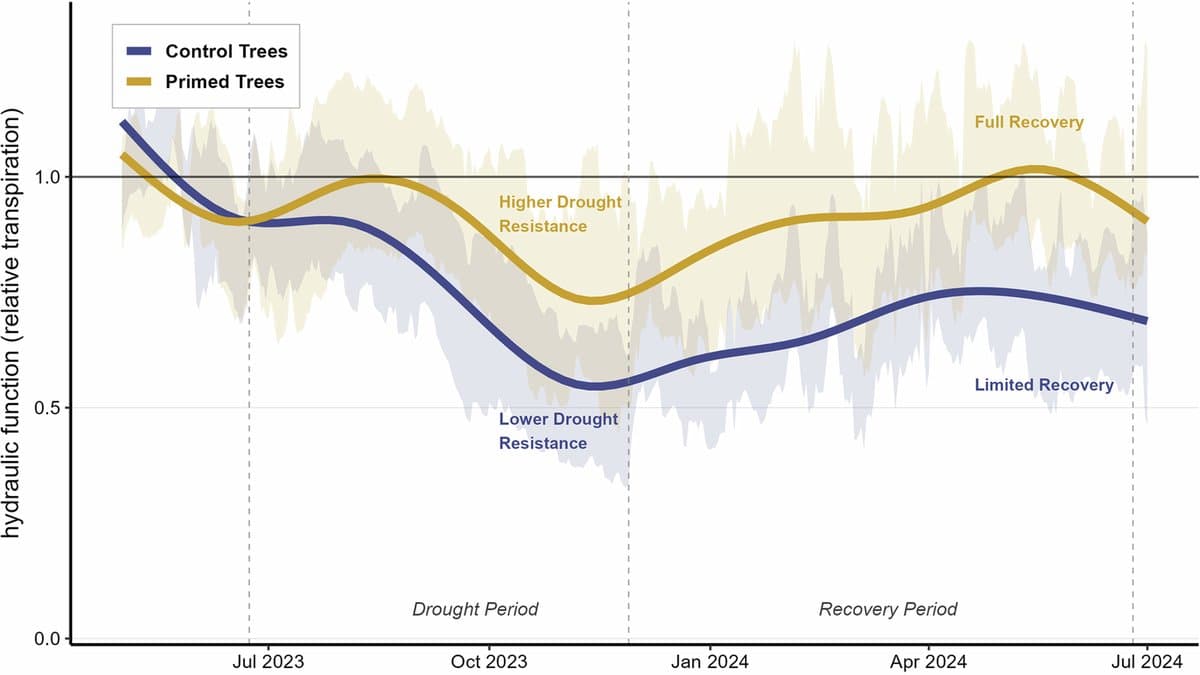
Amazon trees that have had half their rain taken away for more than two decades came through the record 2023 El Niño drought in better shape than untreated trees nearby, researchers report in a study published Sept. 14 in Communications Earth & Environment.
The study tested a question about the Amazon's future: whether a forest that has already lived through years of drought is hardened against sudden extremes, an effect the authors call priming, or is instead left closer to its limit.
During the drought, the long-dried trees reduced transpiration, the water they pull from the soil and release to the air, by 25%, the authors report. The untreated trees dropped by up to 54% from their pre-drought rate. Once the rains returned, the dried plot's trees recovered their full pre-drought rate, while the untreated trees came back only to 77.5% and had shed leaf area.
The comparison runs at the Caxiuanã National Forest in Pará, northern Brazil, where plastic panels and gutters have diverted half of all incoming rain away from one forest plot since 2002. A matching plot beside it gets normal rainfall. Sap-flow sensors on 40 trees, split evenly between the two, supplied the water-use figures.
Laser scans of the trees point to their shape. The primed trees carry smaller crowns for the thickness of their trunks, the authors write, which lowers the water they lose to dry air. Two decades of drought deaths in that plot also left the survivors competing with fewer neighbors for soil water. Their conclusion is that a tree's ability to ride out an extreme drought can come from long exposure to milder ones, through changes in its structure. That comparison rests on the two plots at this one site.
The dry season that year was the driest at the site since measurements there began in 1982, and it ran a month longer than usual.
Sources
- Peer-reviewednature.com