Physicists Convert Ultraviolet Single Photons Into Telecom Light in One Step
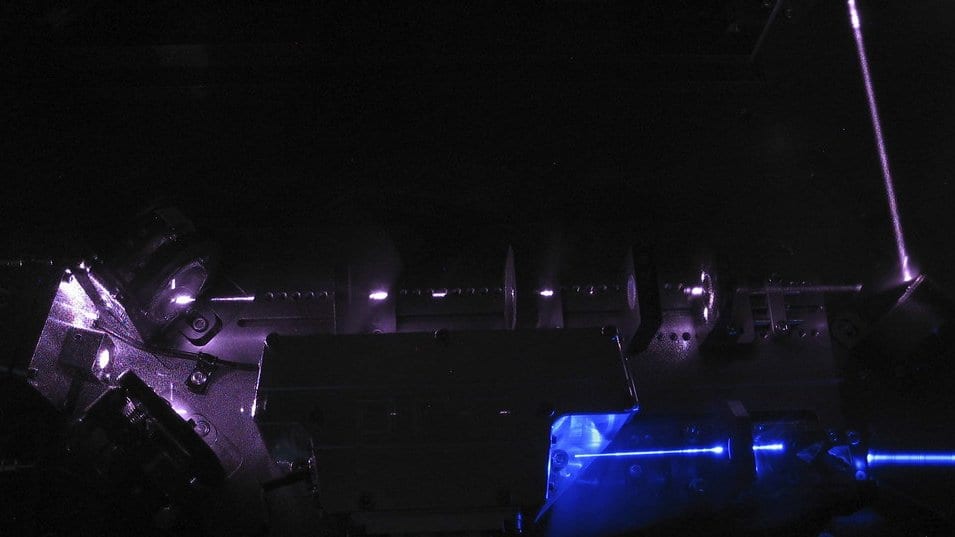
Researchers at the University of Science and Technology of China, working with the Jinan Institute of Quantum Technology and Hefei National Laboratory, have converted single photons of ultraviolet light at 393 nanometers into the telecom C band in one stage, with an external efficiency of 28.8%, in a paper published Oct. 13, 2026.
Trapped calcium ion quantum memories, which hold a quantum bit in a single charged atom, emit light at that wavelength, and ultraviolet light is absorbed quickly in glass fiber. The C band is the window long-distance fiber networks are already built around. Converting the first into the second in a single step is what would let such a memory send its light down cable that is already in the ground.
External efficiency is the end-to-end number: telecom photons leaving the whole device for every ultraviolet photon fed in, with the losses of the surrounding optics counted against it rather than the conversion alone. The Physical Review Letters paper puts the background noise at 35 counts per second, the stray counts a detector registers each second when no converted photon arrives. A converter is judged on the two figures together, because noise well above the signal buries the single photon the device exists to carry.
The authors describe the efficiency as a record for this pair of wavelengths. What they report is a component measured on a laboratory bench, not a working network.
Sources
- Physical Review LettersPeer-reviewed