Correcting a Weather Model's Own Mistakes Improved Month-Ahead Forecasts

Adding a machine learning correction step on top of existing weather models improved their forecasts two to six weeks ahead, a team led from Microsoft Research reported Oct. 14, 2026, in Nature. The method learns the mistakes a forecasting system makes over and over, from the system's own past predictions and the weather that followed, then adjusts its next forecast. It does not predict the weather itself.
Forecasts at that range are used for planting, water allocation, energy management and disaster preparation. The authors report that past about two weeks, both conventional forecasting systems and newer AI ones often score worse than the long-term average for the date, which is the baseline such forecasts are graded against.
Probabilistic bias correction runs two learned corrections side by side, one for errors tied to a place and a time of year, the other blending in recent observations, and averages them. The paper reports gains on every system it was applied to. Against the forecasts ECMWF already adjusts for known bias, the correction improved rainfall predictions at 98% of grid squares worldwide. Applied to the center's AI forecasting system, it doubled that system's average score for 2025, which stood at 0.03, close to the point at which a forecast is worth no more than long-term averages.
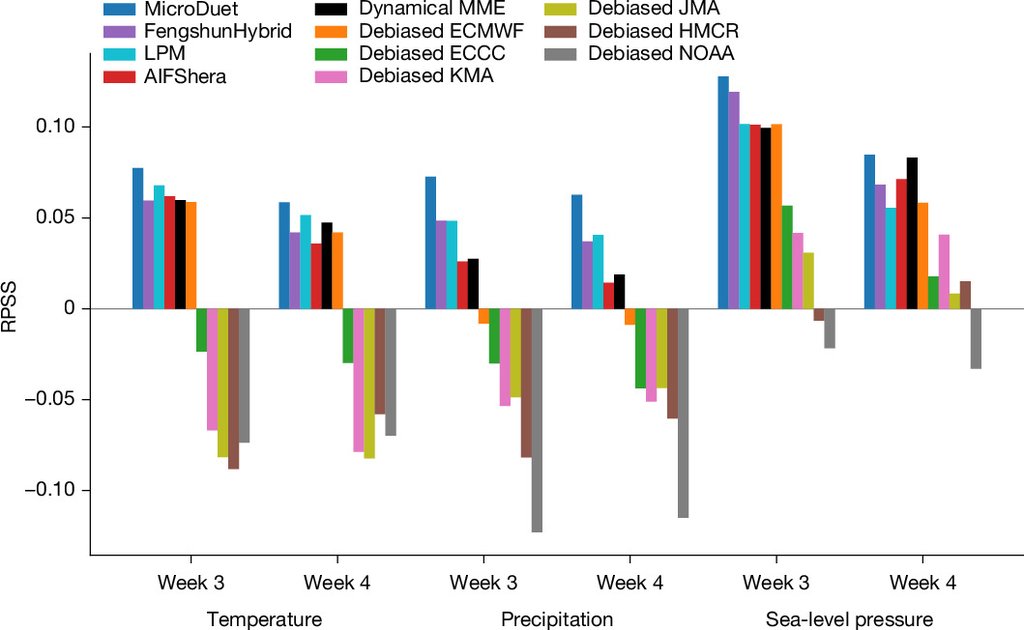
The operational test was the AI Weather Quest, a real-time competition ECMWF launched in 2025. On the competition's published leaderboard, which the paper reproduces, the authors' entry scored best for every variable and lead time in the opening season, ahead of the already-corrected models of six forecasting centers, a combined ensemble of those six, three versions of ECMWF's own AI system and entries from 34 teams. The paper reports that all six centers' models scored below the long-term average for rainfall.
The team also trained the correction to target extremes. Across 2,435 flood events cataloged by the Global Disaster Alert and Coordination System, a joint United Nations and European Commission framework, the correction raised flood forecast skill by 76% to 92% against raw ECMWF output, while the center's own bias adjustment reduced it. The authors describe their method as a post-processing step rather than a replacement for better forecast models, and say it is cheap enough to run at centers with limited computing. Their code is public.
Sources
- NaturePeer-reviewed