A New Benchmark Compares Quantum Computers That Are Built on Different Hardware
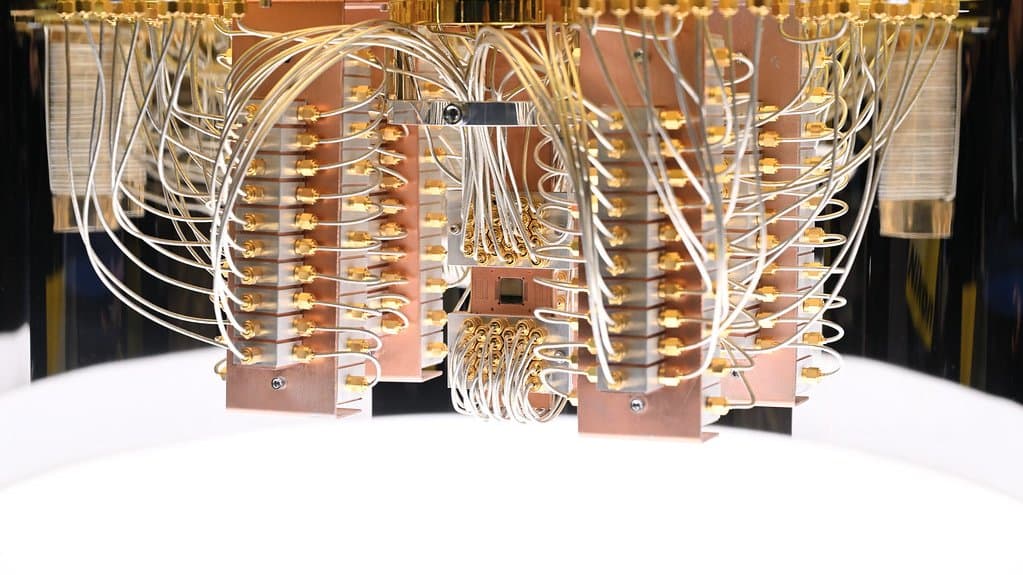
A team led by Sandia National Laboratories has released a single test that measures quantum computers from three companies on the same scale, and reports that today's machines would have to become roughly 100,000 times more capable to run the calculations scientists actually want from them.
The authors call the test the quantum universal operation performance system, or QUOPS. It asks how big a circuit a machine can finish successfully, using circuits of the kind a real calculation would need, and how quickly it finishes. Rival machines are built on different kinds of hardware, the paper says, which has made their progress hard to compare; one scale is meant to let all of them be tracked against the same target.
Timothy Proctor and his colleagues applied QUOPS to processors from Quantinuum, Google and IBM, computing directly on physical qubits, the raw hardware units. They then converted the published resource requirements of recognized challenge problems, the calculations the field treats as the point of building these machines, into the benchmark's own circuit sizes. On that comparison, the authors write, capability "must grow by 5 orders of magnitude," which they read as an argument for error-corrected designs.
The paper was posted on Sept. 10, 2026 and has not been peer reviewed. Its author list includes researchers at Quantinuum and at NVIDIA, so one of the companies whose machines were measured helped build the instrument doing the measuring.
The same benchmark was also run on Quantinuum's Helios-1, a small error-corrected processor of up to eight logical qubits, each spread across a group of physical qubits so errors can be caught. The authors use that result to project how capability might grow across later generations of such machines.
Sources
- PreprintarXiv