A Quantum Memory That One Qubit Can Address Slot by Slot

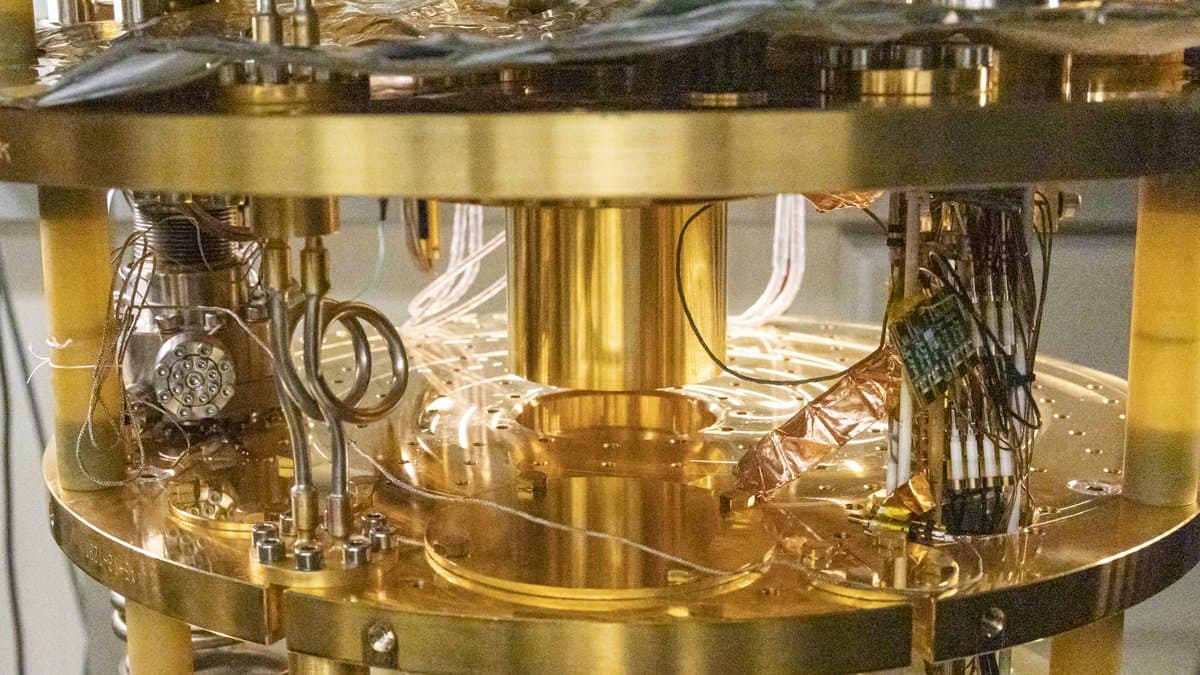
Open the lid of a superconducting quantum computer and most of what you see is not computing; it is wiring. Coaxial lines run down through a refrigerator colder than deep space, one or more for every qubit on the chip, each carrying the microwave pulses that make that qubit do anything at all. A laptop is not built that way. Its processor stays small, and the numbers it is working on sit in a separate bank of memory that it reaches into one address at a time.
That bank is random access memory, and superconducting quantum processors have never had one. Ziqian Li, Eesh Gupta and colleagues open their paper in Nature Physics, published on September 8, 2026, by saying so: the memory that is critical to classical computing is "notably absent in current superconducting quantum processors." What follows is a device built to be the missing piece.
The work spans Stanford, the University of Chicago, SLAC and Fermilab, with two of the ten authors at New York University and Rutgers. The device itself is one transmon, an ordinary superconducting qubit, wired to reach seven memory modes inside a single microwave cavity. A cavity of that kind is a hollow superconducting box, and the standing microwave tones it holds, its modes, can each store a quantum state. Between the processor and the storage cavity the team placed a buffer layer, there to keep processor nonlinearities (the uneven energy spacing that makes a transmon usable as a qubit) out of the modes holding the data.
The addressing is classical, and the word carries weight. Which mode the transmon writes to or reads from is an ordinary choice made in the control electronics, not a quantum superposition of addresses. Quantum random access memory already names something else in this field: a 2008 proposal by Giovannetti, Lloyd and Maccone in which the address itself is quantum, so that many cells can be queried at once. This work cites that proposal. It does not build it.
For what the paper calls "arbitrary random access," the authors report "an average infidelity of less than 1.5% per mode": an error rate, averaged across the modes, with a ceiling on it rather than a figure for any single operation. They also characterize where the error that remains comes from. Many-body interactions, many parts acting on one another at once, dominate the error budget.
The case the authors make is about wiring rather than speed. They write that the architecture "enables a significant reduction in control lines per logical qubit," and that it supports transversal operations inside the memory module, an idea from the design of error-corrected machines. The unit is offered as "a scalable unit cell for fault-tolerant quantum architectures." Those are claims about what the design allows. Nothing fault-tolerant was demonstrated: no logical qubit was stored in this memory, and no error correction was run on it.
Random access quantum memory itself is not new. The paper's own reference list includes a 105-qubit random access quantum memory built in 2019 from an atomic ensemble, a different platform entirely. What had been missing was a version that sits next to a superconducting processor. That is the scope of the absence, and it is a narrow one.
Seven modes on one device in one laboratory is a long way from a working machine. But the payoff this design aims at would show up in the part of a quantum computer nobody photographs: the bundle of lines coming down through the cold, and how many of them one stored qubit has to have.
Sources
- Nature PhysicsPeer-reviewed
- phys.org
- figshare