Mars' Daily Pressure Cycle Shortened During a Dust Storm
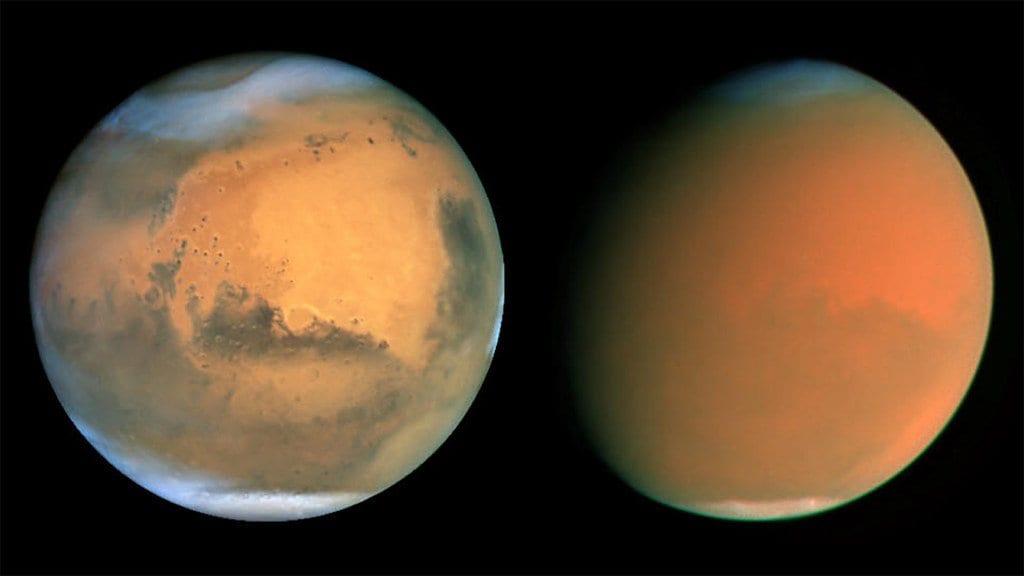
Four researchers say they have extracted a planet-circling pressure wave directly from Mars weather data for the first time, using more than one Martian year of readings from the pressure sensor on NASA's InSight lander.
The wave is what atmospheric scientists call a Kelvin wave of zonal wavenumber 1, meaning it fits exactly once around the planet. The authors label it K1. Its signature had been seen before in Martian surface-pressure records as dust storms began, the paper says, but it had never been pulled out on its own, because its frequency is close to that of the daily pressure swing driven by the Sun, known as the diurnal tide. The team used singular spectrum analysis, a method for separating overlapping repeating signals in a long measurement series.
By that analysis, clear K1 signals appear in the Martian northern hemisphere's spring and autumn with average amplitudes of around 2 pascals. During the storm the authors label the MY34 C dust storm, the wave reached 8 pascals, against a simultaneous diurnal signal of 39 pascals at its maximum. Near the peak the two were in phase and the diurnal period shortened to 23.5 Mars hours, then recovered to 24 as K1 decayed.
The authors read that phase relation and the shortened period as a resonance between the two waves. They also compared the record with the Mars Planetary Climate Model at the grid point closest to InSight's landing site, and report that the model reproduces the pressure variations they measured.
The paper, by Anzu Asumi, Jorge Hernández-Bernal, Kaoru Sato and Aymeric Spiga, was posted to the arXiv preprint server on Aug. 20.
Sources
- arXivPreprint