A Candidate Planet, Weighed by Its Reflected Light Alone
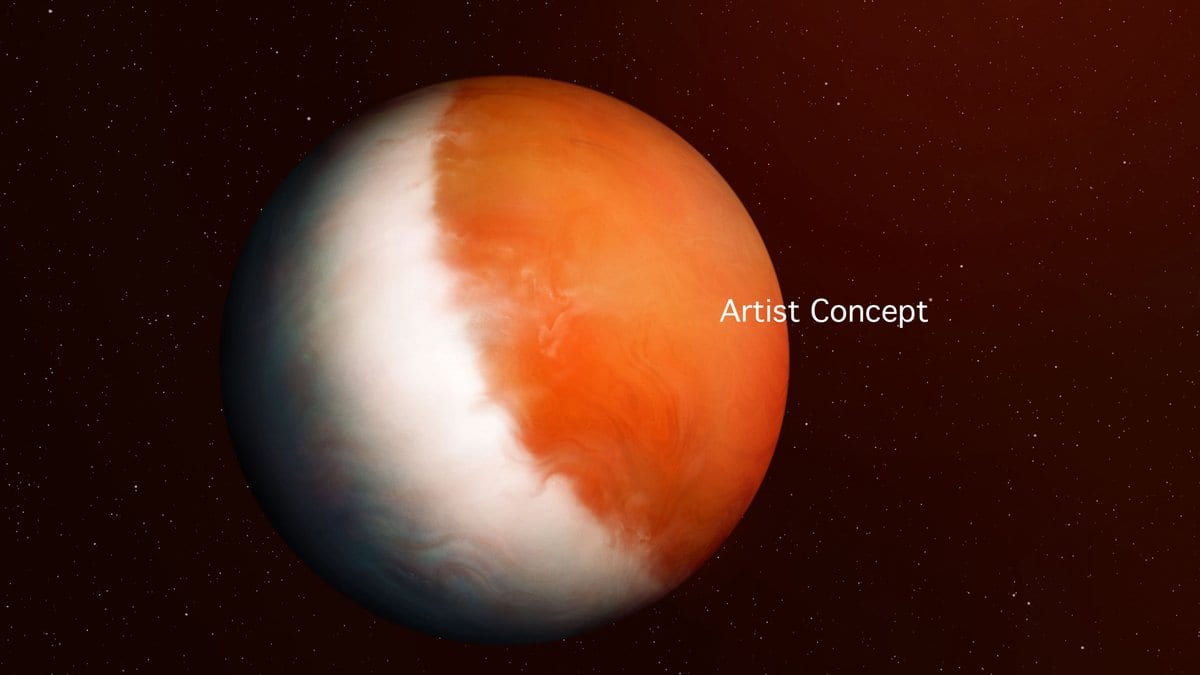
Astronomers have measured the mass and the size of a candidate planet that never passes in front of its star, working from the light it reflects. The result was published Aug. 25 in Astronomy & Astrophysics by a team whose first authors are S. N. Breton of INAF's Osservatorio Astrofisico di Catania and A. Dyrek of the Space Telescope Science Institute.
The Sun-like pulsating star KIC 9139163 carries a steady 0.6-day ripple in its brightness. The best explanation for that signal, the authors write, is a close-in companion that never crosses the star's face from our viewpoint, so its size cannot be read off the dip a transit would produce.
The team combined photometry from the Kepler and TESS space telescopes with spectroscopy from HARPS-N, which tracks a star's motion toward and away from Earth. Those measurements give a companion mass of 7.3 plus or minus 1.4 times Earth's; because the tilt of the orbit enters the calculation, that figure is a minimum mass. Fitting the two missions' phase curves, the rise and fall of reflected light around the orbit, against a model of an ultra-hot planet yields a radius of 2.43 plus or minus 0.14 times Earth's. Taken with the mass and the inferred inclination, the authors write, that implies a bulk density "consistent with a hot water-rich world."
The paper places the object in the Neptunian desert, a range of planet sizes and orbits where planets are expected either to have lost their original hydrogen or helium envelopes or to hold metal-enriched atmospheres.
The Kepler and TESS phase curves, taken six years apart, do not agree. The authors report significant changes in amplitude between them and opposite phase offsets, which they read as a shifting pattern of brightness across the object, possibly from evolving clouds. They call that interpretation tentative, citing the noise and the contamination affecting the TESS photometry. The paper describes the object throughout as a candidate.
Sources
- Astronomy & AstrophysicsPeer-reviewed