Record Ocean Heat Bleached Corals Far North of Japan's Tropical Reefs
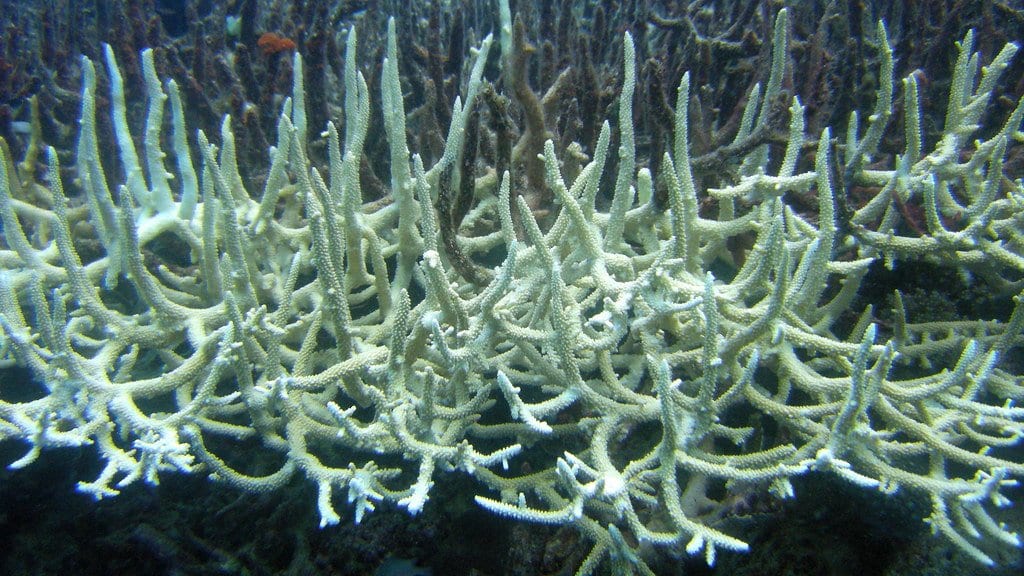
Corals bleached at seven of the eight sites surveyed along Japan's coast after the marine heatwaves of 2024, including cool temperate waters far north of the country's tropical reefs, a team led by Haruko Kurihara of the University of the Ryukyus reports in Scientific Reports, published Aug. 25.
The survey covered a band of coast from 24 to 35 degrees north: two subtropical reef sites in the Ryukyu Islands and six temperate, non-reef sites along the main islands. Degree Heating Weeks, a satellite measure of how much heat stress has accumulated over 12 weeks, exceeded 8 degrees Celsius-weeks at every site and reached 17 to 19 at the highest latitudes, the paper reports. Those were the highest values of the 1982 to 2024 satellite period at all eight sites. The paper cites earlier field studies that put the onset of bleaching above 4 and severe bleaching and death above 8. Bleaching prevalence reached 55 to 95 percent at most temperate sites.
At Tsushima, in the strait between Japan and Korea, 35.6 percent of corals were bleached and 23.9 percent pale, which the authors record as the first thermal-stress bleaching event at that site to their knowledge. Corals of the genus Acropora that have been expanding poleward into these cooler waters fared worst. At Numazu, the paper reports 100 percent bleaching in both dominant Acropora groups. The authors write that their results "challenge the paradigm that temperate regions function as climate refugia."
One site did not bleach at all. At Tateyama, the survey found no pale or bleached corals even though Degree Heating Weeks there passed 12. That, the authors write, underscores "the importance of local thermal thresholds and environmental context" and highlights "limitations of DHW as a predictor in temperate regions."
At Sesoko, on Okinawa Island, coral cover measured 22 percent in September 2024, with 38 percent of that cover fully bleached. When the site was surveyed again in February 2025, no bleached corals remained and cover had fallen to 6 percent.
Sources
- www.nature.comPeer-reviewed